
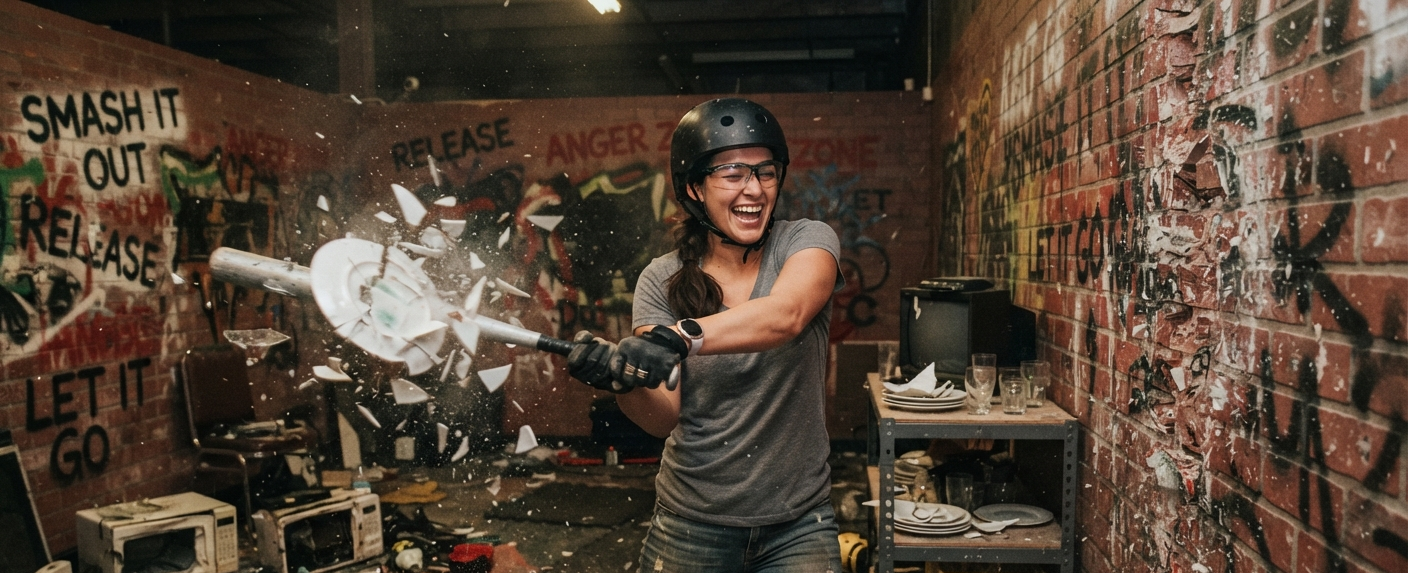
There is a room in Tokyo where you pay to smash things.
Plates, bottles, glasses, old electronics — arranged on shelves, ready for destruction. You put on protective gear, pick up a bat or a sledgehammer, and you break everything in reach. Deliberately, completely, without apology.
This is not vandalism. It is a wellness service. It has a waiting list.
The first rage room opened in Japan in 2008, designed for overworked office employees who had nowhere to put what they were carrying. The concept spread quietly — to Canada, the United States, Europe. By 2026 it has become one of the year’s headline wellness trends. Major cities are hosting outdoor scream clubs in forests. Remote retreats are inviting guests to split logs with sledgehammers as a therapeutic practice. The principle underpinning all of it is simple and, once you hear it, hard to argue with: expressing emotions in a safe, controlled environment is significantly healthier than bottling them up.
Here is the harder question — the one the trend hasn’t quite asked yet:
Why are so many people so full of things they have never been allowed to express?
And for Indians specifically: what has a lifetime of swallowing anger actually cost us?
The Anger We Were Taught to Hide
Indian households manage anger primarily through suppression.
Not always explicitly — nobody sits a child down and says “you are not allowed to be angry.” But the message arrives through a hundred smaller moments. Parents tell the child who expresses frustration that they are being disrespectful. Adults tell the teenager who raises their voice that they have no right to speak that way. Managers tell the employee who expresses workplace anger to be professional, to not create problems, to let it go.
The result is a generation of people who are very good at not showing anger. They develop sophisticated internal systems for containing it — converting it into silence, into sarcasm, into passive withdrawal, into the particular brand of Indian politeness that holds enormous amounts of feeling underneath an unruffled surface.
What nobody talks about is what happens to the anger that never found expression.
It does not disappear. It accumulates.
What Suppressed Anger Actually Does to You
The body keeps score in ways the mind tries to ignore.
Chronic anger suppression — the sustained habit of feeling anger and overriding it before it can be expressed — is not neutral. It produces measurable physiological effects that accumulate over time. Elevated cortisol. Sustained increase in blood pressure. Compromised immune function. A baseline of tension in the body that becomes so familiar it stops feeling like tension and starts feeling like personality.
It also produces psychological effects. People who consistently suppress anger are at higher risk of anxiety and depression — not because anger is inherently dangerous, but because the energy required to contain a powerful emotion continuously is enormous, and it crowds out the resources available for everything else. Clarity, creativity, genuine joy — all of these require an interior that is not perpetually occupied with containment.
The American Psychological Association’s guidance on anger makes a distinction that is critical and almost never discussed in mainstream Indian wellness conversations: the goal of anger management is not to eliminate anger. It is to express it in ways that are healthy and constructive. The emotion itself is not the problem. The absence of a safe, appropriate channel for it is.
Rage rooms are, in this light, a very blunt instrument — but they are addressing a real problem. The problem is not that people want to smash things. The problem is that they have spent years not knowing what to do with something real and powerful that lives inside them.
The Indian Man and the Anger He Cannot Show
This conversation needs to happen in the Indian context. It does not happen enough.
Indian society trains men from childhood to suppress vulnerability — and anger, when it is not about dominance, is often deeply vulnerable. It says: something hurt me. Something was unfair. Something went wrong and I have feelings about it.
Indian society treats that kind of anger — the anger of the person who was overlooked, dismissed, treated unjustly, or simply pushed past their limits — as socially unacceptable in most contexts. The only anger men get permission for is power-anger: the anger of someone exercising authority. The moment a man without power expresses anger, society expects him to contain it.
The result is a particular kind of Indian man who appears very calm and carries, underneath that calm, decades of unprocessed emotion. He has never had a single conversation where he said clearly: this hurt, this was unfair, I am angry about this.
That man eventually finds a channel for what he carries. It is rarely a healthy one.
The Indian Woman and the Anger She Was Never Allowed to Have
For Indian women, the suppression runs deeper and in more directions.
Indian culture codes anger in women as instability, aggression, or unattractiveness. The “good woman” in the Indian imagination stays patient, accommodating, self-sacrificing, and uncomplaining. She channels whatever anger she carries into endurance rather than expression — if she allows herself to feel it at all.
The result is striking. Many Indian women have no conscious relationship with their own anger. Culture has trained them so thoroughly to not feel it — to convert it instantly into guilt, self-blame, or the exhaustion of accommodating everyone else — that the anger becomes invisible to them even as it shapes everything they do.
Rage rooms opening across European cities draw women disproportionately. Not because women carry more anger than men. Because women have carried unexpressed anger for longer, in more directions, with fewer outlets that society considers acceptable.
What Healthy Anger Expression Actually Looks Like
The rage room is a theatrical version of a real principle. For most people, most of the time, the path to healthy anger expression is significantly less dramatic — and significantly more useful.
Name it. The first step is the hardest for people who have spent their lives not feeling anger: recognising it. Not the secondary emotion — not the frustration, the irritability, the low-grade resentment — but the primary one underneath. Something was wrong, Hurt & unfair. I am angry about this.
Understand what it is telling you. Anger signals that a boundary was crossed, a value was violated, an injustice occurred. The content of the anger — what it is actually about — is worth understanding before it is expressed or released.
Find a physical outlet. This is where rage rooms touch on something real. Anger has a physical component — adrenaline, elevated heart rate, increased muscle tension. Physical movement — running, swimming, strength training, even a brisk walk — processes these physiological responses in ways that thinking and talking alone cannot.
Express it in words, to the right person, at the right time. This is the part that rage rooms cannot teach. Learning to say clearly — not explosively, not destructively — “I am angry about this, and here is why” is one of the most important communication skills most people were never taught. It requires practice, a degree of psychological safety, and often the support of a therapist or a genuinely safe relationship.
Consider professional support. For anger that is chronic, that has accumulated over years, or that is beginning to affect relationships and physical health, a therapist is not a last resort. It is the most efficient tool available.
NIMHANS — the National Institute of Mental Health and Neurosciences in Bengaluru — offers outpatient mental health services and resources for emotional wellness that are most credible available in India.
The Rage Room in India: What Would It Mean?

A handful of rage rooms now operate in Indian cities — Mumbai, Bengaluru, Delhi, Hyderabad. Reviews describe them with a consistency that is telling: people report a sense of release. Something lifting. Coming out lighter than they went in.
Not because smashing plates is psychologically sophisticated. But for many visitors, it marks the first time they gave themselves permission to express something forcefully — in a space where nothing that mattered would break, and nobody would judge them for it.
That permission is what the rage room actually sells. The plates are just the delivery mechanism.
The deeper question — the one that a rage room visit opens without answering — is where that anger comes from, and what it has been doing inside the person who has been carrying it. That question is worth sitting with long after the protective gear comes off.
What Karna Knew About Anger
Something worth noticing lives inside the stories India tells about the people it most admires.
Karna stood in the arena at Hastinapur after public humiliation, after being denied his right to compete on the basis of caste, and did not rage. He stood still. He bore it.
We call that dignity. And it is dignity. But a harder question sits underneath it: where did the anger go? What did it cost him to keep it contained? Is his story — the weight he carried, the isolation of a man denied his rightful place at every significant threshold — partly a story about what unexpressed anger does to a person over decades?
The greatest warriors in Indian mythology do not lack anger. Their anger, when it finally finds expression, is enormous. Arjuna’s grief on the Kurukshetra battlefield carries within it the anger of someone who has held an impossible weight too long. Krishna pressing the chariot wheel into the earth with divine force is rage — directed cleanly at injustice.
The tradition does not ask us to have no anger. It asks us to find a form of expression that is neither destructive nor swallowed whole.
That instruction is considerably more sophisticated than “be calm.”
A Final Thought
Rage rooms are a trend. They will peak and they will pass, and something else will take their place in the wellness media cycle.
But the thing they are responding to will not pass. The accumulated, unprocessed, culturally-suppressed anger that a significant proportion of Indian adults carry in their bodies every day — that is not a trend. That is a condition. And it deserves more than a room full of breakable plates.
It deserves honest conversation. And, It deserves the normalisation of anger as a valid, important, informative human emotion that does not make you a bad person or an unstable one. Moreover, It deserves the cultural permission to say, clearly and without apology: something was wrong, and I have feelings about it.
That permission, given to yourself, is the beginning of something genuinely therapeutic.
The plates are optional.
The anger you suppress does not disappear. It becomes the weight you carry without knowing why you are tired.
Quick Recap
- Rage rooms — spaces designed for controlled physical expression of anger — are a global wellness trend in 2026, growing from Japan’s 2008 original concept
- The principle behind them is real: expressing emotions in a safe environment is healthier than suppression
- Indian culture systematically suppresses anger across genders — with specific and different costs for men and women
- Chronic anger suppression produces measurable physical effects: elevated cortisol, blood pressure, compromised immunity, and psychological depletion
- Healthy anger expression involves naming it, understanding what it is telling you, physical outlets, verbal expression, and professional support where needed
- The rage room is the theatrical version of a real need — the deeper question it opens is worth sitting with long after the session ends
Read next: [Why Discipline Feels Impossible Some Days — link here] | [What the Rain Teaches You About Letting Go — link here]