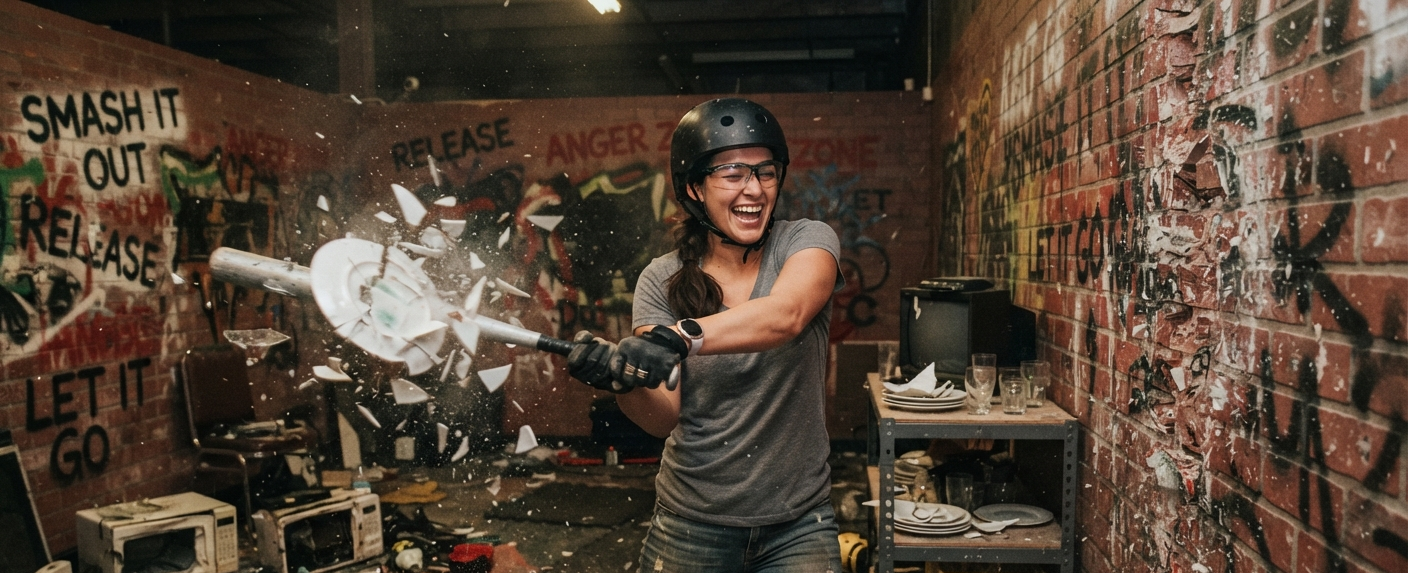


You know exactly what you’re supposed to do today.
You’ve done it before. You’ve built the habit, kept the streak, proved to yourself that you’re capable of it. And yet this morning — for a reason you can’t fully name — you cannot make yourself do it.
The workout doesn’t happen. The writing doesn’t start. The healthy meal gets replaced by whatever requires the least effort. You spend the day feeling vaguely guilty about all of it, which makes everything harder, which compounds the problem further.
You haven’t failed. You haven’t lost your discipline. Something specific has happened — and once you understand what it is, you can actually do something about it.
First: You’re Not the Problem
The most damaging thing about hard discipline days isn’t the missed workout or the skipped task. It’s the story you tell yourself about what it means.
I’m weak. I have no willpower. I’ll never be consistent. Everyone else can do this except me.
None of that is true. And all of it makes the next day harder.
Here’s what’s actually happening on a day when discipline feels impossible: your available cognitive and emotional resources — the finite daily supply of energy your brain uses to make decisions, regulate behaviour, resist impulses, and override defaults — are depleted or severely constrained. Not because you’re lazy. Because something is using them up before discipline ever gets a chance to show up.
Understanding what that something is changes everything.
The Seven Real Reasons Discipline Disappears
1. You Didn’t Sleep Enough Last Night
This is the single most common cause of discipline collapse — and the most underestimated.
Sleep deprivation impairs your prefrontal cortex, the part of the brain responsible for impulse control, rational decision-making, and the capacity to choose long-term benefit over short-term comfort. With a compromised prefrontal cortex, discipline doesn’t fail because you’re weak. It fails because the neural machinery that runs it isn’t operating properly.
A night of poor sleep doesn’t just make you tired. It makes you a slightly different, slightly less capable version of yourself. And expecting that version to perform at the same discipline level as your well-rested self is like expecting a car to run at full speed on a quarter tank of fuel.
2. You’re Emotionally Depleted
A difficult conversation. A frustrating commute. A piece of news that unsettled you. A situation at work or home that drained your emotional bandwidth before 9 AM.
Emotional regulation and self-discipline draw from the same reservoir. When something depletes your emotional energy — even something that seems minor — there’s less available for everything that requires willpower afterward. This is why people who’ve had a stressful day are significantly more likely to skip their evening workout, eat impulsively, or abandon their evening routine entirely.
It’s not weakness. It’s resource allocation.
3. Your Blood Sugar Has Crashed
This sounds mundane but it’s real: skipping breakfast, waiting too long between meals, or eating high-sugar processed foods that spike and crash your glucose creates a measurable drop in cognitive function and self-control.
Your brain runs on glucose. When supply is inconsistent, every high-order function — including discipline — becomes unreliable. Many people who describe discipline as “impossible” in the afternoon have simply not eaten properly since morning.
4. Your Environment Is Working Against You
Discipline isn’t just an internal resource. It’s deeply influenced by your physical environment. A cluttered desk, a loud background, a phone sitting face-up with notifications pinging — each of these creates micro-decisions and micro-distractions that chip away at focus and self-regulation.
The people who appear most disciplined from the outside are usually people who have engineered their environment to require as little active willpower as possible. The gym bag packed the night before. The phone in another room. The workspace cleared before starting. The choice made in advance, so the moment of discipline never has to rely on in-the-moment willpower.
5. Your Goal Has Lost Its Meaning
Discipline is easiest when it’s connected to something you genuinely care about. When the connection between the daily action and the bigger reason behind it becomes fuzzy — when you can’t immediately feel why any of this matters — the friction of doing it suddenly becomes much larger than the pull of the goal.
This isn’t a motivation problem. It’s a meaning problem. And the solution is different from anything in the usual “stay motivated” toolkit.
6. You’re Fighting Yourself Instead of the Habit
Sometimes discipline fails not because the habit is too hard but because some part of you is in genuine conflict with it. You’re forcing yourself toward a goal that was right six months ago but doesn’t quite fit anymore. Or a goal that was someone else’s definition of success, absorbed and internalised without examination.
When discipline feels like fighting yourself, it’s worth asking: am I fighting my laziness, or am I fighting a goal that doesn’t actually belong to me?
7. You’ve Been Perfect for Too Long
Sustained high discipline over a long period — no breaks, no variation, no permission to rest — creates a psychological pressure that eventually finds its release. The body and mind build up resistance to rigid structures the same way physical muscles need rest to grow.
Many discipline collapses aren’t failures. They’re the system’s natural response to operating without recovery. The problem wasn’t the collapse — it was the absence of planned recovery before the collapse happened.
What to Actually Do About It
On a Bad Discipline Day: The 2-Minute Rule
Don’t try to find the motivation to do the full version of what you planned. Instead, commit only to starting — and commit to only two minutes.
Two minutes of the workout. Two minutes of opening the document. Two minutes of the task you’ve been avoiding.
The science behind this is well-established: starting is the hardest part. Once you’re in motion, the activation energy required to continue drops dramatically. The two-minute rule isn’t a trick. It’s a physiological reality about how momentum works.
James Clear’s framework around the two-minute rule captures this well — the goal of the rule isn’t to do two minutes. It’s to get started, at which point continuing becomes the path of least resistance.
Most of the time, two minutes becomes twenty. Sometimes it doesn’t — and that’s fine too. Two minutes of something is categorically different from zero. It keeps the identity intact. It keeps the streak real. And identity — who you believe yourself to be — is what discipline actually runs on at its deepest level.
Reduce, Don’t Quit
On a hard day, give yourself permission to do the reduced version. Half the workout. One page instead of five. A walk instead of a run. A healthy snack instead of a full meal prep.
The reduced version keeps the habit alive. Quitting breaks the chain. And broken chains are significantly harder to restart than reduced chains are to scale back up.
This isn’t lowering your standards. This is intelligent management of a biological system that operates differently on different days.
Name What’s Actually Going On
Before you judge yourself for the discipline failure, spend sixty seconds naming what is actually happening in your life today.
Did you sleep badly? Say it. Are you emotionally drained by something? Name it. Are you running on an empty stomach? Acknowledge it. Is your environment chaotic? Note it.
Naming the real cause removes it from the “I’m just weak” category and puts it in the “this is a solvable situation” category. The solutions to “I’m weak” and “I didn’t sleep well and I’m running on an empty stomach in a cluttered environment” are completely different — and only one of them is actually addressable.
Build Your Discipline on Systems, Not Willpower
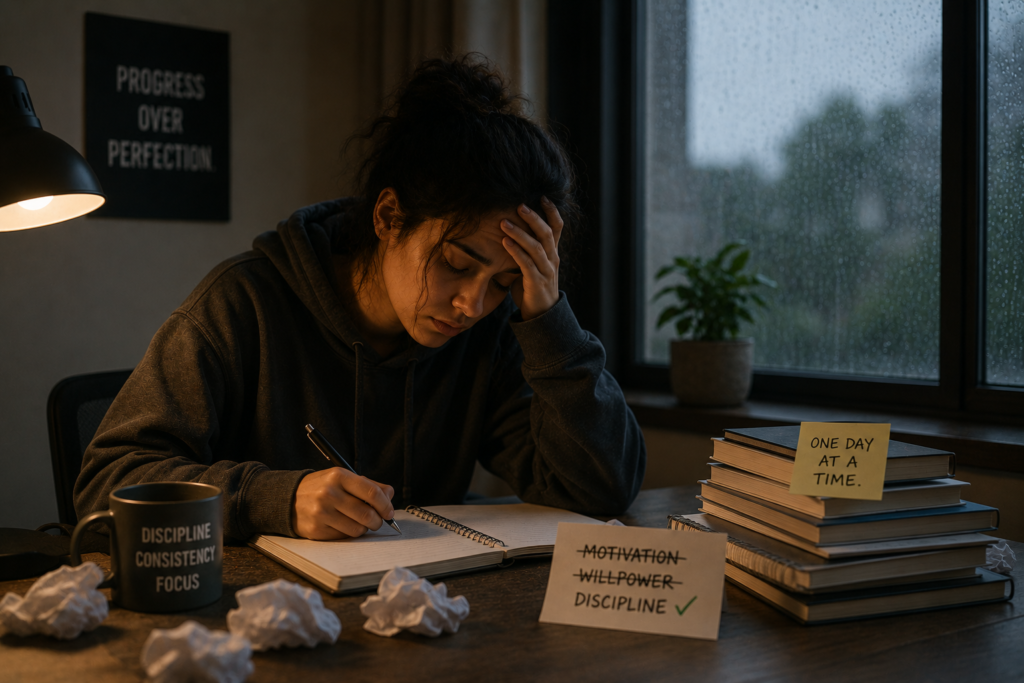
The biggest mistake people make with discipline is treating it as a character trait rather than a system design problem.
Willpower is unreliable. It fluctuates daily based on sleep, nutrition, emotion, and a hundred other variables. Building your discipline on willpower is building on sand.
Systems don’t require willpower at the point of execution. When you pack your gym bag the night before, you’re not relying on morning willpower — the decision is already made. When you put your phone in another room before starting focused work, you’re not relying on in-the-moment self-control — the environment has removed the choice.
Every unit of willpower you save by making decisions in advance is a unit available for the moments when discipline actually needs to be active.
Reconnect to the Reason
On the days when discipline feels meaningless, the task is not to generate more motivation. It’s to reconnect with the reason the habit exists in the first place.
Not the surface reason. The real one.
Why do you want to be fit? Not “to look better” — go deeper. Why does that matter? And deeper still? The answer that’s three or four levels below the surface reason is the one that actually drives behaviour when conditions are hard. That’s the one worth writing down somewhere you’ll see it on the hard days.
The Discipline Identity Shift
Here’s the reframe that changes everything long-term.
Discipline is not about what you do on your best days. Everyone is disciplined on their best days. The weather is perfect, the sleep was great, the mood is right, the stars aligned — and you showed up. That doesn’t tell you much.
Discipline is about what you do on your worst days. Not a perfect version of what you do. Not the full version. Just something. Just enough to keep the identity alive.
The person who has been exercising consistently for five years is not someone who has never had a bad discipline day. They are someone who, on their bad discipline days, found a way to do something small enough to keep the habit alive until the next good day arrived.
Bad days don’t break discipline. The decision to define yourself as someone who stops on bad days — that’s what breaks it.
A rooted mind doesn’t grow only in perfect conditions. It grows through the difficult seasons precisely because it stayed rooted.
A Final Honest Thing
If every day feels like a bad discipline day — if the impossible feeling is not occasional but constant — that’s worth paying attention to as a different kind of signal.
It may mean the goal needs to change. It may mean your recovery is insufficient for what you’re demanding. It may mean something in your mental or physical health deserves attention.
Chronic discipline failure isn’t always a mindset problem. Sometimes it’s your system telling you something important. The discipline to listen to that signal honestly — rather than pushing through it indefinitely — is its own form of strength.
Quick Recap
- Discipline disappears on hard days because of sleep deprivation, emotional depletion, poor nutrition, environment, lost meaning, internal conflict, or insufficient recovery — not weakness
- The two-minute rule gets you started when starting is the entire battle
- Reduced versions of habits keep chains alive through hard days
- Name the real cause before judging yourself
- Build systems that reduce the reliance on in-the-moment willpower
- Identity — who you believe yourself to be — is the foundation discipline actually runs on
Read next: [The 5 AM Lie Nobody Told You About ] | [Why we should adopt ‘Skilliday’, Europe’s Hottest Travel Trend]