Greatest Stories Series — Vol. 04
Before the battle begins, there is a moment.
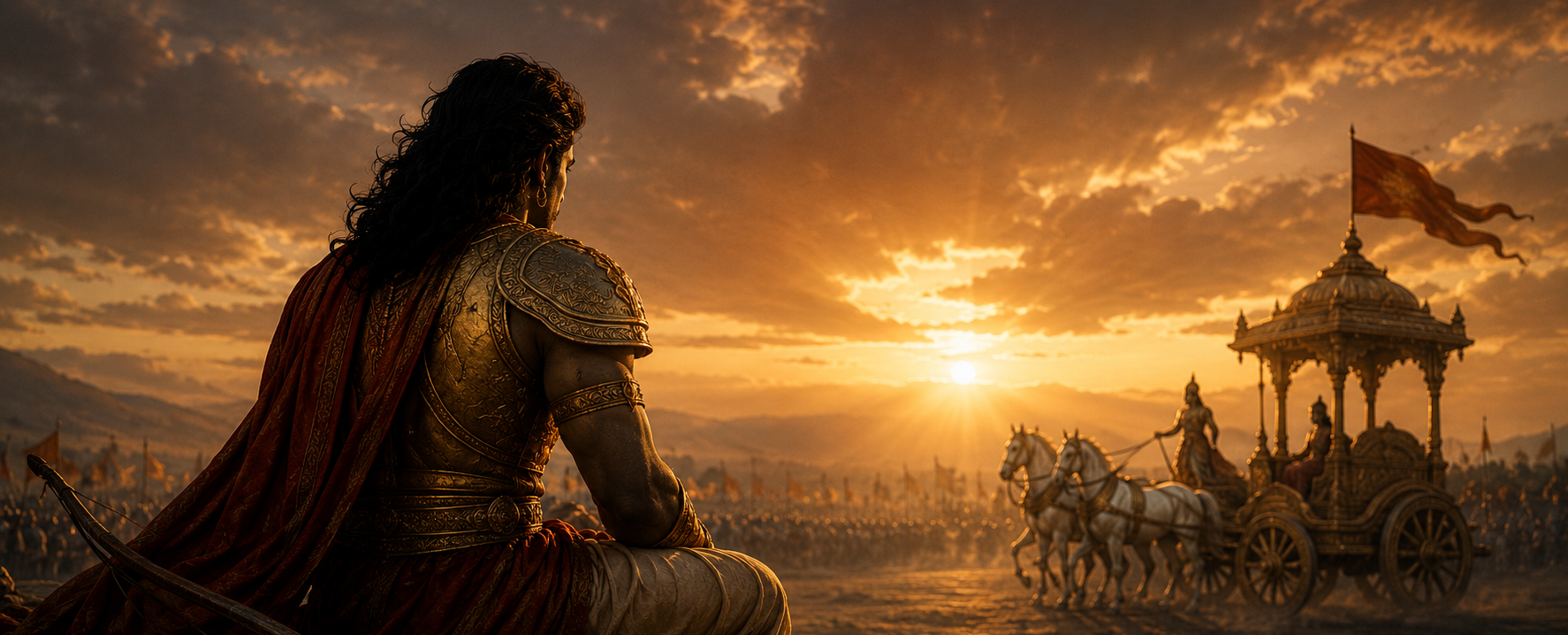
The two armies face each other across the field of Kurukshetra. Thousands of warriors on each side. The air thick with the weight of what is about to happen. And standing on the Kaurava side, in armour that was born with him — golden, impossible, divine — is a man who should not be here.
Not because he doesn’t belong on a battlefield.
Because he was never supposed to lose everything before he arrived at one.
His name is Karna. And his story is the one the Mahabharata tells most quietly — and most completely.
The Beginning Nobody Chose
Kunti was a princess. Young, unmarried, curious in the way that changes lives. She had been given a boon — a mantra that could invoke any god to bear her a child. Testing it without understanding the full weight of what she was doing, she called upon Surya, the Sun God.
He came.
And nine months later, a child was born — radiant, wrapped in a natural golden armour called Kavacha and divine earrings called Kundala, both part of his body itself. A child born of the sun. With impossible heritage. A child Kunti could not keep.
She was unmarried. The birth could not be explained. The world of that time had no mercy for what could not be explained. So she placed the infant in a wooden box and set him on the river Ganga — a decision she would carry the weight of for the rest of her life.
The river carried him.
A charioteer named Adhiratha found the box. He and his wife Radha raised the child as their own. They named him Vasusena. He would later be known as Radheya — son of Radha. And he would be known by the world as Karna.
He grew up not knowing who he was. But he grew up knowing, in his bones, what he was capable of.
The Humiliation at Hastinapur
Karna trained. Obsessively, completely, with the kind of focus that belongs to people who have nothing to fall back on except their own capability. He learned the art of war. Further studied under Parashurama — one of the greatest teachers alive — by concealing his true identity, because Parashurama taught only Brahmins and Kshatriyas, and a charioteer’s son was neither.
He became extraordinary. By any honest measure, he became one of the greatest warriors who had ever lived.
And then came the tournament at Hastinapur — a public display of skill organised to showcase the Pandava and Kaurava princes. Arjuna performed. The crowd was dazzled. And Karna walked into the arena and matched him, shot for shot, feat for feat, with a calm that spoke of someone who had been preparing for this moment for his entire life.
The crowd stirred. The princes stared. And then Kripacharya — the royal teacher — asked the question that stopped everything:
“Who are you? What is your lineage? Only a prince may challenge a prince.”
The arena fell quiet.
Karna had no answer that the world would accept. He was the son of a charioteer. without any kingdom, no title, no lineage the court would recognise. He stood in the centre of that arena — having just demonstrated himself to be the equal of the greatest warrior of his generation — and was disqualified not for what he could do, but for where he came from.
Bhima laughed. The Pandavas turned away. Draupadi reportedly said words that cut.
And Karna stood there.
He did not collapse. Neither did he beg. He did not perform grief for the audience.
He stood there and bore it.
Duryodhana — who saw in Karna something the rest of the court refused to see — stepped forward immediately and made Karna the king of Anga. A kingdom, a title, a lineage. The one thing the court required and refused to give.
Karna bowed to Duryodhana. And from that day, his loyalty was absolute.
Not because Duryodhana was righteous. He was not. But because when every hand was turned against Karna, one hand reached out. And Karna was not the kind of man who forgot that.
What Was Taken From Him, and How He Responded
Here is where Karna’s story becomes something beyond mythology.
What was taken from Karna, across his life, reads like a list designed to break a person completely.
His identity. He spent his childhood and youth not knowing he was the firstborn son of Kunti — which made him the eldest of the Pandavas, the one who should have stood with Yudhishthira and Arjuna, the one who should have been the crown prince of a royal house. He lived his entire life one disclosure away from a completely different story.
His education. When Parashurama discovered that Karna was not a Brahmin — Parashurama cursed him. The knowledge Karna had earned through years of discipline and sacrifice would leave him in his moment of greatest need. The Brahmastra, the ultimate weapon, would fail him when he needed it most.
His armour. Indra — father of Arjuna, father of Karna’s rival — came to Karna disguised as a Brahmin, knowing that Karna’s generosity was absolute and unconditional. He asked for Karna’s Kavacha and Kundala — the divine armour that was literally part of his body, the thing that made him near-invincible. Karna knew who Indra was. He gave it anyway. Because he was Karna, and Karna did not refuse a request.
His final weapon. Karna possessed the Vasava Shakti — a weapon given by Indra in exchange for the armour, usable only once. He had saved it, across the entire war, for Arjuna. And then he was forced to use it earlier, on Ghatotkacha, because the situation demanded it. The one weapon he had reserved for the decisive moment was spent before that moment came.
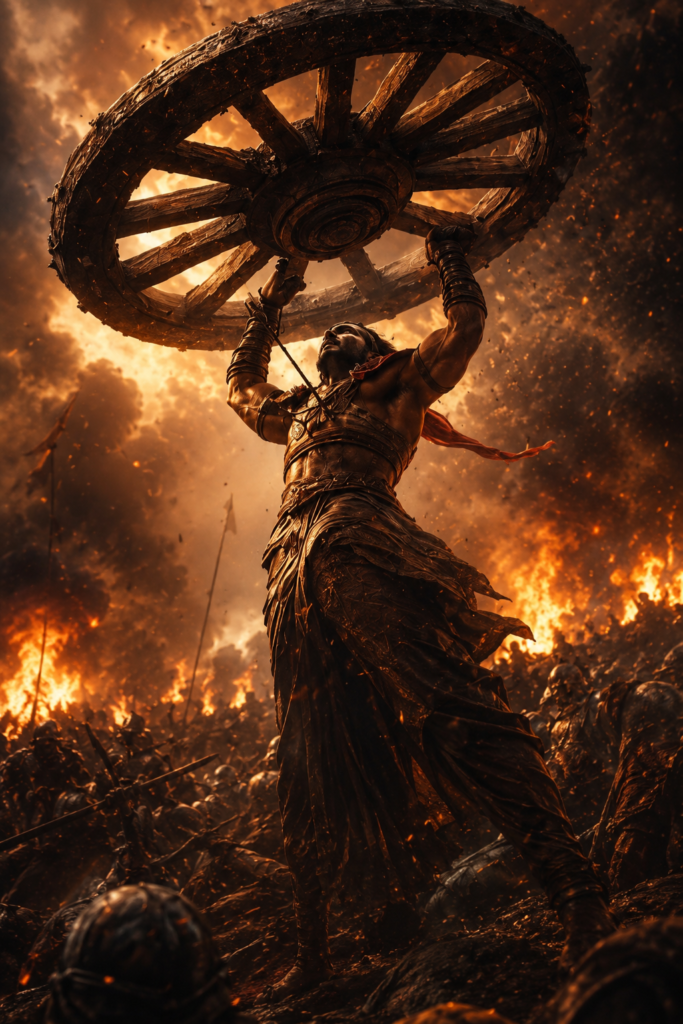
His chariot wheel. On the seventeenth day of battle — in his final confrontation with Arjuna — Karna’s chariot wheel sank into the earth. He stepped down to free it. He asked Arjuna, in the tradition of honourable warfare, to pause — to not strike a man who was unarmed and occupied. Krishna, Arjuna’s charioteer, reminded Arjuna of every dharmic violation the Kauravas had committed. Arjuna released his arrow.
Karna died on his knees in the mud, freeing a wheel, asking for the honour the rules of war had always promised.
The honour was not given.
The Choice He Made That Nobody Talks About Enough
Before the war began, Kunti came to Karna.
She revealed herself — finally, after a lifetime — as his mother. She told him the truth of his birth: that he was not a charioteer’s son. That he was the firstborn of the Pandavas. That he was, by blood and by right, one of them.
And then she asked him to change sides. To stand with his brothers. To let the war resolve differently.
She offered him everything the world had denied him. His true lineage. His rightful place. The recognition he had been refused in that arena at Hastinapur. A mother. Brothers. A different ending.
Karna listened.
And then he said no.
Not out of rage. Neither out of bitterness. He said it quietly, with the clarity of a man who had thought through every version of this situation long before she arrived.
Also told her: Duryodhana gave him a kingdom when the world gave him nothing. He gave Duryodhana his word. He would not break it because the circumstances had become inconvenient, because a better offer had appeared, because his blood turned out to be royal.
Loyalty was not contingent, for Karna. It did not have exit clauses. It did not dissolve when something more advantageous arrived.
He Choice He Made That Nobody Talks About Enough
Before the Kurukshetra war, Kunti finally revealed the truth to Karna—she was his mother. She told him he was not a charioteer’s son but the eldest Pandava, born before Yudhishthira. She asked him to leave Duryodhana and join his brothers.
In that moment, Karna was offered everything he had been denied his entire life: his true identity, royal status, family, and the respect he had always deserved.
But he refused.
Not out of anger or pride, but because he believed loyalty mattered more than opportunity.
Karna reminded Kunti that when the world rejected him, Duryodhana accepted him. He gave Karna friendship, honor, and a kingdom when no one else would. Karna could not abandon the man who had stood by him simply because a better offer had appeared.
He made Kunti one promise: he would not kill any Pandava except Arjuna. No matter the outcome, she would still have five sons.
Karna entered the war knowing the odds were against him. He knew fate had already turned against him, yet he chose to keep his word until the very end.
His story reminds us that integrity is often tested when changing sides seems easier. Karna’s greatest legacy was not his unmatched skill with the bow—it was his unwavering commitment to the promises he chose to keep.
The Mahabharata text itself , across its eighteen books, returns to Karna’s story with a consistency that signals how central the author considered him — not as a villain, not as a cautionary tale, but as a study in what it means to hold integrity under conditions specifically designed to erode it.
The Mindset Lessons Hidden in Plain Sight
Karna’s story has survived three thousand years not because it is a tale of triumph. It has survived because it is a map of something harder and more universal than triumph.
1. Your Origin Does Not Determine Your Capability
Karna was told, at every significant moment, that he did not belong in the arena he had clearly mastered. The message was consistent, institutional, and delivered by people with the authority to make it stick.
He did not accept it as truth. Rather he continued to train. He continued to compete. And continued to show up in spaces that tried to exclude him. Not out of naive optimism — Karna was never naive — but out of the simple refusal to let other people’s definition of his ceiling become his ceiling.
The world will tell you what you’re worth based on where you come from. You can hear that information. You do not have to agree with it.
2. Loyalty Is a Practice, Not a Convenience
Karna could have switched sides. By any rational calculation, he should have. The Pandavas were righteous, would win, and were his blood. Duryodhana was not righteous and would lose.
Karna knew all of this.
He stayed anyway — because the commitment was made before the calculation changed. Because loyalty that only holds when it’s convenient isn’t loyalty. It’s strategy wearing the costume of character.
The people who are truly worth trusting are the ones whose commitments survive inconvenience. Karna was that person, in the most extreme version of the test imaginable.
3. Generosity Without Conditions Is the Rarest Strength
Every request Karna ever received — from Indra disguised as a Brahmin, from Kunti asking him to surrender his future, from the strangers and warriors and enemies who came to him throughout his life — he met with open hands.
He knew Indra had come to weaken him. But, he gave anyway.
He knew what Kunti was asking would cost him everything. But, he listened anyway.
His generosity was not careless. It was not ignorance. It was a considered, principled, repeated choice to let what he could give matter more than what he stood to lose by giving it.
In a world that optimises relentlessly for self-preservation, Karna’s daana — his gift-giving — was a form of courage that most people mistake for foolishness only until they understand what he was actually doing.
He was saying: my character is not negotiable based on what I receive in return.
4. Dignity Is an Inside Job
Karna stood in that arena at Hastinapur after being publicly humiliated by the people his talent had just matched — and he did not collapse.
Not because it didn’t hurt.
Because his sense of who he was did not depend on their recognition of it.
This is the hardest lesson in his story and the most important one. Recognition, acknowledgment, the validation of the people in the room — these are wonderful things when they come. They are not the foundation. If your self-worth is built on what the arena says about you, the arena owns you.
Karna built his identity on what he knew about himself — and what he chose to do with what he knew. The court’s verdict did not change either of those things.
5. What You Cannot Avoid, Meet With Courage
Karna went to war knowing the outcome. The curse of Parashurama. The stolen armour. The spent weapon. The wheel that would sink. He had enough information to predict, with reasonable accuracy, how his last day would unfold.
He did not run. And he did not negotiate a way out to save himself by betraying the commitment he had made.
He met what was coming with his eyes open and his back straight.
There is a kind of courage that happens when you don’t know what’s coming. And there is a different kind — harder, quieter, and far rarer — that happens when you do know, and you show up anyway.
Karna’s courage was the second kind.
What History Did to Him
Here is the final injustice of Karna’s story, and perhaps the deepest one.
He died on the Kaurava side — which means he died on the side that history recorded as having lost. The Mahabharata was written by the winners’ tradition, in the sense that the Pandavas’ story is the central spine. Karna’s story is told around the edges, in fragments, in other people’s recollections of him.
And yet — even filtered through the accounts of the people who fought against him — something about Karna refuses to be reduced.
Even the Pandavas, after the battle, mourned him. Arjuna, who had feared him as an equal for the entire war, stood over his body and felt something that war is not supposed to make you feel for your enemy.
Even Krishna — who had strategically arranged every element of Karna’s defeat, who had reminded Arjuna to fire the arrow that killed him — acknowledged, in the aftermath, that Karna was the greatest of all warriors. Not in spite of everything. Because of it.
The curses, the betrayals, the losses, the impossible conditions — and still. Still, he stood and gave. Still, he kept his word.
Scholars of the Mahabharata have long noted that Karna functions in the epic as a kind of mirror — reflecting back every question about fate versus choice, birth versus character, loyalty versus wisdom, recognition versus inner worth. The epic doesn’t resolve these questions. It holds them open. Because they are questions every human life has to answer for itself.
The Size of the Struggle
There is a line that has circled the internet, often without attribution, often in the context of Karna’s image:
“The size of your struggle measures the size of your soul.”
It is easy to read that as a consolation — something offered to the defeated to make the loss feel meaningful.
It is not a consolation. Rather, it is a measurement.
Karna’s soul, measured against the scale of what he carried — the birth, the rejection, the stolen weapons, the curses, the loyalty that cost him everything — was enormous. Not because he suffered. Plenty of people suffer. Because of what he chose to do inside the suffering. Because of who he remained while everything was being taken from him.
That’s the measure. Not the circumstances. The choices made within them.
A Final Thought
The Mahabharata has 100,000 verses. It contains kings and gods and demons and warriors and sages. It is the longest poem ever written. And somewhere in all of that — in the margins, in the echoes, in the way every character who encounters Karna seems changed by the meeting — lives the story of a boy put in a river by a frightened mother, found by a kind charioteer, denied at every significant threshold he reached, and who nevertheless became, by any honest assessment, the person the whole epic was trying to describe.
Neither perfect. Nor victorious. Not remembered with the clarity he deserved.
Just — sovereign.
Sovereign in his loyalty. And in his generosity, in the quiet dignity of a person who knows who they are when the world has done its best to make that knowledge impossible.
Born rejected. Died legendary. The struggle was the point. He was the proof.
Quick Recap — Karna’s Five Lessons
| Lesson | What it means in practice |
|---|---|
| Origin doesn’t determine capability | What you come from doesn’t decide what you can do |
| Loyalty is a practice, not a convenience | Commitments that only hold when convenient aren’t commitments |
| Generosity without conditions | Giving regardless of return is a choice of character, not naivety |
| Dignity is an inside job | Your worth doesn’t require the room’s recognition to be real |
| Meet what you cannot avoid with courage | Eyes open, back straight — the second kind of courage |
The Greatest Stories Series
This post is part of TheMindPole’s Greatest Stories series — real lives, real struggles, real lessons. Each story is chosen not for the size of the trophy but for the depth of the character revealed in the trying.
Read next: [Stoicism and the Bhagavad Gita — What Marcus Aurelius and Krishna Had in Common — link here] | [Why Discipline Feels Impossible Some Days — link here]