Greatest Stories Series — Vol. 09
Harry Kane’s greatest story motivation begins not with a goal, but with a rejection.
He was a child when Arsenal released him. The reason, later confirmed by Arsenal youth coach Liam Brady, was blunt: Kane was “a bit chubby.” Not fast enough. Also, not the prototype. Not what the academy was looking for.
The boy released by Arsenal went on to score 500 career goals.
Harry Kane became the most prolific English footballer in the history of the sport — surpassing Jimmy Greaves, surpassing Wayne Rooney, surpassing every Englishman who ever laced up boots on a professional pitch. He became England’s all-time leading scorer. Also, he became Tottenham Hotspur’s all-time leading scorer. Achieved the second-highest scorer title in Premier League history. He became the highest-scoring Englishman in Champions League history.
He did all of this while carrying things that would have broken most people. A trophy drought that stretched across fourteen years at the club he loved. A missed penalty that ended England’s World Cup in public, in front of millions. A narrative that followed him for the better part of a decade: brilliant, yes. But no trophies. Not the real thing. Not yet.
Harry Kane’s story is the story of a man who kept scoring while carrying everything the world decided he was missing.
At 33 years old, at his third World Cup, with 14 goals in the tournament and England still standing — he is still scoring. He has stopped carrying the weight. He is using it.
The Kid Nobody Wanted
Walthamstow, East London. Not a place that produces football legends on a schedule. A working-class neighbourhood in the north-east of the city, far from the academies and the pathways and the infrastructure that tends to shape elite players early.
Kane was born there on July 28, 1993. His father Patrick had come from Galway, Ireland. His family were ordinary, grounded, football-loving in the way that English families simply are.
He joined Arsenal’s youth academy young. Arsenal — the academy that produces players, that has a reputation for developing technical excellence, that finds the right kind of talent and shapes it.
They released him. Too chubby. Not the prototype.
He went to Ridgeway Rovers. Then he went to Watford’s academy. Finally he found his way to Tottenham Hotspur, the club from north London that would become the defining address of his career. He spent fourteen years there. He scored 280 goals — their all-time record, by a distance.
And across those fourteen years, in one of the most successful individual goal-scoring tenures any player has had at any single club in the modern era, Tottenham Hotspur did not win a single major trophy.
Not one.
Fourteen Years. Zero Trophies.
This is the fact that defined the first act of Kane’s career — and the fact that his critics returned to, repeatedly, as evidence of something. Of bad luck, some said. While others suggested, of poor decisions. Of a player who was individually exceptional but collectively insufficient.
The argument was unfair. Trophies are team achievements. Kane did not lose those finals and near-misses alone. But he wore the label because he was the face of the club, because he was the captain-in-waiting, because when you are the best player on a team that should be winning and isn’t, the gap between individual excellence and collective success becomes your story whether you wrote it or not.
He stayed. That is the part that gets overlooked in the narrative of the trophy drought.
He had offers. He could have left for clubs where the infrastructure existed to win things. In 2021, Manchester City pursued him with serious intent. He did not go. He stayed at Tottenham — loyal to a club and a city and a support base that had given him everything, in the knowledge that the loyalty was costing him the silverware his talent deserved.
Gary Lineker, himself one of England’s greatest ever strikers, later called Kane “the greatest English striker we’ve ever had.” That assessment included the trophy drought. It accounted for it. And it still arrived at the same conclusion.
Qatar 2022: The Penalty
If the fourteen years without a trophy were the weight Kane carried quietly, the penalty in Qatar was the weight he carried publicly.
December 10, 2022. England versus France in the World Cup quarterfinal. The score 2-1 to France with minutes remaining. England won a penalty. The moment that could equalise, that could send the match to extra time, that could keep the dream of a first World Cup since 1966 alive.
Kane stepped up.
He had scored England’s first penalty in the match. Moreover, he had converted penalties under pressure throughout his career with a reliability that made him one of the most trusted spot-kick takers in the world.
He missed.
High. Over the bar. Into the crowd. Gone.
England went out. The camera found Kane’s face and stayed there — the specific expression of a person who has just understood the full weight of a moment that cannot be undone. His teammates tried to console him. He stood still.
The internet was not kind. It rarely is in moments like this. The commentary was immediate and merciless — the greatest English striker without a trophy had now also missed the penalty that ended England’s World Cup.
He went home and said the right things publicly. He did not hide or deflect. And, he accepted what had happened with the same directness he brings to everything.
And then, quietly, he went back to work.
Munich: The Gamble That Paid Off
In the summer of 2023, at thirty years old, Harry Kane made the decision that his career had been building toward.
He left Tottenham. He joined Bayern Munich for €110 million — the most expensive signing in the history of the Bundesliga.
The move carried risk. At thirty, moving to a new country, a new league, a new language, a new culture. Strikers who move late sometimes fail to adapt. The pressure of being the most expensive player in Bundesliga history brought its own weight.
In his first season at Bayern, Kane scored 36 league goals — winning the European Golden Shoe, equalling the league record, producing numbers that most strikers never reach in a career of peak seasons. He scored 44 goals across all competitions.
Bayern Munich won nothing.
The first trophy-less season in over a decade at the Bavarian club. Kane’s first season in Germany produced the finest individual goalscoring numbers and no silverware. The narrative followed him across the Alps.
Then came the second season.
Bayern won the Bundesliga. Harry Kane, at thirty-one years old, lifted his first major professional trophy. After fourteen years at Tottenham and one year at Bayern. Post the penalty miss and the quartet draft. And after Arsenal had decided he was too chubby and every season at Spurs had ended without the thing that silverware-obsessed football cannot stop counting.
He lifted it. He described the feeling afterward with the specificity of a man who had been waiting a long time to say exactly this.
“This should shut up all the idiots who say Harry Kane has never won anything.”
2025-26: The Season of Records
The third season in Munich produced something that belongs in a different category from goals and assists and trophies.
Kane scored 61 goals across all competitions — the second-highest tally in a single season ever recorded. He won the European Golden Shoe again. Not only scored a hat-trick in the DFB-Pokal final as Bayern won the domestic double But Also, reached 500 career goals on February 14, 2026 — his 743rd career appearance — against Werder Bremen.
On October 14, 2025, he scored a brace as England beat Latvia 5-0. He surpassed Jimmy Greaves’s all-time English goalscoring record — the tally that had stood for over fifty years, that belonged to the man widely considered the finest natural goalscorer England had produced. Kane passed him. Quietly, in a qualifying match, in the way that records built over decades tend to fall — not in a final, not on the biggest stage, but in the accumulation of ordinary matches done with extraordinary consistency.
He finished the 2026 World Cup qualification campaign as England’s top scorer with eight goals. He arrived at the tournament in the best form of his career at thirty-two years old.
Encyclopaedia Britannica’s profile of Kane describes him as “a prolific striker” who has “scored over 500 career goals for club and country” — a fact that becomes more extraordinary when set against the context of the boy Arsenal deemed unworthy of development.
World Cup 2026: Still Scoring
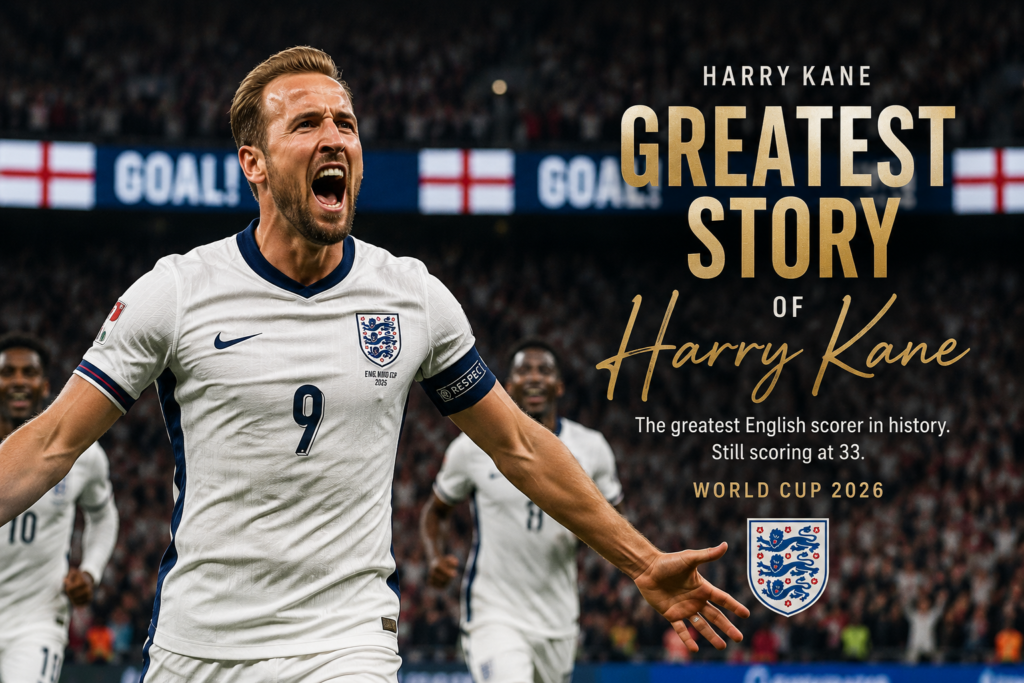
Harry Kane’s greatest story motivation has its most recent chapter playing out in North America right now.
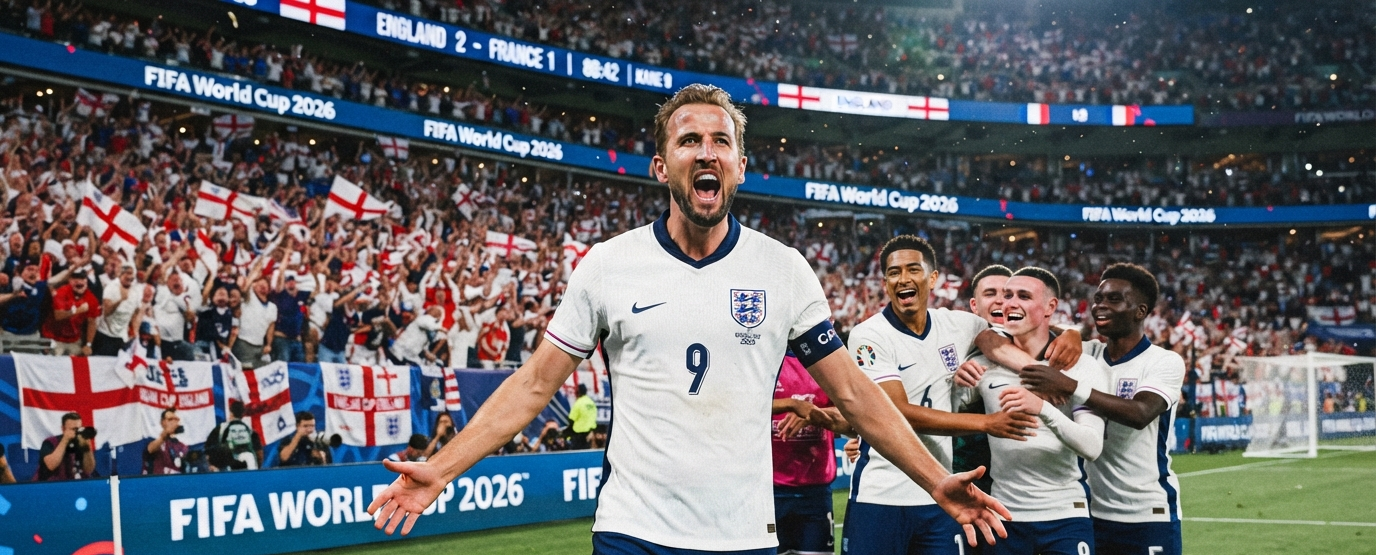
At the 2026 World Cup, Kane has scored 14 goals — becoming England’s all-time top World Cup scorer, surpassing Gary Lineker. He is the joint fifth-highest scorer in World Cup history, level with Gerd Müller. Moreover, He scored a hat-trick against Panama. Also, he scored the penalty that sent England past Mexico at the Azteca — the first team ever to beat Mexico there in a World Cup match.
At the age of thirty-two. He is at his third World Cup. And he is the best version of himself.
The one thing missing from his career — the World Cup — remains unresolved. England face Norway in the quarterfinals. The tournament continues. The story continues.
But even if it ends in the quarterfinals, the arc is already extraordinary. The boy Arsenal released because he was too chubby is the most prolific English footballer in history. The player who carried fourteen trophy-less years at Tottenham won his first major title at thirty-one and has not stopped since. The man who missed the penalty at Qatar 2022 came back to the 2026 World Cup and scored fourteen goals in it.
The Mindset Map in His Story
1. Being Released Is Not the Final Verdict
Arsenal looked at the young Harry Kane and saw insufficient. Too heavy. Not the prototype.
The rejection was real. Its verdict was not.
What Arsenal released was not who Kane would become. It was who Kane was at that specific moment, assessed against criteria that had nothing to do with what was being built inside him. The lesson is not that rejection is always wrong — sometimes it is accurate. The lesson is that a rejection of your current form is not a rejection of your trajectory.
You are not who you are right now. You are what you are becoming. The two things are different — and Kane’s career is as clear a demonstration of that difference as sport has produced.
2. Loyalty Has a Cost — and the Cost Can Be Worth It
Kane stayed at Tottenham when he could have left for trophies. That choice cost him silverware during his most physically dominant years. It also gave him something no transfer could purchase: the complete, unqualified love of a support base, a city, and a club that he led with everything he had.
When he finally left, no one at Spurs held it against him. He had given everything. He left when the chapter was finished.
The lesson is not “stay at all costs” — it is that loyalty chosen consciously, with clear eyes about what it costs, is a different thing from loyalty that is merely fear of leaving. Kane knew what staying cost. He chose it anyway. And when he was done choosing it, he left.
[Karna’s story Below – depicts the same theme of loyalty as a chosen principle, not a convenience]
3. The Missed Penalty Does Not Define You — How You Come Back Does
Qatar 2022. The penalty over the bar. The image of Kane’s face that every camera in the stadium found and held.
He could not undo it. And, he did not try to. He accepted it cleanly, said what was true about it, and returned to training.
Two years later he was at his career best. Three and a half years later he has fourteen World Cup goals and is England’s greatest ever scorer.
The missed penalty is part of his story. It is not the end of it. And the distance between that moment and this one was covered by the same quality that produced the goals before and after it: consistent, disciplined, ego-managed work. Day after day. Match after match.
The worst moment of your career is a moment. It is not a summary.
4. Trophies Are Late — Excellence Is Daily
For most of Kane’s career, the absence of trophies defined the public narrative. The individual numbers were historic and the collective silverware was absent, and football — which cannot stop counting trophies — decided this meant something about his career.
It meant very little about his daily practice.
Kane turned up to training the same way when Spurs were out of title contention in March as he did at the start of the season. His goalscoring consistency across fourteen years — seasons when the team was challenging, seasons when it was not — was the product of someone who did not require external validation to perform at his level.
The trophy came eventually. It always comes, or it doesn’t — but the daily excellence that makes it possible exists regardless. Kane practised the daily excellence for fourteen trophy-less years before the trophy arrived. The trophy did not change the practice. The practice was always the point.
5. Peak Form Has No Age Requirement
At thirty-three, at his third World Cup, Harry Kane is producing the finest numbers of his career. Not declining gracefully. Not managing what remains. Producing — with the same hunger and the same precision and the same daily intention that produced 500 goals before this moment.
The idea that peak performance has an expiry date is one of the most limiting beliefs available. Kane’s career — the goalscoring records falling in his thirties, the European Golden Shoes won after thirty, the first trophy at thirty-one, the 500th goal at thirty-two — is a sustained argument against it.
You do not peak once. You peak at the intersection of accumulated capability and maximum intention. For Kane, that intersection has moved forward with every season, not backward.
FIFA’s official record of Kane’s 2026 World Cup goals documents each one — from the hat-trick against Panama to the penalty against Mexico — and captures the cumulative weight of a career that is still, at thirty-three, producing moments nobody can claim to have fully anticipated.
[Kane’s consistency through the trophy-less years is the discipline lesson made visible in a career]
A Final Thought
Somewhere in Walthamstow, there is a child who just got cut from a football academy.
They do not know that Harry Kane was cut from Arsenal. Or they do know, and they know it the way that matters: not as a consolation, but as evidence. Evidence that the people who release you are not releasing the person you will become. They are releasing who you are today, assessed against criteria that the future has not yet had a chance to correct.
Kane corrected it. Goal by goal, season by season, across every rejection and drought and missed penalty and trophy-less year that the narrative attached to his name.
He is England’s greatest scorer. Also, the most prolific Englishman in the history of the sport. He is thirty-three years old and still scoring at a World Cup, still leading his country, still carrying the armband with the same intention he brought to every single match across every year that nothing was being won.
The Arsenal academy saw a chubby kid and let him go.
He scored 500 goals and a nation changed its mind about what it was looking at.
The person who was rejected for not fitting the prototype, who waited fourteen years for his first trophy, who missed the biggest penalty of his career in public and came back — that person became the greatest English scorer in history. The weight was always going somewhere. It went into the goals.
Quick Recap — Kane’s Five Lessons
| Lesson | What it means in practice |
|---|---|
| Rejection is not the final verdict | You are not who you are now — you are what you are becoming |
| Loyalty has a cost worth counting honestly | Chosen loyalty is different from fearful loyalty — and leaving when the chapter ends is not betrayal |
| The worst moment is a moment, not a summary | Qatar 2022 to World Cup 2026 records: the comeback is always available |
| Trophies are late — excellence is daily | The daily practice exists regardless of what the trophy count says |
| Peak form has no age requirement | 500 goals at 32, European Golden Shoe at 33, World Cup records at 33 |
Greatest Stories Series: [Karna] · [Mbappé] · [Jude Bellingham] · [Novak Djokovic] · [Jannik Sinner]