
Greatest Stories Series — Vol. 08
Jannik Sinner’s greatest story does not begin on a tennis court.
It begins in San Candido — a town of four thousand people in the Dolomites, the mountain range in Italy’s far north, where the peaks are pale and vertical and the winters are long and complete. It is not a place that produces tennis champions. There are no clay courts under the August sun, no academies with waiting lists, no pathways designed for the sport that Sinner would eventually come to dominate.
What San Candido produces is skiers. And Sinner’s story of motivation begins there — on the mountain, before tennis ever entered the picture.
And Sinner was a good one. A very good one. A junior-ranked alpine skier, training on the mountains that surrounded his childhood the way sea surrounds an island. Speed, precision, the management of risk at velocity — these were the skills the Dolomites gave him before tennis gave him anything at all.
He was thirteen when he chose. Not the mountain. The court.
Most professional tennis players begin serious training at six or seven. The academies that produce champions recruit at eight, nine, ten at the latest. At thirteen, the conventional wisdom says the window has closed — that the neuromuscular patterns are set, that the time required to reach the top from that starting point simply does not exist.
Jannik Sinner became the world number one tennis player anyway.
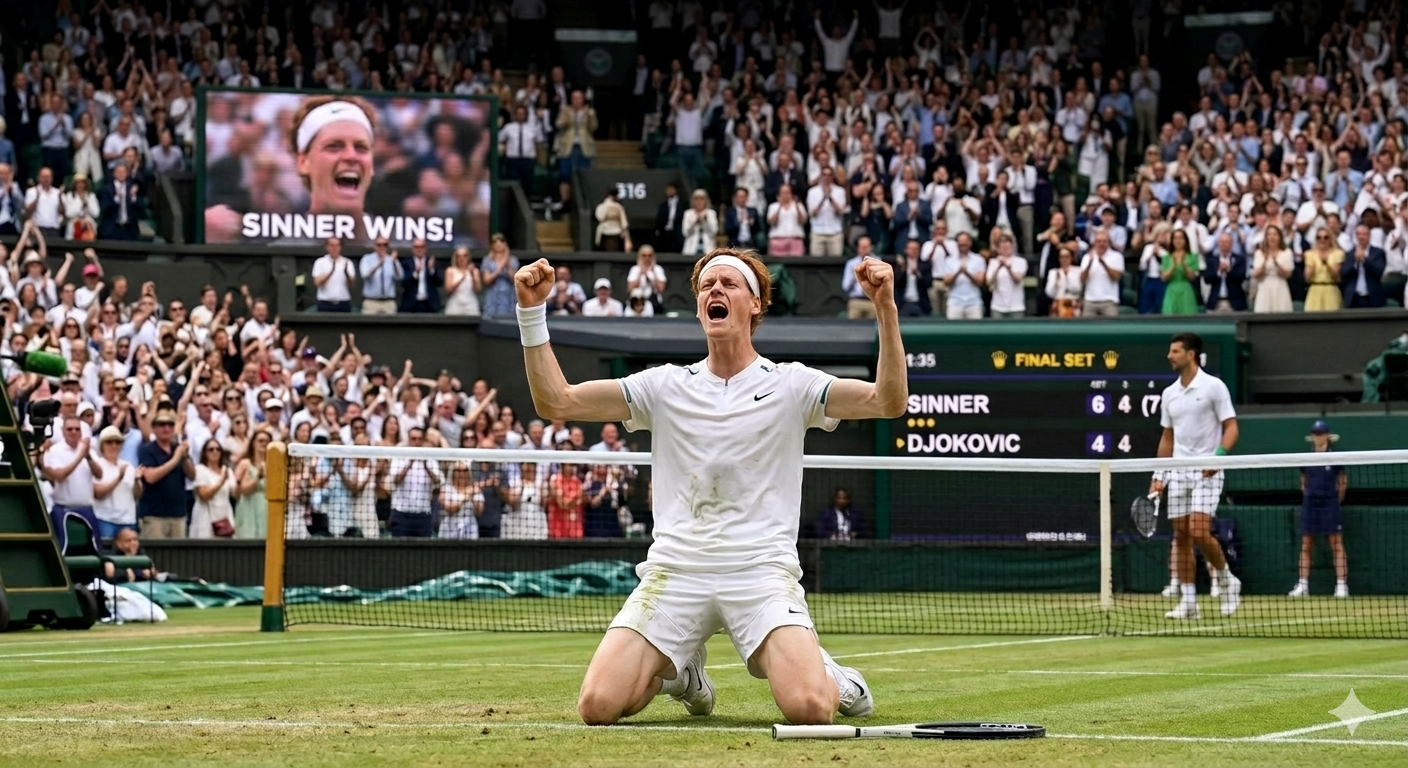
He is 24 years old. And he holds four Grand Slam titles. Additionally, he has spent more weeks at the top of the men’s rankings than any other player of his generation. And on Sunday, at Wimbledon, he steps onto Centre Court to defend the title he won there last year — against Alexander Zverev, having dispatched Novak Djokovic, the seven-time Wimbledon champion, in straight sets in the semifinal two days ago.
The quiet kid from San Candido is the most dominant tennis player in the world. And Jannik Sinner’s greatest story — the motivation, the setbacks, the method — is one of the most instructive in modern sport.
This is how it happened.
The Mountain Kid Who Chose the Wrong Sport
The Dolomites are not gentle mountains. They are limestone towers — abrupt, pale, spectacular — and the skiing they produce is technical, demanding, and fast. A child who excels there learns something specific about pressure: how to read it, how to manage it, how to make precise decisions at speeds that leave no room for hesitation.
Sinner was a top-ranked junior skier. His future, in that world, was visible. The path was there. The talent was there.
At thirteen he walked away from it and told his parents he wanted to play tennis.
They did not push. They did not resist. His father, Johann, a chef, and his mother, Siglinde, a waitress — both simple, practical, mountain people who had built a life in San Candido with their hands — trusted their son’s instinct and let him go to the Riccardo Piatti tennis academy in Bordighera, on the Italian Riviera.
He left the mountains. And he arrived at a court. He was already years behind every serious competitor his age.
He trained. Every day, with the same completeness he had brought to the mountain. No fanfare. No social media presence that announced his intentions. Just work.
A detail that tells the complete story of the Sinner family: at the 2025 Wimbledon final, the All England Club offered Sinner’s parents a seat in the Royal Box — the most prestigious seating in tennis, where royalty and celebrities watch the championship matches. His parents declined.
They did not feel comfortable there, they said. They went to the family box instead.
The world number one’s parents, on the day their son won Wimbledon, chose the family box over the Royal Box because it felt more like them.
That is the ground Sinner grew from. It explains almost everything about how he plays.
The Lanky Kid Who Rebuilt Himself
When Sinner arrived on the ATP Tour, the assessments were consistent: enormous potential, but a game too dependent on groundstrokes, a frame too lanky to sustain the physical demands at the highest level.
He heard it. He did what the assessments implied.
In 2022 he changed his entire coaching and fitness team. He rebuilt his serve — working on technique changes that would take time to embed before they paid off. Not only that, he added bulk to his frame, changing his physical conditioning with the same methodical intention he applied to his shots. Moreover, He studied what his game was missing and addressed it directly, without ego about what had worked before.
The improvements were not immediate. Rebuilding never is. He reached the quarterfinals of Wimbledon and the US Open that year — but lost both in five sets to the eventual champions.
Losing, for Sinner, is data. Not drama.
He took what the losses told him. He kept building.
2024: The Year Everything Arrived at Once
In 2024 Sinner did something that confirmed the quiet rebuild had worked.
He won the Australian Open — his first Grand Slam title. He was 22. The manner of the victory told the story more clearly than the result: down two sets to Daniil Medvedev in the final, a lesser player folds. Sinner dismantled the third set, then the fourth, then the fifth. He did not panic, never change his plan. He simply kept playing, kept finding solutions, kept moving forward with the patience of someone who has spent years understanding that the match, like the training, is a long game.
Later that year he won the US Open. He reached the world number one ranking. He became the first Italian man to hold that position in the history of tennis.
At the same time, the most serious crisis of his life was building quietly in the background.
The Storm That Could Have Ended Everything
In March 2024, at the Indian Wells Masters, Sinner tested positive for clostebol — a banned anabolic steroid. Twice.
The International Tennis Integrity Agency investigated. Their conclusion: Sinner had been inadvertently contaminated by his physiotherapist, Giacomo Naldi, who used a spray containing clostebol on a cut on his own finger before giving Sinner a massage. The contamination was trace, unintentional, and documented. The ITIA found Sinner bore no fault or negligence.
The case then went to the Court of Arbitration for Sport. The World Anti-Doping Agency challenged the finding. Sinner faced a possible two-year ban. He faced the possibility of losing his Australian Open title. Also, he faced a public doping accusation at the exact moment his career had reached its peak.
He kept playing.
Neither he hide. Nor did he collapse. He showed no visible anger at the injustice, though the scrutiny was real and punishing. Moreover, he defended his Australian Open title in 2025. So, he reached the French Open final. And went to Wimbledon.
A plea agreement with WADA resulted in a three-month ban, served before the 2025 Italian Open. Then he came back and beat Carlos Alcaraz in the Wimbledon final in four sets. He lifted the trophy.
At the post-match press conference he said the victory felt more special because of what he had lived through to get there. He did not perform relief. He stated a fact. The thing that had tried to derail him became the context that gave the achievement its full weight.
In every retelling of Jannik Sinner’s greatest story, this chapter — the doping storm, the ban, the return — sits at the centre.
TIME Magazine named Sinner one of the 100 Most Influential People in Sports in 2026, noting that his doping case had threatened to derail a career that was emerging as one of the defining forces in the sport — and that he had come through it by doing exactly what he always does: continuing to work, without drama, without deviation from the plan.
The Sinner Method: Quiet as a Strategy
Watch Sinner play and something becomes visible that is unusual among elite athletes.
He does not perform.
There are no theatrics between points. No elaborate rituals. No visible emotion management — he does not need to manage emotions that he does not allow to surface. He bounces once before he serves. Walks to the baseline. He serves. If the point goes against him he bounces once, walks to the baseline, serves again.
This is not emotional blunting. It is something more sophisticated — the decision, made over years of training, to keep the internal state as consistent as possible regardless of what the scoreboard says. To not ride the emotional peaks and valleys that most players experience within a single match.
The result is a player who looks the same at 0-40 as he does at 40-0. Who looks the same in the fifth set as in the first. Whose opponents cannot read his internal state because his internal state is not available to be read — it has been disciplined into consistency.
Djokovic, after losing to him 6-4, 6-4, 6-4 on Friday, said: “He was playing so solid from all ends. He’s as solid as anyone really from back of the court.”
Solid. That is the word his opponents consistently reach for. Not brilliant. Not explosive. Solid — in the way that a mountain is solid. Present, complete, unmoved.
He grew up in the mountains. He became one.
The Rivalry That Will Define the Next Decade
The tennis world spent thirty years defining itself through the rivalry of Federer, Nadal, and Djokovic — three men whose contrasting styles and sustained excellence gave the sport a narrative structure that audiences across the world organised themselves around.
That era is ending. And the rivalry that replaces it is already in full view.
Sinner versus Alcaraz.
Carlos Alcaraz — the Spanish prodigy, spectacular and emotional and physically overwhelming — represents one vision of what tennis can be. Sinner represents another. Where Alcaraz creates, Sinner solves. And, where Alcaraz performs, Sinner executes. Where Alcaraz takes risks, Sinner takes percentages.
Their meetings have been among the finest matches of the decade. Five-set epics. Wimbledon finals decided in tiebreakers. The French Open final that lasted five exhausting sets. The US Open that went the other way.
The current head-to-head tilts one way, then another. Neither has established dominance. Both are still becoming.
That is what makes the rivalry the sports story of the 2020s — not just the quality of the tennis, but the sense that both players are still discovering what they are capable of. The ceiling has not been found. The story has not finished.
Encyclopaedia Britannica’s profile of Sinner notes that the Sinner-Alcaraz rivalry could exceed even Federer-Nadal in generating lasting intrigue — not because either player is more talented than those predecessors, but because the contrasts in style and approach are sharp enough to sustain a narrative for a generation.
Wimbledon 2026: Defending on the Biggest Stage
The 2026 Wimbledon campaign began with a five-set opening round match that most observers read as a warning sign — Sinner stretched and uncomfortable, the defending champion potentially vulnerable.
Then he settled. Match by match, he found the form that the first round had obscured. And on Friday evening he walked onto Centre Court and produced one of the finest serving performances of his career against Djokovic — 16 aces, 40 winners, 16 unforced errors. Clinical in every sense of the word.
Tomorrow he faces Zverev, the French Open champion, on the grass that Sinner now treats as home turf.
Zverev arrives riding the confidence of his Roland Garros title. He is a different kind of challenge from Djokovic — taller, more powerful on serve, capable of finishing points at the net in ways that disrupt Sinner’s baseline game. The match will not be easy.
But here is what Wimbledon 2026 has established about Jannik Sinner: he does not need it to be easy. He needs it to be a tennis match — a problem to be solved, methodically, point by point, for however many sets it takes.
The mountain kid from San Candido does not require favourable conditions. He requires a court and an opponent and enough time to find the solution.
He always finds the solution.
The Mindset Map in His Story
1. Starting Late Is Not the Same as Starting Too Late
At thirteen, Sinner was years behind every serious competitor on the ATP Tour. By thirty — the point at which many players begin to decline — he will have spent seventeen years of focused, methodical development at the sport.
The starting point matters less than most people assume. What matters is the quality and consistency of the work done after the start. Sinner’s late beginning meant he arrived at the highest level without the burnout that early specialisation produces in many prodigies. He came to tennis with fresh intention.
You do not have to start first. You have to start seriously.
2. Quiet Consistency Outlasts Loud Brilliance
Sinner has never been the most exciting player to watch in a single point. Alcaraz produces the moments that make highlight reels. Djokovic produces the comebacks that make legends. Sinner produces results — consistently, week after week, tournament after tournament, without the peaks and valleys that more expressive players experience.
Over a season, over a career, quiet consistency accumulates into something that loud brilliance cannot match. The week when Sinner is 80% is still good enough to beat almost everyone on tour. The week when he is 100% is unreachable.
That reliability — that refusal to have truly bad weeks — is the product of discipline applied to the internal state as much as to the technique.
3. How You Handle Injustice Defines You More Than the Injustice Itself
The doping accusation against Sinner was not fair. The contamination was accidental, documented, and confirmed by an independent investigation. And yet the case dragged on. The public scrutiny was real. The possibility of losing everything he had built was genuinely present.
He did not collapse into the injustice. And he did not perform victimhood. He accepted the process, served the ban when it was handed down, and came back.
The way a person handles something that is genuinely unfair — particularly when that something happens at the most visible moment of their life — reveals the depth of the character underneath the achievement. Sinner revealed depth.
4. Your Parents Don’t Need to Sit in the Royal Box
The detail about Sinner’s parents declining the Royal Box is the most instructive thing in this entire story — and the one most likely to be overlooked.
A chef and a waitress from a mountain town of four thousand people raised the world’s best tennis player. They attended his Wimbledon final. And when offered the most prestigious seat in the building, they chose the seat that felt like them.
They did not perform the arrival. Niether they did upgrade their identity to match the occasion. They stayed rooted. In the family box. Being exactly who they are.
Sinner plays like his parents think. Without performance, upgrade. And without pretending to be something other than what he is.
That groundedness — the refusal to let the occasion distort the person — is the most transferable lesson in his story.
Rooted mind. Limitless game.
[Greatest Story of Djokovic— the contrast: Djokovic built his fortress in war, Sinner built his in mountain silence. Both are unbreachable.]
5. The Problem Is Always Solvable. Keep Working.
Sinner’s response to every setback in his career has been identical: find what needs to change, change it, keep working.
Groundstrokes too dominant? Changed the coaching team. Serve not good enough? Changed the technique. Career threatened by a doping accusation? Served the ban. Came back.
This is not resilience as a personality trait. It is resilience as a method — the specific, repeatable process of identifying a problem clearly and addressing it without drama.
The mountain taught him this first. On a ski run, when something goes wrong, there is no room for emotion. There is only the next gate, the next turn, the next fraction of a second of decision. You solve it or you fall.
He learned to solve it before he learned to play tennis.
A Final Thought
Somewhere in the Dolomites tonight, the mountains are pale and still.
The town of San Candido is quiet. Four thousand people, the same as always. The ski runs are green now, summer-green, waiting for winter.
A boy grew up there. He skied those runs. Then he left. He chose a different path — one that the conventional wisdom said started too late, on a stage too large, for a player who hadn’t come through the usual channels.
He is defending his Wimbledon title tomorrow.
His parents are in the family box.
His game is as solid as anyone’s from the back of the court.
The quiet storm from the Dolomites has not finished becoming what it is. At 24, with four Grand Slams and the world number one ranking, Jannik Sinner is still in the early chapters of a story whose end nobody can yet see.
What is already visible is this: the method works. Quiet, consistent, methodical, rooted — and limitless in what it produces.
You do not have to be the loudest in the room to be the last one standing. The storm from the mountains rarely announces itself. It simply arrives.
Quick Recap — Sinner’s Five Lessons
| Lesson | What it means in practice |
|---|---|
| Starting late is not starting too late | Quality and consistency of work matters more than when it began |
| Quiet consistency outlasts loud brilliance | Reliability over time accumulates what peaks and valleys cannot |
| How you handle injustice defines you | Accepting process, serving consequence, returning stronger |
| Stay rooted as the stage gets bigger | Your parents in the family box, not the Royal Box |
| Every problem is solvable — keep working | Identify, address, continue. No drama. Every time. |
Read next: [Novak Djokovic: The Man Who Built a Fortress From Rubble — link here] | [The All-or-Nothing Mindset Is Costing You — link here]