
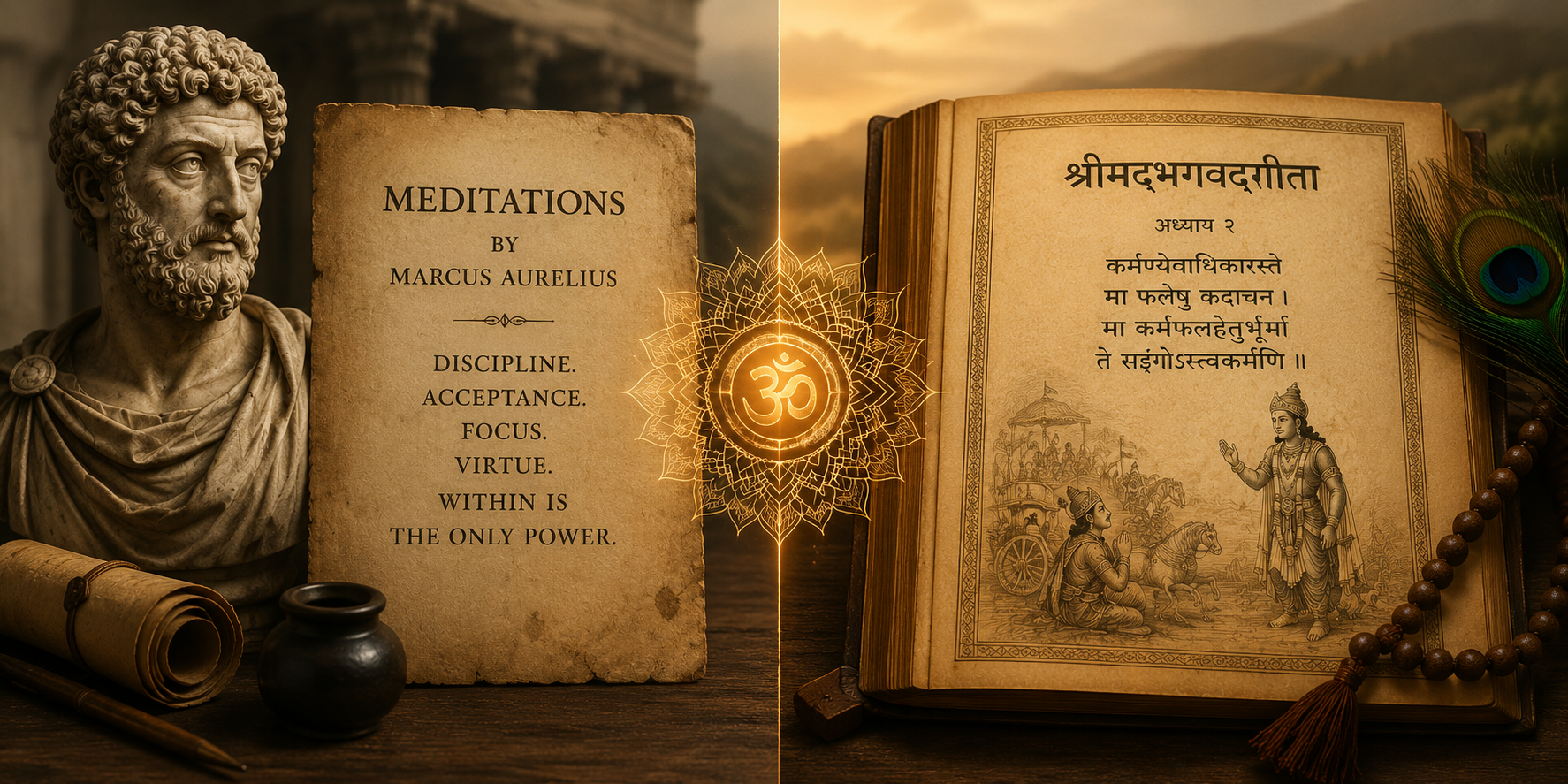
Two men. Two worlds. Twenty centuries between them.
One was a Roman Emperor — the most powerful man alive in the second century AD — who spent his evenings writing private reflections in a journal he never intended anyone to read. His name was Marcus Aurelius. His journal became one of the most widely read philosophy texts in human history, known today as Meditations.
The other was a charioteer. Or rather: a divine being who chose to appear as one, on a battlefield at the edge of dawn, speaking to a warrior who had lowered his bow and refused to fight. His name was Krishna. His words — spoken on the field of Kurukshetra — became the Bhagavad Gita.
Meditations was written in Greece, in the late second century AD.
The Bhagavad Gita is dated by scholars to somewhere between the fifth and second centuries BC — predating Marcus Aurelius by at least three hundred years, possibly more than seven hundred.
They never knew of each other. They shared no language, no culture, no communication. And yet — read them side by side — they were teaching the same things.
Not similar things. The same things.
Why This Matters for You
The convergence of two of history’s most revered philosophical traditions — Stoicism from the Greco-Roman world and the Gita’s synthesis of Karma Yoga, Jnana Yoga, and Bhakti Yoga — across centuries of separation and thousands of miles of distance is not a coincidence.
It’s evidence.
When independent systems of wisdom, developed entirely without contact, arrive at the same conclusions about how to live, how to face suffering, and how to act with integrity under pressure — those conclusions are worth paying very close attention to.
For Indians specifically, this convergence matters in a particular way. Many of us grew up with the Gita as background noise — present in the house, reverent in reference, but not always deeply explored. Meanwhile, Stoicism has had a massive global renaissance over the past decade, with millions of people discovering Marcus Aurelius, Epictetus, and Seneca as if they’ve found something entirely new.
What they found was half the map. The other half was already in your own tradition.
The First Parallel: Control What You Can. Release What You Can’t.
This is the bedrock of Stoic philosophy. Epictetus — the former slave who became one of Stoicism’s most important teachers — called it the dichotomy of control: some things are within our power, and some things are not. The Stoic practice is learning, rigorously and repeatedly, to distinguish between the two and to direct all energy only toward what you can actually influence.
Marcus Aurelius returns to this idea constantly throughout Meditations. His reflections circle back to it with the patience of someone who knows he will need to be reminded of it every single day.
The Bhagavad Gita says the same thing — but it says it first, and it says it with an image so precise it has lasted millennia.
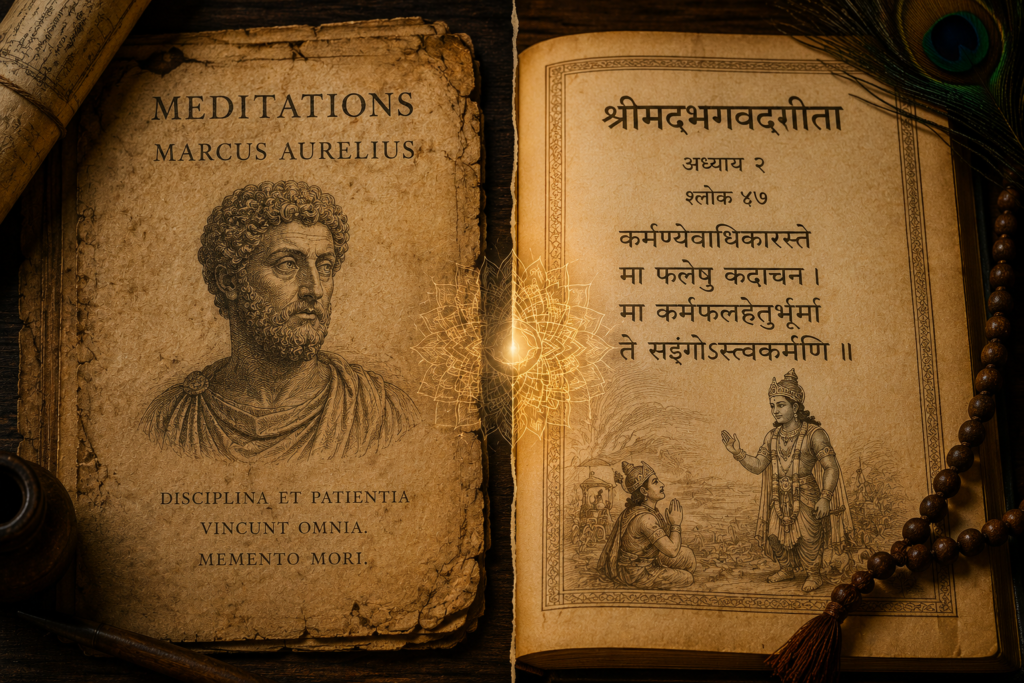
In Chapter 2, Verse 47 — one of the most cited verses in all of Hindu philosophy — Krishna tells Arjuna:
“You have a right to perform your prescribed duties, but you are not entitled to the fruits of your actions.”
This is not passive resignation. It is a precise instruction about where to place your attention and your energy. Do what is yours to do — fully, without hesitation, with complete commitment. But do not grip the outcome. The outcome is not in your jurisdiction.
The Stoics reached this same conclusion through a different path and a different vocabulary. But the instruction is identical: act within what is yours. Release what is not.
For someone navigating 2026 — a world of constant uncertainty, algorithm-driven anxiety, outcomes that often bear no relationship to effort, results that arrive on timelines you cannot control — this teaching is not ancient history. It is the most practical operating principle available.
The Second Parallel: The Observer Within
Marcus Aurelius had a concept he returned to repeatedly in Meditations: the idea of the inner self — the rational, observing mind — as distinct from the emotions, the body, and the circumstances that move through it.
He believed that while you cannot always control what happens to you, you retain complete control over how you interpret it, what meaning you assign to it, and how you choose to respond. Between stimulus and response, in that space, lies your freedom. The Stoics called this the hegemonikon — the governing faculty, the rational core of the self.
Daily Stoic describes this as the central Stoic insight: external events have no inherent meaning. The meaning is assigned by the mind that observes them. Change the interpretation, and you change the experience.
The Bhagavad Gita calls this same inner faculty the Atman — the eternal, unchanging self that witnesses experience but is not consumed by it. In Chapter 2, Krishna describes the Atman as imperishable — untouched by grief, by fear, by the fluctuations of circumstance. The practice of Yoga, in the Gita’s sense, is the gradual uncovering of this witnessing self and the realisation that it is more real, more permanent, and more foundational than any external situation.
The Roman Emperor called it the rational governing faculty. The divine charioteer called it the Atman. Both were pointing to the same interior space — the place inside a person that neither victory nor defeat can fully reach.
The Third Parallel: Do Your Duty Without Attachment to Outcome
The concept of Dharma in the Bhagavad Gita — the righteous duty appropriate to your nature, your role, and your moment — is one of the most sophisticated ethical ideas ever articulated.
Arjuna’s crisis at the start of the Gita is not a crisis of courage. He is one of the greatest warriors who ever lived. His crisis is ethical: should he fight? The people on the other side are his teachers, his cousins, his family. The cost of doing his duty appears, in this moment, to be enormous. Is it still his duty?
Krishna’s answer is not simple. But its core is this: your duty is your duty regardless of the personal cost. Not because suffering is irrelevant, but because the person who acts from duty rather than from personal desire or personal fear is the person who acts rightly — and right action, in the Gita’s view, is its own justification.
Marcus Aurelius, who carried the weight of an empire on his shoulders for nearly twenty years — who fought wars he did not want to fight, administered justice in situations with no clean answer, and governed millions of people while managing his own grief, illness, and doubt — wrote his way to the same conclusion.
His version: do what the moment requires of you. Do it fully. Do it without complaint. Not because the result will always be what you hoped for — it won’t — but because living in accordance with your duty and your nature is the only life that retains its integrity regardless of outcome.
Both the Gita and Meditations describe a kind of action that is free from ego — performed not to be seen, not for the reward, not even entirely for the result, but because it is the right thing to do in this moment by this person in this role.
In a world that increasingly rewards performance over substance, and image over action, this teaching is almost uncomfortably countercultural.
The Fourth Parallel: Impermanence as Teacher
Memento mori. Remember that you will die.
This is perhaps the most famous Stoic practice — the deliberate, regular contemplation of mortality. Not as morbidity, but as clarity. When you hold the reality of impermanence in view, what is trivial becomes easier to release. What matters becomes easier to see. The Stoics used the awareness of death not to create despair but to sharpen the quality of attention they brought to the present moment.
Marcus Aurelius wrote of this constantly. He reminded himself that emperors and slaves alike return to dust. That the famous names of history are already mostly forgotten. That his own time was brief, his legacy uncertain, his empire temporary.
It didn’t diminish him. It focused him.
The Bhagavad Gita’s relationship with impermanence goes deeper still. Krishna’s instruction to Arjuna in Chapter 2 includes one of the most striking articulations of impermanence in any philosophical tradition: the body is temporary; the soul is not. All things that have a beginning have an end. Grief over impermanent things is a misallocation of energy and attention.
This is not callousness. Krishna does not tell Arjuna that death is irrelevant. He tells him that identifying so completely with the temporary form of things — the body, the role, the outcome — that you forget the permanent reality beneath them is the root cause of suffering.
Impermanence, in both traditions, is not the enemy. It is the teacher. The one that keeps reminding you to be fully present for what is here now, because what is here now will change.
The Fifth Parallel: Equanimity in the Face of Circumstances
Apatheia in Stoic philosophy does not mean what it sounds like in English. It does not mean apathy — the absence of feeling. It means equanimity — the stable, unshaken inner state that allows you to feel what you feel without being controlled by it. The Stoic sage is not someone who feels nothing. They are someone who is not enslaved by what they feel.
Marcus Aurelius wrote about this in the context of dealing with frustrating people, painful circumstances, public criticism, and personal loss. His instruction to himself — patient, consistent, written for no audience — was always toward the same quality: steady. Not unfeeling. Not performing contentment. Genuinely steady, from the inside.
The Bhagavad Gita’s equivalent concept is Sthitaprajna — the person of steady wisdom. In Chapter 2, Krishna describes this person in detail: one who is undisturbed in misfortune and unelated in good fortune. Who is free from attachment, fear, and anger. Who is neither proud in praise nor deflated in criticism.
The Sthitaprajna and the Stoic sage are the same person described in two languages.
Both descriptions are of someone most of us will never fully become. But both traditions offer them not as impossible ideals but as directions — compasses rather than destinations. The practice is the movement toward that quality, not the achievement of it.
Why the Gita Got There First
Here is something worth sitting with for a moment.
Stoicism was founded by Zeno of Citium around 300 BC. Marcus Aurelius was writing in the late second century AD. The Bhagavad Gita predates even the founding of Stoicism by most scholarly estimates — its philosophical content emerging from a tradition that stretches back further still, into the Upanishads and the broader river of Vedic thought.
India was working out these questions — about duty, about impermanence, about the inner witness, about right action without attachment to outcome — before the Stoics arrived at the same conclusions.
This isn’t a competition. Philosophy doesn’t work that way. But for Indians who have absorbed the Gita as cultural background rather than as a living philosophy — and who then encounter Stoicism as something new and Western and contemporary — it’s worth knowing: you already had this. In some ways, you had it first. And in some ways, you had it deeper.
The Gita isn’t just a parallel to Stoicism. It’s a more comprehensive map. Stoicism tells you how to live with equanimity. The Gita tells you that too — and then explains why equanimity is possible, at the level of the self’s deepest nature.
How to Actually Use This
Philosophy that stays in books is scenery. These two traditions survived not because they were beautiful but because they were useful — because people brought them into the practical friction of actual life.
Here are five questions drawn from both traditions that are worth returning to regularly. Not as a quiz. As a practice.
1. What, in this situation, is actually within my control? The Stoic and Gita answer is always: your intention, your action, your interpretation. Almost never: the outcome, the response of others, external events.
2. What is my duty here — not what do I want, but what does this moment require of me? Dharma is situational. It changes with your role, your relationships, your moment. But the question is always the same.
3. Am I acting from ego — from the need to win, to be seen, to protect my identity — or from genuine purpose? Both traditions are unsparing about ego as the primary source of poor decisions and unnecessary suffering.
4. What am I gripping that I need to release? Not because it doesn’t matter. But because the grip itself is causing damage that the thing being gripped cannot justify.
5. If this moment were temporary — and it is — what would I regret not having done, said, or been? Memento mori. The impermanence lens. Used not to create anxiety but to clarify what deserves your actual attention and energy.
Meditations by Marcus Aurelius is available in multiple translations — Gregory Hays’ version is widely considered the most readable for modern readers. Read it alongside the Bhagavad Gita — any good translation — and the parallels will reveal themselves without needing a guide.
A Final Reflection
Marcus Aurelius was one of the most powerful men who ever lived. He had armies, territories, and the machinery of the greatest empire of his age at his disposal. And in the evenings, alone, he wrote reminders to himself about humility, about releasing outcomes he could not control, about doing his duty without expecting gratitude.
Krishna spoke on a battlefield, to a man in crisis, about why action without attachment to outcome was not passivity — but the highest form of human engagement possible.
Thousands of years. Thousands of miles. The same conversation.
Maybe wisdom doesn’t have a geography. Maybe the deepest truths, arrived at honestly, keep finding each other across time and distance — because they’re true, and truth doesn’t need a passport.
The conversation is still happening. You just joined it.
A rooted mind doesn’t borrow its wisdom only from one tradition. It recognises the same river flowing through all of them.
Quick Recap
- Stoicism (Marcus Aurelius) and the Bhagavad Gita (Krishna) independently developed the same core philosophical insights across centuries and continents
- Control only what you can: the Stoic dichotomy of control mirrors Gita’s Chapter 2 Verse 47 on Karma without attachment to fruit
- The Stoic hegemonikon and the Gita’s Atman describe the same witnessing inner self
- Duty without ego (Dharma) maps directly to the Stoic ideal of action in accordance with nature and role
- Impermanence (memento mori / the Gita’s teaching on the body and soul) is a teacher in both traditions
- Apatheia (Stoic equanimity) and Sthitaprajna (Gita’s steady wisdom) describe the same human ideal
- The Gita predates Stoicism — Indians were working out these questions first
Read next: [Why Discipline Feels Impossible Some Days — link here] | [What the Rain Teaches You About Letting Go — link here]