What if your next trip didn’t just give you photos to post — but a skill you actually kept?
That’s the idea behind the Skilliday — and in 2026, nearly half of Europeans are planning one.
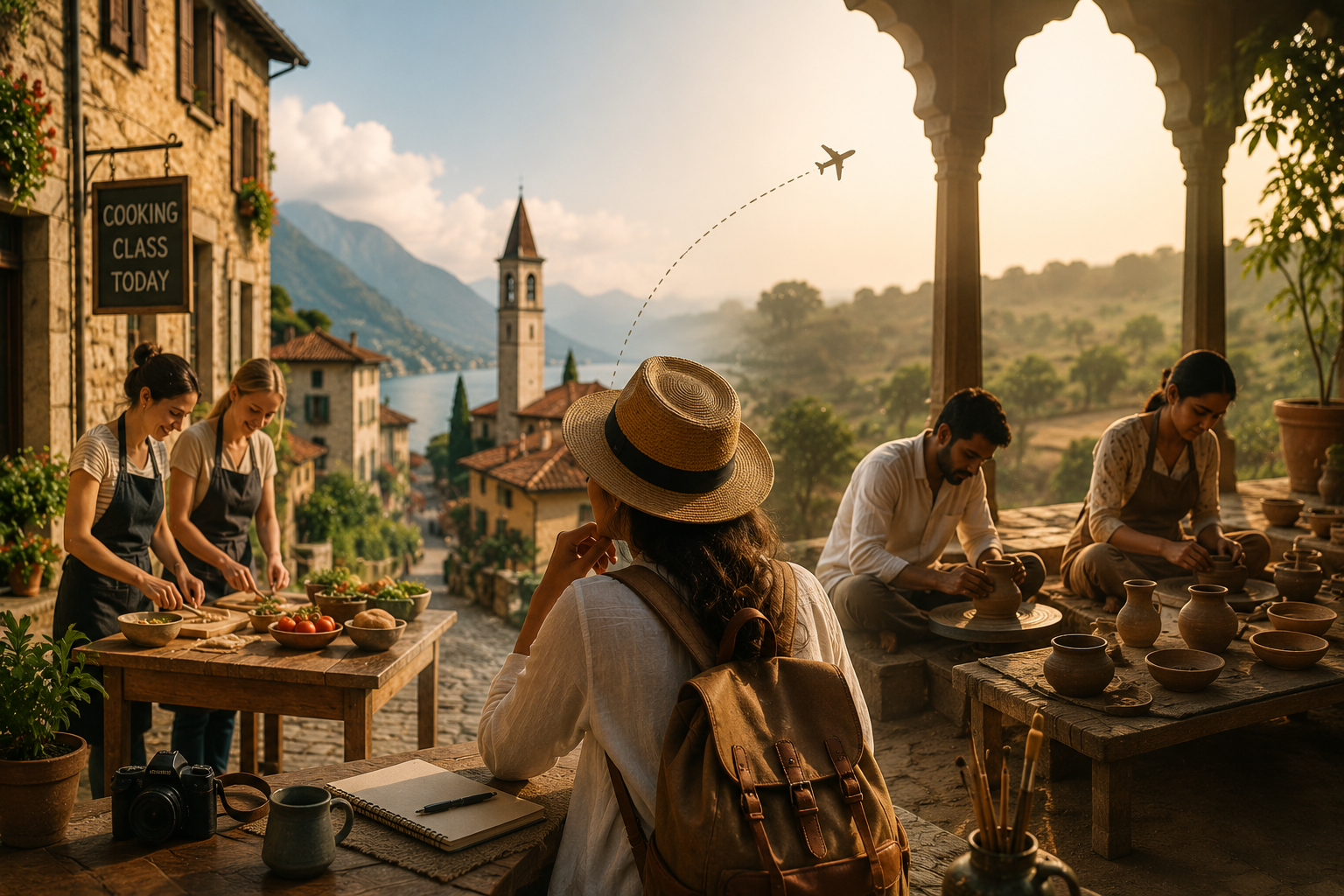
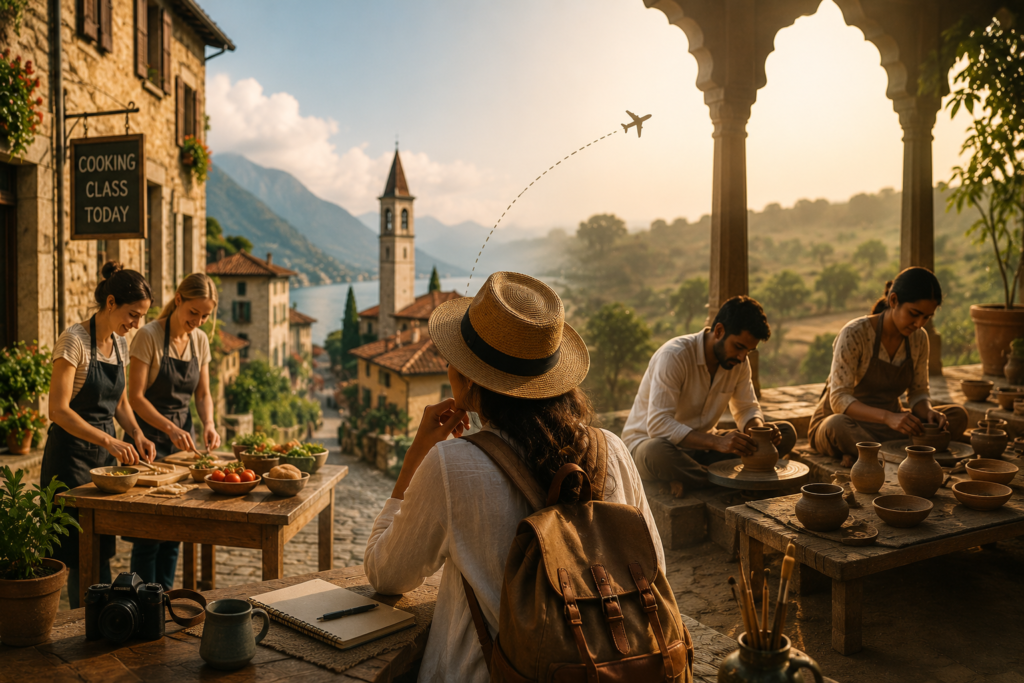
A Skilliday is exactly what it sounds like: a holiday built around learning something. Not sightseeing as the main event. Not ticking landmarks off a list. A trip where the primary purpose is coming home with a new capability — whether that’s pottery in Portugal, pasta-making in Tuscany, surfing in Cornwall, or Arabic calligraphy in Morocco.
It sounds niche. It isn’t. It’s the fastest-growing travel format in Europe right now, and the reason why tells you something important about where people’s heads are at in 2026 — and why India, of all places, is positioned better than almost anywhere else in the world to become the global capital of Skilliday travel.
Why This Trend Is Happening Now
Travel fatigue is real.
After years of Instagram-optimised holidays — fly in, hit the five famous spots, fly out with a camera roll full of near-identical images — a significant portion of travellers are questioning what they actually took away from the experience. The destination looked great. The memories faded quickly. The cost was high. What changed?
Nothing, usually.
The Skilliday is a direct response to that emptiness. It replaces passive consumption of a place with active participation in it. Instead of watching someone make traditional pottery in a cultural centre, you sit down and learn to centre the clay yourself. Instead of eating at the restaurant, you spend a morning in the kitchen with a local cook.
The experience becomes the point — not the backdrop.
This connects to a broader shift happening across Europe and globally: what researchers and travel analysts are calling the move from experience economy to transformation economy. People don’t just want to feel something on holiday. They want to return as a slightly different, slightly more capable person than the one who left.
Google’s 2026 Travel Trends report confirms that “slow travel” hit an all-time high in search this year, with “month-long yoga retreat” and “month-long hotel stay” among the top trending searches globally. The Skilliday is slow travel’s more purposeful cousin — shorter in duration but equally intentional.
What Makes a Skilliday Different From Regular Travel
The difference isn’t just in what you do. It’s in how you plan, how you show up, and what you come back with.
A regular holiday: You arrive, you explore, you rest, you eat well, you take photos. The destination is the product. You are the consumer.
A Skilliday: You arrive with a specific learning intention. The destination is the context. The skill is the product. You are both student and participant — and the place reveals itself to you through what you’re learning, not just where you’re standing.
A traveller who spends four days in Jaipur visiting monuments experiences one version of the city. A traveller who spends four days in Jaipur learning block printing from a master craftsman in the old city experiences a version most tourists never access — the workshops behind the markets, the families who’ve held these skills for generations, the slow unfolding of a tradition through your own hands.
Same city. Completely different journey.
Why India Is the World’s Best Skilliday Destination
India doesn’t just have things to see. It has things to learn that exist nowhere else on earth.
The depth and diversity of craft, cooking, wellness, philosophy, music, movement, and art traditions across this country is genuinely unmatched. And unlike many European Skilliday destinations where the “authentic experience” has been packaged and commodified for tourists, India still has access to the real thing — masters of dying crafts, unbroken lineages, and communities where the skill lives in daily life, not in a tourism workshop.
Here’s what that looks like in practice:
Craft & Art
- Block printing and natural dyeing — Jaipur, Rajasthan
- Madhubani painting — Mithila region, Bihar
- Warli art — tribal communities, Maharashtra
- Bidriwork metalcraft — Bidar, Karnataka
- Blue pottery — Jaipur
- Pattachitra painting — Raghurajpur, Odisha (India’s first heritage crafts village)
Cooking
- Kashmiri Wazwan — traditional multi-course royal cuisine, Srinagar
- Chettinad cooking — one of India’s most complex spice traditions, Tamil Nadu
- Coastal Konkani cuisine — Goa and coastal Maharashtra
- Rajasthani dal baati churma — Jodhpur or Jaisalmer with a local family
- Onam Sadhya preparation — Kerala, especially around festival season
Wellness & Movement
- Ashtanga yoga at source — Mysore, Karnataka (the global origin point of the practice)
- Kalaripayattu — Kerala’s ancient martial art, the oldest surviving in the world
- Ayurvedic medicine basics — Kerala, with certified practitioners
- Vipassana meditation — 10-day silent retreat centres across India, genuinely life-changing
Music & Language
- Classical Carnatic or Hindustani vocal — Chennai or Varanasi
- Tabla basics — Varanasi or Mumbai
- Sanskrit or Hindi intensive — Varanasi
- Folk music of Rajasthan — immersive sessions with Manganiyar or Langa musicians
Nature & Sustainability
- Organic farming and permaculture — Auroville, Tamil Nadu
- Bamboo architecture — workshops in Kerala and Northeast India
- Spice plantation management — Coorg or Wayanad, Karnataka/Kerala
- Tea estate work experience — Munnar, Darjeeling, or Assam
The Mindset Angle: Why a Skilliday Is More Than a Holiday
There’s a deeper reason the Skilliday resonates beyond its Instagram appeal.
Learning a skill — even a basic one, even for four days — puts you in a state of deliberate beginner’s mind. You are incompetent. sometimes you are slow. OR You are watching someone with decades of experience do something that looks easy and feels impossible. You fail repeatedly before you get it right.
That experience, in a low-stakes holiday context, is genuinely valuable as a mindset practice.
It rebuilds your relationship with not knowing. In daily life, most of us operate almost entirely within our zones of existing competence. We rarely voluntarily put ourselves in situations where we are the student, where we struggle visibly, where we have to ask basic questions without embarrassment.
The Skilliday forces that. And it’s oddly clarifying.
You remember what it feels like to be a beginner. And you remember that mastery — in anything — is a long road of exactly this kind of stumbling. You come back to your regular life slightly more patient with your own learning curves. Slightly more humble about what you don’t yet know. Slightly more curious about what you could.
The person who never puts themselves back in the student seat slowly loses the ability to grow. The Skilliday is one of the simplest ways to stay a learner.
How to Plan Your Skilliday in India: A Practical Guide
Step 1 — Choose the skill, then the destination
Reverse the usual travel planning process. Don’t pick a place and then figure out what to do there. Pick the skill you want to learn — or more precisely, the skill you’re most curious about — and let that lead you to the destination. The destination will reveal itself differently because you already know what you’re there to learn.
Step 2 — Find the real practitioner, not the tourist version
This is the most important step and the most commonly skipped one. There is a packaged tourist version of almost every craft and skill in India — a two-hour workshop at a resort, a demonstration at a cultural centre. These are fine as introductions. They are not Skillidays.
A real Skilliday requires a real teacher. That means doing the research: finding community workshops, artisan cooperatives, yoga shalas with serious lineages, cooking instructors who teach in their homes. It takes more effort to find. It’s completely worth it. The quality of what you learn is entirely different.
Step 3 — Build in duration
A Skilliday isn’t a day trip. You need enough time to get past the initial awkwardness of being a beginner and actually start to feel the skill taking shape. For most crafts and physical skills, that minimum threshold is three to four days of daily practice. Whereas, for something like yoga, a week. For something like Vipassana, the standard programme is ten days — and the structure is built into the retreat itself.
Step 4 — Disconnect intentionally
The Skilliday works best when you treat it as a deliberate break from your regular digital environment. Not because being offline is inherently virtuous, but because the quality of learning — the attention, the presence, the absorption — is significantly higher when you’re not splitting focus with notifications and feeds.
This is where the Digital Life pillar of mind.pole intersects directly with travel: a Skilliday is one of the few contexts where disconnecting has a clear, immediate, observable payoff. You are better at what you’re learning when you’re fully there.
Step 5 — Document the learning, not just the place
The photos worth keeping from a Skilliday aren’t the landmarks. They’re the process shots — your hands covered in clay, the block print that didn’t work, the finished piece beside the master’s finished piece. The story of learning is a better story than the story of sightseeing. It’s also far more original content.
Five Skilliday Itineraries Worth Planning Right Now
1. The Potter’s Week — Jaipur (5 days) Blue pottery workshop mornings, old city exploration afternoons, evening block printing session. Stay in a heritage haveli in the walled city.
2. The Yoga Source Trip — Mysore (7 days) Daily Ashtanga primary series at a traditional shala. Rest days for Mysore Palace, local coffee, and silence. The most globally recognised yoga pilgrimage in the world.
3. The Spice & Kitchen — Coorg (4 days) Morning spice estate tour and harvest participation, afternoon Coorgi cooking class with a local family, evening around a plantation bonfire. The food you learn to cook here will permanently change your kitchen.
4. The Living Craft — Raghurajpur, Odisha (4 days) India’s only heritage crafts village, where the entire community practices Pattachitra painting as a living tradition. Learn from families who have been doing this for generations. Genuinely rare access to something that is still real.
5. The Silence — Igatpuri or Dhamma Giri, Maharashtra (10 days) Vipassana. No phones. No talking. Ten days of meditation instruction at the source. Not a holiday in any conventional sense — but possibly the most transformative ten days you could spend. Waitlists exist for a reason.
The Bigger Picture
The Skilliday trend isn’t really about travel.
It’s about a growing collective tiredness with passive consumption — of content, of experiences, of life — and a turn toward active participation, learning, and growth. Europe got there first in its travel habits. India has the raw material to become the world’s leading destination for this kind of travel. The crafts, the traditions, the teachers, the landscapes — all of it is here.
What’s needed is the awareness. The decision to plan differently. The choice to come back from a trip not just with photos but with something you actually built, learned, or grew.
Incredible India has been positioning heritage and cultural tourism for decades — the Skilliday is the modern traveller’s natural next step from that positioning.
That step starts with you deciding what you want to learn — and then going to the place that can actually teach you.
Save This for Your Next Trip Planning Session
Before you book your next holiday, ask one question: what do I want to come back knowing how to do?
The answer will take you somewhere more interesting than the usual shortlist. It will put you in rooms most tourists never find. It will give you a story that doesn’t start with “I went to” — but with “I learned to.”
That’s the Skilliday. And India has been waiting to host it long before Europe had a name for it.
A rooted mind doesn’t just travel to see the world. It travels to grow in it.
Read next: [10 Monsoon Travel Destinations in India ] | [ What the Rain Teaches You About Letting Go ]