

Connected More Than Ever, Present Less Than Before

Not long ago, going online was something we did intentionally. We sat down at a computer, checked our emails, perhaps browsed a few websites, a constant connectivity and then returned to our day.
Today, the internet follows us everywhere. It wakes up beside us in the morning, sits next to us during meals, accompanies us during commutes, and is often the last thing we see before falling asleep.
Most of us don’t think twice about it anymore.
Checking notifications while waiting for coffee feels normal. Scrolling through social media before getting out of bed feels normal. Watching videos while eating lunch feels normal. Yet somewhere along the way, constant connectivity stopped being an activity and became a permanent state.
The strange part is that despite being more connected than any generation before us, many people feel increasingly distracted, mentally exhausted, and disconnected from the things that matter most. The cost isn’t obvious. That’s what makes it dangerous.
When Every Quiet Moment Gets Filled
Think about the last time you stood in a queue.
Ten years ago, people simply waited. They looked around, observed their surroundings, or let their minds wander. Today, almost every spare moment is instantly occupied. The moment boredom appears, a phone comes out.
A quick glance at messages turns into checking social media. One reel becomes ten. A news update leads to another article. Before we realize it, the small pocket of silence has disappeared.
At first glance, this doesn’t seem like a problem. But those quiet moments once served a purpose. They gave the mind room to process thoughts, reflect on experiences, and occasionally stumble upon creative ideas. Now many people move from one form of stimulation to another without ever allowing their minds to rest.
The Attention Economy Is Competing for Your Mind
Most people believe they are choosing what they pay attention to. In reality, thousands of companies are competing for that attention every day.
- Every notification is designed to bring you back.
- Every auto play feature is designed to keep you watching.
- Every endless feed is designed to prevent you from leaving and that’s constant connectivity hook.
The business model of much of the modern internet depends on one thing: keeping people engaged for as long as possible. There’s nothing inherently wrong with technology companies wanting engagement. The challenge is that human attention is limited. When dozens of apps compete for that attention simultaneously, concentration becomes harder.
This is why many people have experienced something surprising: They can watch short videos for an hour but struggle to read ten pages of a book. The issue isn’t intelligence.
It’s adaptation.
Our brains become accustomed to constant stimulation and begin finding slower activities more difficult. One growing response to this overload is resetting your relationship with screens through a dopamine detox.
Why We Feel Mentally Tired Even When We Haven’t Done Much
One of the most confusing experiences of modern life is ending the day feeling exhausted without being able to explain why. Many office workers know this feeling. They spend hours responding to emails, attending virtual meetings, replying to messages, switching between tabs, checking updates, and managing notifications. Physically, they haven’t done anything demanding.
Mentally, however, they’ve been constantly interrupted. Each interruption seems insignificant. A message here. An email there. A notification that takes three seconds to read. But attention doesn’t switch as effortlessly as we imagine. Every interruption requires the brain to stop, refocus, and start again. By evening, that constant connectivity switching leaves many people feeling drained. Not because they worked harder, but because their minds never received a break.
Social Media Didn’t Create Comparison—It Amplified It
Human beings have always compared themselves to others. What’s changed is the scale. A century ago, people compared themselves to neighbours. Today, with constant connectivity they compare themselves to millions of people.
Open any social media platform and you’ll quickly find someone:
- more successful
- wealthier
- fitter
- traveling more
- achieving more
The logical part of our brain understands that these are curated highlights.
The emotional part often forgets. We see someone’s best moments and compare them to our ordinary Tuesday afternoon. It’s an unfair comparison, yet many people do it unconsciously every day. Over time, this constant exposure can quietly affect self-esteem, satisfaction, and happiness. Not because life has become worse. But because expectations have become distorted.
The New Form of Rest That Isn’t Actually Rest

After a long day, many people tell themselves they’re going to relax. They sit on the couch, open their phones, and begin scrolling. An hour later, they often feel no more refreshed than before. This happens because consumption and recovery are not always the same thing.
The brain continues processing information:
- videos
- opinions
- advertisements
- news
- conversations
It’s activity disguised as rest. True recovery usually involves moments where the mind isn’t constantly absorbing new information.
That’s one reason why activities like walking, reading, gardening, exercising, or simply sitting outdoors often leave people feeling more refreshed than endless scrolling.
Relationships Are Changing in Small Ways

Technology has made communication easier than ever.
Yet many people quietly miss something they can’t quite describe. Perhaps you’ve seen it yourself. A group of friends sitting together at a restaurant. Everyone physically present. Several people looking at their phones.
No conflict.
No argument.
Just divided attention.
Technology hasn’t removed relationships from our lives. But it has become a permanent participant in many conversations. The challenge isn’t whether we’re communicating. The challenge is whether we’re fully present when we do.
Why Digital Detoxes Keep Gaining Popularity
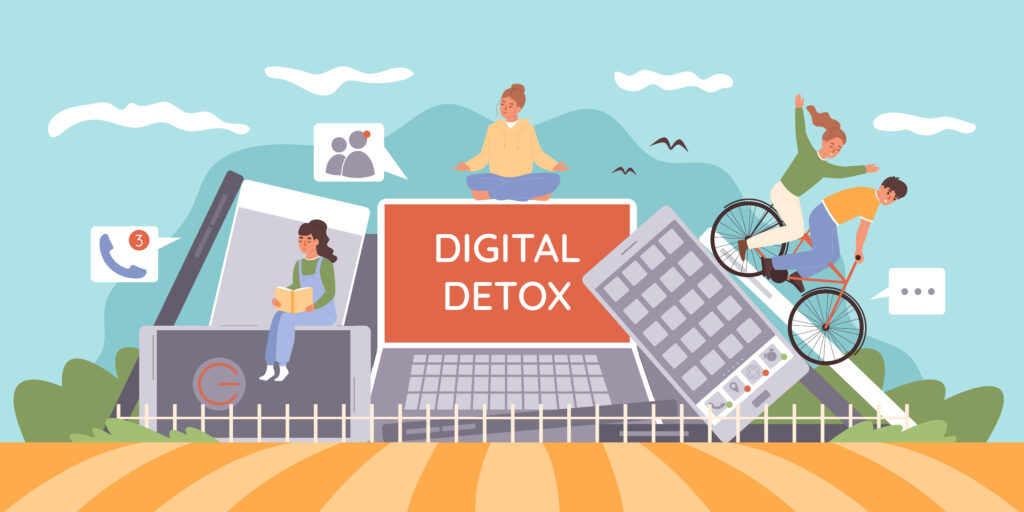
The growing popularity of digital detoxes reveals something interesting. People aren’t rejecting technology. They’re reacting to overload. Many who take temporary breaks from screens report similar experiences: They sleep better. They focus longer, feel calmer. They become more aware of how often they reached for their phones automatically. The surprising realization for many isn’t how much they use technology. It’s how little they were consciously choosing to use it.
Finding Balance in a World That Never Logs Off
The solution isn’t throwing away your smartphone or abandoning social media altogether. Modern life runs on technology — that’s simply the reality. The goal is awareness, not abstinence. Part of why disconnecting feels so hard is how AI algorithms are quietly rewiring the way we think.
The goal is awareness, not abstinence
It’s asking simple questions:
Am I using this intentionally? Or am I using it automatically? Am I consuming information because it adds value? Or because I’m uncomfortable with silence?
Small changes often create meaningful results. A phone-free dinner. An hour without notifications. A walk without headphones. A morning that begins without social media. These habits may seem insignificant, but they gradually return something many people have lost: control over their attention.
Final Thoughts
The silent cost of being always online isn’t measured in data usage or screen time reports. It’s measured in something far more valuable.
- Attention.
- Presence.
- Focus.
- Peace of mind.
Technology has improved our lives in countless ways, and it will continue shaping the future. But perhaps one of the most important skills of the modern world is learning when to disconnect. Because some of life’s most meaningful experiences don’t appear on a screen. They happen in conversations, quiet moments, unexpected observations, and experiences that require us to be fully present. And in a world constantly competing for our attention, presence may become one of the rarest skills of all.