
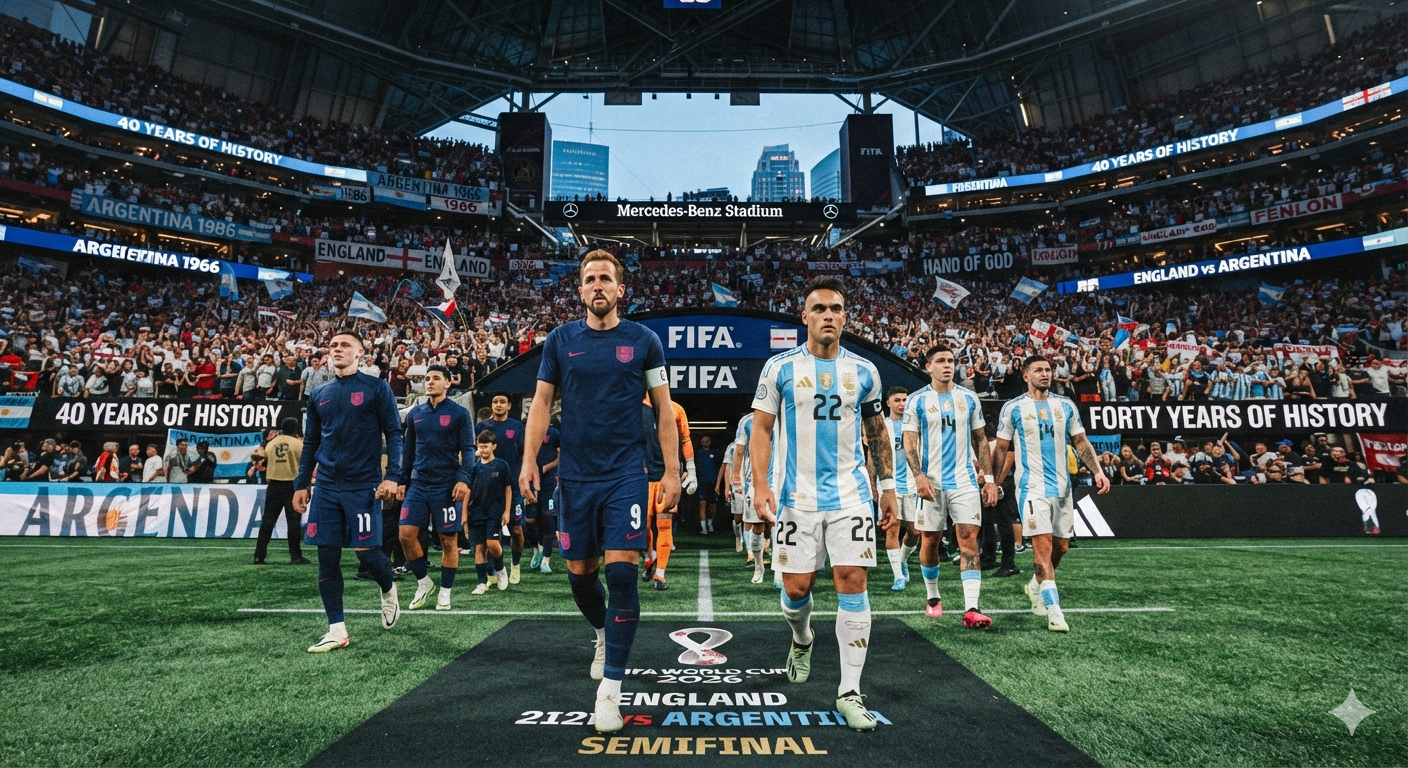
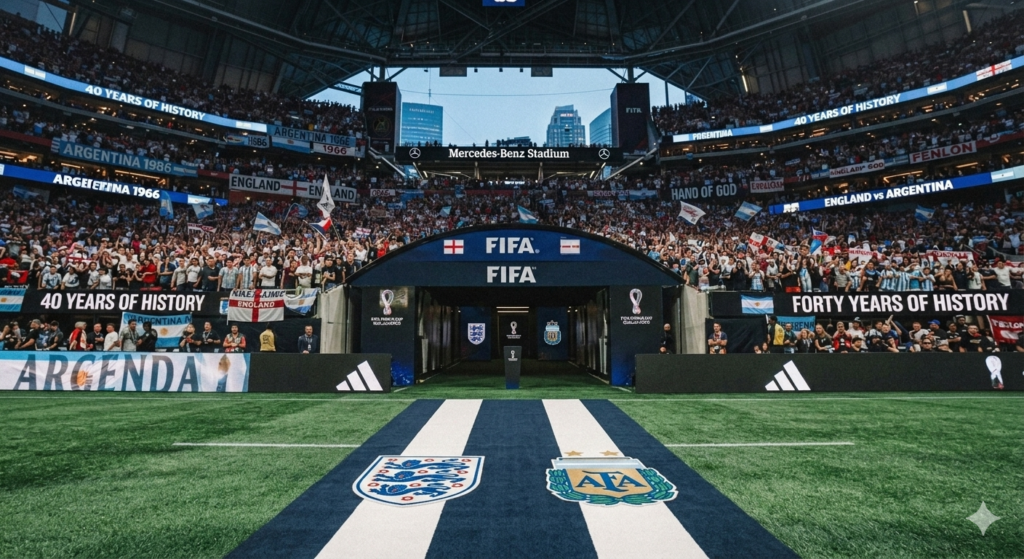
Today, England and Argentina walk onto a football pitch in Atlanta.
They have done this before. Not in Atlanta — but the walk itself, the specific weight of this particular fixture, has happened six times at World Cups across forty years of accumulated history, grievance, and moments that football cannot stop referring to.
- Diego Maradona punched the ball into the net with his hand and called it the Hand of God. Four minutes later he ran sixty yards through the England defence in what many still consider the greatest goal ever scored. Argentina won. England went home.
- David Beckham, 23 years old, lying on the grass after a foul, flicked his boot at Diego Simeone’s leg. The referee reached for red. England played with ten men for seventy-three minutes. They lost on penalties. Beckham became the most hated man in England for the better part of a year.
- England got revenge — won on penalties, sent Argentina home — but the fixture had already accumulated enough mythology to sustain a generation of conversation.
Today is the eighth meeting. The stakes are the highest they have ever been. England need to win to reach their first World Cup final since 1966. Argentina need to win to defend their title and become the first nation since Brazil in 1958 and 1962 to win back-to-back World Cups.
The history sits in the stadium before a ball is kicked. It sits in the changing rooms. It sits inside every player who grew up watching footage of everything that came before.
The question that mind.pole always asks of these moments is not who will win. It is: what does carrying this kind of history do to the people who carry it?
What Collective Memory Does to Performance
Every England player who walks out today carries something that has nothing to do with their own performance record.
They carry 1986, 1998. They carry sixty years of a nation waiting for something that last arrived when most of their grandparents were young. Moreover, They carry every penalty shootout, every near-miss, every tournament that ended one match too early. They did not create this weight. They inherited it.
This is one of the most interesting performance challenges that sport produces — the inherited pressure. The expectation that belongs not to your own achievement record but to the collective memory of everyone who came before you in the same shirt.
Individual pressure is comprehensible. You have done something, or not done something, and the pressure corresponds to that record. Collective pressure is different — it arrives regardless of your personal contribution, assigned to you by virtue of the shirt you wear and the history attached to it.
Jude Bellingham is 22 years old. He was not born when Maradona scored the Hand of God. Rather he was five years old during England’s last serious World Cup run in 2018. He carries none of the personal memory that makes this fixture feel as heavy as it does.
And yet he walks onto that pitch today carrying all of it — because the weight does not require personal memory to be real. It is transmitted through culture, through expectation, through the faces of every England supporter who has waited their entire lives for something that keeps not arriving.
The players who handle this best are not the ones who pretend the weight does not exist. They are the ones who learn to convert it — to treat the collective expectation as fuel rather than burden. To let the history behind them push rather than press.
What Argentina Carries
Argentina’s weight is different. And in some ways heavier.
They are the defending champions. They won in Qatar 2022 in a final that many consider the greatest ever played — against France, in a match that swung multiple times, settled in extra time, decided on penalties. Messi finally won the trophy that had been the missing piece of the greatest career in football history.
Defending a World Cup title has broken better squads than Argentina’s. Only Brazil managed it — in 1958 and 1962 — and the football world was a different, smaller, less analytically ruthless place then.
Argentina have not been dominant at this tournament. They have been scrappy, comeback-driven, Messi-dependent. Moreover, they were 2-0 down to Egypt in the round of sixteen and won 3-2 in stoppage time. They needed extra time against Switzerland in the quarterfinal.
They keep winning ugly. That is its own kind of pressure — the knowledge that the manner of the victories has not been convincing, that the margin between winning and elimination has been a single Messi moment or a Julián Álvarez goal out of nowhere.
What Argentina carries today is the most dangerous kind of pressure: the pressure of a team that knows it has been living on the edge and cannot afford to live there one more time.
What the Great Players Do With It
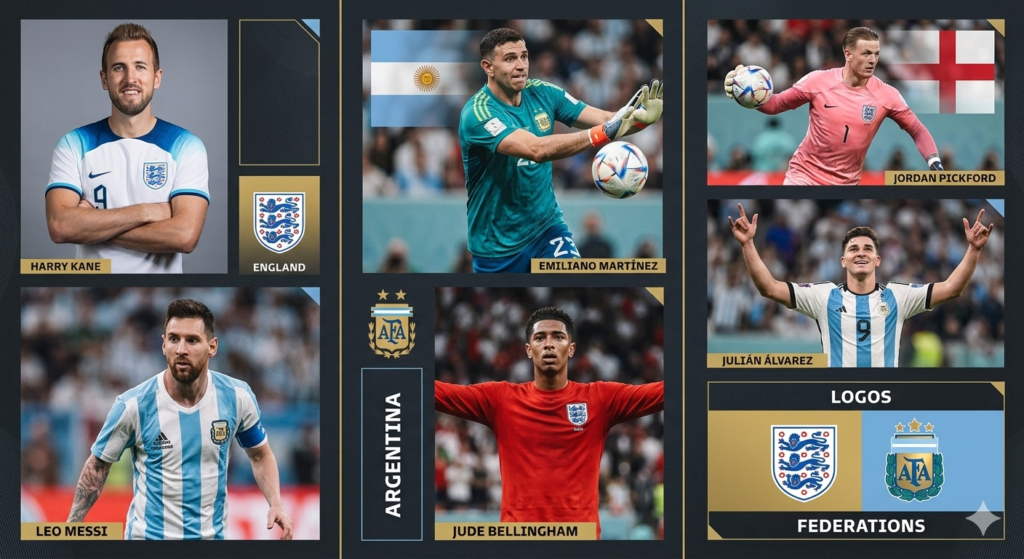
The players who define fixtures like this are not the ones who are unaffected by the weight. They are the ones who have learned — through experience, through failure, through the specific education of performing badly under pressure and figuring out why — to use the weight productively.
Bellingham scored a brace against Norway in the quarterfinal. Kane has six goals in the tournament. They are performing at their best when the stakes are highest — not in spite of the pressure, but shaped by years of learning to stand in it without being consumed.
Messi at 39 has eight goals at this tournament. He is demonstrating something that transcends sport: the capacity to perform at the absolute limit of your capability at the exact moment when the collective weight is greatest. Moreover, he has spent his entire career being told the weight of Argentina’s expectation was too much for one person. He has spent his entire career proving otherwise.
The lesson for anyone who has ever stood in a high-stakes moment — a job interview, a difficult conversation, a decision that carries more than its immediate weight — is not “remove the pressure.” The pressure cannot be removed. The lesson is in what Messi does, what Bellingham does, what every player in that stadium today does with it.
They feel it, acknowledge it. They step onto the pitch anyway — and they play the next ball, not the whole history.
The Hand of God happened in 1986. Today’s match happens today. The players who perform best will be the ones who can hold that distinction clearly — honouring the history without being paralysed by it, carrying the weight without letting it slow the feet.
The 2026 FIFA World Cup official page documents the full bracket and results — England vs Argentina in the semifinal at Atlanta, 3pm ET today.
The Mindset Lesson in Four Points
Inherited pressure is real — and it is not yours to solve. Every England player today carries sixty years of national expectation they did not create. The first step is recognising that this weight belongs to the history, not to you. You can honour it without being defined by it.
Collective memory can push or press — you choose the direction. The same weight that paralysed England teams in previous tournaments has pushed Bellingham to a brace in the quarterfinal. The difference is not the weight. It is the relationship with it.
The next ball is the only ball. Maradona’s Hand of God cannot be undone. Beckham’s red card cannot be undone. Whatever happens in the first twenty minutes today cannot be undone. The players who handle this fixture best will be the ones whose attention returns, immediately and completely, to the next moment — not the accumulated history of the last forty years.
Performing under pressure is a learnable skill, not a personality trait. Bellingham was not born clutch. He became clutch — through the overhead kick against Slovakia at the Euros, through the brace against Norway, through the accumulated experience of performing badly under pressure and understanding why. The capacity to perform when it matters most is built, not given.
History is the context. It is not the opponent. The opponent is the next ninety minutes. That is the only thing that can be won or lost today.
A Final Thought
Whatever happens in Atlanta today, this fixture will add another chapter to a story that has been running for forty years.
If England win, they go to their first World Cup final since 1966 — and the weight of all those years becomes the fuel that got them there. If Argentina win, they take another step toward something no nation has done in sixty-four years — and Messi’s last World Cup becomes something that belongs permanently to the sport’s highest conversation.
Either way, the players who walk off the pitch having performed their best will not be the ones who forgot the history. They will be the ones who carried it — and chose, in the moments that mattered, to play the ball in front of them rather than the one from 1986.
That is the lesson. Not just for football. For every high-stakes moment that carries more than its own immediate weight.
The history is there. Step onto the pitch anyway.
The weight of what came before you is real. The only thing that can change what comes after is what you do right now.
Quick Recap
- England vs Argentina carries forty years of shared World Cup history — 1986 Hand of God, 1998 Beckham red card, six previous meetings
- Inherited pressure — expectation that belongs to history rather than personal record — is one of the most complex performance challenges in sport
- Argentina carry the burden of defending champions who have been unconvincing; England carry sixty years of national longing
- The players who perform best are not unaffected by the weight — they convert it from burden to fuel
- The mindset lesson: honour the history, play the next ball, not the accumulated weight of forty years
Read next: [Harry Kane: The Weight He Carried and the Goals That Kept Coming — link here] | [Jude Bellingham: The Kid From Stourbridge — link here]