Category: Businesses That Are Changing the World | The Mind Pole
Most people spend their teenage years figuring out what they want to do with their lives. Aadit Palicha and Kaivalya Vohra spent theirs getting into Stanford — and then walking away from it to solve India’s grocery problem.
Today, at 23 and 22 respectively, they are among India’s youngest billionaires. Their company, Zepto, is processing over 2.33 million orders every single day across India, and is days away from filing for an IPO that could value the business at $7–8 billion. Not bad for a startup that began as two teenagers stuck at home during a pandemic, frustrated they could not get eggs delivered quickly.
Dubai, Stanford, and a Pandemic Realisation
Aadit Palicha and Kaivalya Vohra did not meet at a startup conference or a Silicon Valley networking event. They grew up together in Dubai, attended the same school, and shared a passion for coding and entrepreneurship from their early teens. By the time they were 18, both had earned admission to Stanford University’s Computer Science programme — one of the most competitive programmes in the world.
They enrolled. Then, in 2020, the pandemic hit and they found themselves back in Mumbai under lockdown. Like millions of Indians, they struggled to get basic groceries delivered reliably. The existing options were slow, unreliable, or both. However, unlike most people, they did not just complain about the problem. They started building a solution.
In April 2021, backed by early investor Contrary Capital — who reportedly offered to fund them specifically if they dropped out — Palicha and Vohra left Stanford’s CS programme and returned to India. They were 19 years old. It remains one of the boldest bets in Indian startup history.
What Is Zepto, Actually?
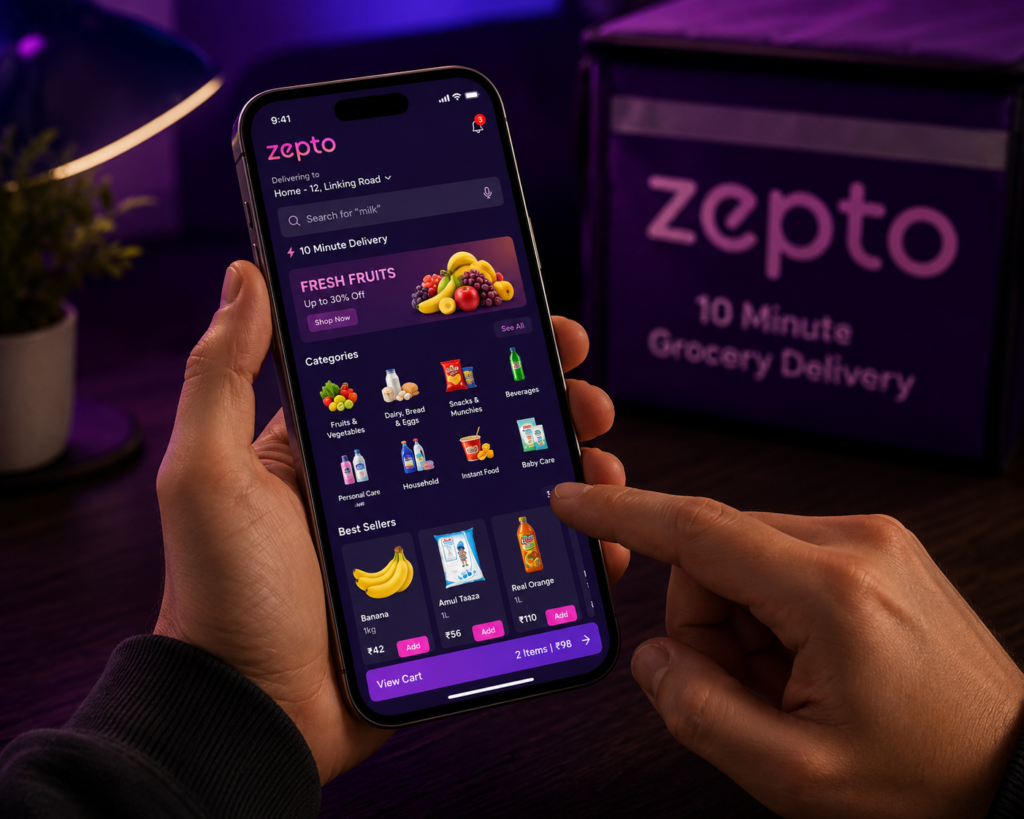
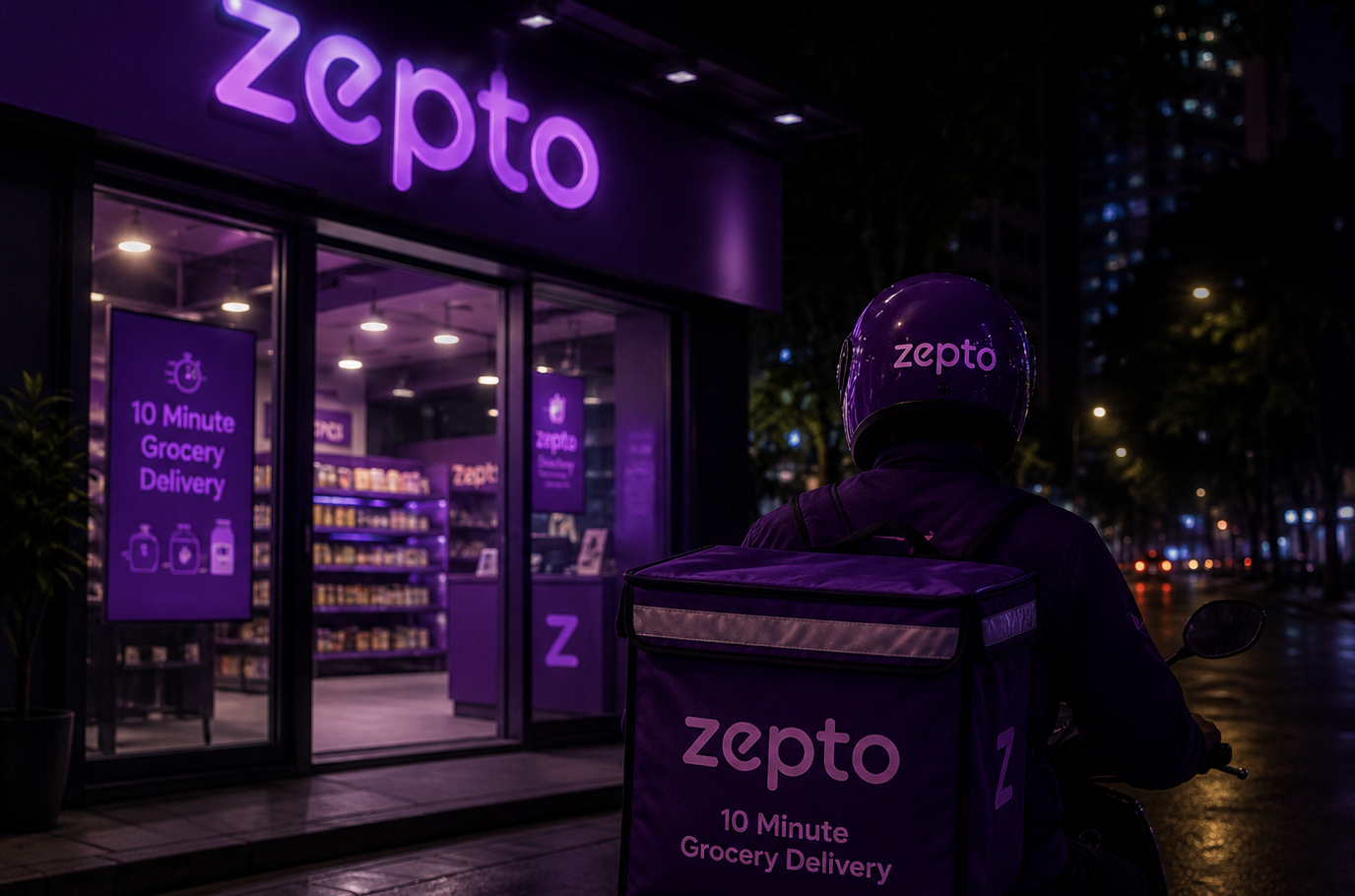
At its simplest, Zepto is a quick commerce platform that promises to deliver groceries and daily essentials to your door in 10 minutes. Not an hour. Not 30 minutes. Ten.
That promise sounds almost unreasonable — until you understand the operational infrastructure behind it. Zepto does not work like a traditional e-commerce platform, picking orders from a distant warehouse and dispatching a delivery partner. Instead, it operates through a network of dark stores — small, hyper-local fulfilment centres of around 2,000–3,500 square feet, tucked into dense urban neighbourhoods, invisible to the public, and stocked exclusively with fast-moving daily essentials.
Each dark store carries approximately 2,500 SKUs — groceries, personal care, household products, electronics, and more — all curated based on what that specific neighbourhood orders most. When you place an order, a picker inside the nearest dark store assembles it in under 90 seconds, and a delivery partner on a bicycle or two-wheeler covers the last mile in under eight minutes.
In other words, Zepto did not just build a delivery app. It built an entirely new kind of retail infrastructure — one designed from the ground up for speed.
From KiranaKart to Zepto: The Pivot That Changed Everything
The company did not start as Zepto. Its original avatar, KiranaKart, partnered with local kirana stores to facilitate delivery — a model that made intuitive sense but had a fatal flaw: Palicha and Vohra could not control quality, inventory, or speed when they were dependent on thousands of independent shop owners.
As a result, they made a pivotal decision in late 2021: scrap the kirana partnership model entirely, build their own dark stores, and own the entire delivery experience from shelf to doorstep. They rebranded to Zepto. Most observers thought it was too capital-intensive to work in India. Moreover, they thought the 10-minute promise was a marketing gimmick.
Both were wrong.
The Dark Store Machine
By March 2026, Zepto had 1,139 dark stores and 75 warehouses operational across India — up from just a handful of pilot locations in 2021. That network now spans 70+ cities, from Mumbai and Bangalore to Pune, Hyderabad, and beyond.
The numbers from the DRHP filed with SEBI on June 8, 2026 reveal the scale of what has been built:
- 47.97 million annual transacting users — up 25% year-on-year
- 2.33 million orders per day in Q4 FY26
- 2,140 orders per dark store per day — up from 1,425 a year earlier
- Order volumes grew at a CAGR of 119.5% between FY24 and FY26
- Revenue reached ₹22,623 crore in FY26 — more than double the prior year
Furthermore, a majority of Zepto’s dark stores have now turned EBITDA-positive, with the time to profitability per new store falling from two years in 2022 to under six months today. That improvement in unit economics is precisely why investors are paying attention.
Beyond Groceries: Building a Platform
Zepto started with groceries because they are high-frequency, habitual purchases. However, the founders always had a larger vision: use the dark store network as a fixed-cost infrastructure layer that can serve an expanding range of categories at marginal incremental cost.
That strategy is now playing out. Zepto’s ecosystem today includes:
Zepto Now — the flagship 10-minute delivery service covering 30,000+ SKUs including groceries, personal care, and household essentials.
Zepto Café — freshly prepared food and beverages delivered in minutes, competing in the food delivery space without needing a kitchen network.
Zepto Superstore — pharmacy and health products, one of the fastest-growing verticals in Indian quick commerce.
Zepto Atom — a subscription analytics tool for brands selling through the platform, creating a higher-margin B2B revenue stream alongside the consumer business.
In addition, non-grocery categories including electronics, apparel, and general merchandise already contribute ₹200 crore monthly in sales. The grocery app is becoming a platform. And platforms, as Zepto’s investors know well, are worth far more than delivery services.
The IPO: India’s Quick Commerce Moment
On June 8, 2026 — just days before this article was published — Zepto filed its Updated Draft Red Herring Prospectus (UDRHP) with SEBI, targeting a listing on both the BSE and NSE in July 2026.
The IPO is expected to raise approximately ₹10,000 crore ($1.2 billion), comprising a fresh issue of ₹8,010 crore and an offer for sale by existing investors. At the targeted valuation of $7–8 billion, Zepto will become the first pure-play quick commerce company to list on Indian stock exchanges — a milestone for an industry that did not exist five years ago.
Notably, the October 2025 pre-IPO funding round was led by CalPERS — the California Public Employees’ Retirement System, one of the world’s largest pension funds. That is not a speculative venture capital bet. That is institutional, long-term capital from a fund that manages the retirement savings of 2 million American public servants. When CalPERS leads a $450 million round in an Indian grocery startup, it tells you everything about how the world now views India’s consumer technology opportunity.
The Honest Picture: Challenges Worth Knowing
Zepto’s story is inspiring — but it is not without complications, and any honest telling of it must acknowledge them.
First, the company is not yet profitable at the net level. FY26 net losses reached ₹5,905 crore, widening from prior years as Zepto aggressively expanded its dark store network. The company’s argument — supported by improving unit economics per store — is that these are investment losses, not structural ones. The trajectory supports that view, but the path to net profitability remains a key watchpoint for investors.
Second, the competitive landscape is fierce. Zepto holds approximately 30% market share in Indian quick commerce, competing directly with Blinkit (owned by Zomato) and Swiggy Instamart. All three are spending heavily. Margins are thin. Differentiation requires constant innovation.
Third, the updated DRHP discloses that the Enforcement Directorate issued summons to both founders in April 2026 under the Foreign Exchange Management Act — related to questions about foreign investments and ownership structures. Both founders appeared before the agency and submitted requested documents. The matter remains under review. It is disclosed as a risk factor in the prospectus, and worth monitoring — though it has not disrupted the IPO timeline.
What This Means for India
The Zepto story matters beyond the balance sheet. In fact, it represents something much larger happening in India right now.
India’s grocery retail market is worth approximately ₹50 trillion ($617 billion) — one of the largest consumer markets in the world. And yet, as recently as 2024, kirana stores still accounted for 92% of that market, with online grocery penetration below 1% of total spend. The gap between where India is and where it is going is almost incomprehensibly large.
Zepto is not just competing for market share. It is helping build an entirely new category — and in doing so, creating jobs for hundreds of thousands of delivery partners, dark store workers, and supply chain professionals across India’s cities.
Moreover, it is proving something that many doubted: that world-class consumer technology companies can be built in India, by Indians, for India — and that Indian public markets are ready to value them accordingly.
The Lesson from Two Teenagers Who Said No to Stanford
There is a moment in the Zepto story that deserves to sit with you.
Two 19-year-olds, admitted to one of the most prestigious universities on the planet, walked away. Not because they did not value education. Not because they were cavalier about the opportunity. But because they believed — with the specific, irrational confidence that the best founders always have — that the problem in front of them was more important than the credential behind them.
Ultimately, what makes Zepto remarkable is not the 10-minute delivery. It is the 10-minute decision: the moment two teenagers looked at a broken system, decided they could fix it, and chose to act before the world told them they were ready.
That, more than any valuation, is what makes this a business worth knowing about.
Key Facts at a Glance
| Detail | Info |
|---|---|
| Founded | 2021, Mumbai, India |
| Founders | Aadit Palicha (CEO), Kaivalya Vohra (CTO) |
| Founded Age | Both 19 years old |
| Previous Name | KiranaKart |
| IPO Target | July 2026 (BSE & NSE) |
| IPO Size | ~₹10,000 crore ($1.2 billion) |
| Valuation | $7–8 billion |
| FY26 Revenue | ₹22,623 crore |
| Daily Orders | 2.33 million (Q4 FY26) |
| Dark Stores | 1,139 across 70+ cities |
| Annual Users | 47.97 million |
| Total Funding | ~$2.93 billion |
| Key Investors | CalPERS, Y Combinator, Contrary Capital |
| Market Share | ~30% of Indian quick commerce |
Final Thought
SpaceX showed us that a rocket company could survive near-bankruptcy and reach the stars. Klarna showed us that an 85% valuation crash is not necessarily the end of the story. And Zepto is showing us something equally powerful: that age is not a prerequisite for audacity, and that India’s next great businesses will be built by people who grew up ordering food on their phones — and decided to reimagine how that works.
The 10-minute grocery delivery is not just a feature. It is a statement about what is possible when you refuse to accept the world as it is.
At The Mind Pole, we believe the most inspiring businesses are not the ones that play within the rules. They are the ones that rewrite them.