Category: Businesses That Are Changing the World | The Mind Pole
Most companies get one shot at a valuation peak. Very few survive a crash of 85%. And almost none come back from it, go public, and rewrite the fintech rulebook in the process.
And yet, that is exactly what Klarna did.
What Is Klarna — and Why Should You Care?

Before we get to the drama, here is the simple version: Klarna is a Swedish financial technology company that lets you buy something today and pay for it later — in instalments, interest-free. No credit card required. No complicated bank forms.
In other words, it turned the ancient idea of paying in parts into a seamless, app-first experience that over 119 million people across 26 countries now use actively — a figure that grew 21% year-over-year. Moreover, it has crossed a milestone that few payment companies ever reach: over 1.07 million merchant partners worldwide, up 49% in a single year. From global giants like H&M and IKEA to Sephora and eBay, Klarna is now embedded at checkout across virtually every major retail vertical.
The numbers behind those merchants are equally striking. Sephora recorded a 70% increase in purchase frequency after adding Klarna. eBay saw average order values triple. In other words, Klarna does not just process payments — it actively grows the businesses that use it.
Three Students, One Bold Idea
The story begins in 2005, in Stockholm, at the Stockholm School of Economics. Three students — Sebastian Siemiatkowski, Niklas Adalberth, and Victor Jacobsson — entered a business plan competition with a simple pitch: make online payments safer and easier by letting the buyer pay after receiving their goods, not before.
The judges were unimpressed. They came last.
Undeterred, the three founders launched Klarna anyway. At the time, online shopping was still young and trust was a major barrier — consumers were afraid of paying for something they might never receive. Klarna’s model solved that anxiety completely by shifting the risk to itself. The merchant got paid immediately. The buyer paid Klarna later. Simple, elegant, and quietly revolutionary.
Within five years, Klarna was the dominant payments provider in Scandinavia. By 2015, it had entered the United States in partnership with Macy’s, taking on the world’s most competitive retail market.
The Peak, the Crash, and the Humbling
By 2021, Klarna was flying. The pandemic had turbo-charged e-commerce, Buy Now Pay Later (BNPL) was the hottest trend in fintech, and investors were pouring money into anything with a growth story. In June 2021, Klarna raised $639 million in a funding round led by SoftBank’s Vision Fund — at a staggering valuation of $45.6 billion. It was the most valuable private fintech company in Europe, ever.
Then everything changed.
In 2022, inflation surged, interest rates rose sharply, and the technology sector entered a brutal correction. Suddenly, loss-making growth companies were no longer celebrated — they were punished. Klarna, which had been spending aggressively to capture market share, found itself in a deeply uncomfortable position.
In July 2022, Klarna raised emergency funding at a valuation of just $6.7 billion — a drop of 85% in thirteen months. It was one of the most dramatic valuation collapses in startup history. The company laid off 10% of its global workforce. Co-founder Niklas Adalberth had already stepped back from the business years earlier. The boardroom faced turbulence. Critics wrote Klarna’s obituary more than once.
The Rebuild: Spend-Centric, Not Lend-Centric
However, CEO Sebastian Siemiatkowski did not panic. Instead, he made a series of disciplined, strategic decisions — and one of the most important was redefining exactly what kind of company Klarna was.
Most fintech lenders are what the industry calls lend-centric: they make money primarily by issuing credit and collecting interest. Affirm earns 61% of its revenue from interest income. Synchrony earns 94%. Nubank earns 85%. These businesses are fundamentally built around debt.
Klarna, by contrast, positioned itself as spend-centric — a company built around transaction volume and consumer habit, not loan books. Its revenue composition reflects this: 55% comes from merchant fees and 26% from interest income, with the remainder from membership, advertising, and other services. As a result, Klarna turns its loan book over 10.4 times per year — compared to 2.6x for Affirm and just 1.7x for Synchrony. The average outstanding consumer balance is just $124, and the average loan life is only 39 days.
That is not a lending business. That is a shopping habit.
This distinction matters enormously. It means Klarna carries far less credit risk than traditional lenders, despite having underwritten over $500 billion in transactions since inception. Notably, its provision for credit losses is just 0.6% — and that number has been falling even as GMV grows, reaching $128 billion in annual volume in 2025.
Furthermore, Siemiatkowski cut costs aggressively and refocused on profitability. He restructured the business to lean on Klarna’s Swedish banking licence, which allowed it to fund lending through nearly $10 billion in customer deposits rather than expensive debt — significantly lowering the cost of capital compared to rivals.
The AI Bet That Paid Off
Third, and most consequentially, Siemiatkowski went all-in on artificial intelligence. In 2023, Klarna deployed an AI-powered customer service assistant built on OpenAI — and it worked. The assistant handled the equivalent workload of 700 human agents in its first month. While the company later had to course-correct on some AI-driven workforce changes due to quality concerns, the underlying commitment to AI efficiency remained central to the business.
By 2024, Klarna had returned to profitability. The comeback was real, and the numbers proved it.
The Flywheel Nobody Talks About
One of the most underappreciated aspects of Klarna’s business is what the company calls its flywheel — a self-reinforcing growth cycle that becomes more powerful the larger it gets.
It works like this: consumers discover Klarna at trusted brands and adopt it. As they use it more, they see additional value and adopt more services. Over time, they actively prefer Klarna and demand it at checkout. That consumer demand, in turn, attracts more merchants — over 1 million of them now offer Klarna as a default option. And more merchant availability brings in more new consumers.
The result is a loop that accelerates on its own. In fact, Klarna has signed default payment partnerships with some of the world’s largest payment processors — JP Morgan Payments ($2.6 trillion in combined processing volume), Worldpay ($2.1 trillion), Stripe ($1.9 trillion live), and Adyen ($1.35 trillion) — giving it embedded reach across nearly $9.5 trillion in combined processing volume.
The IPO: Europe’s Biggest Fintech Moment
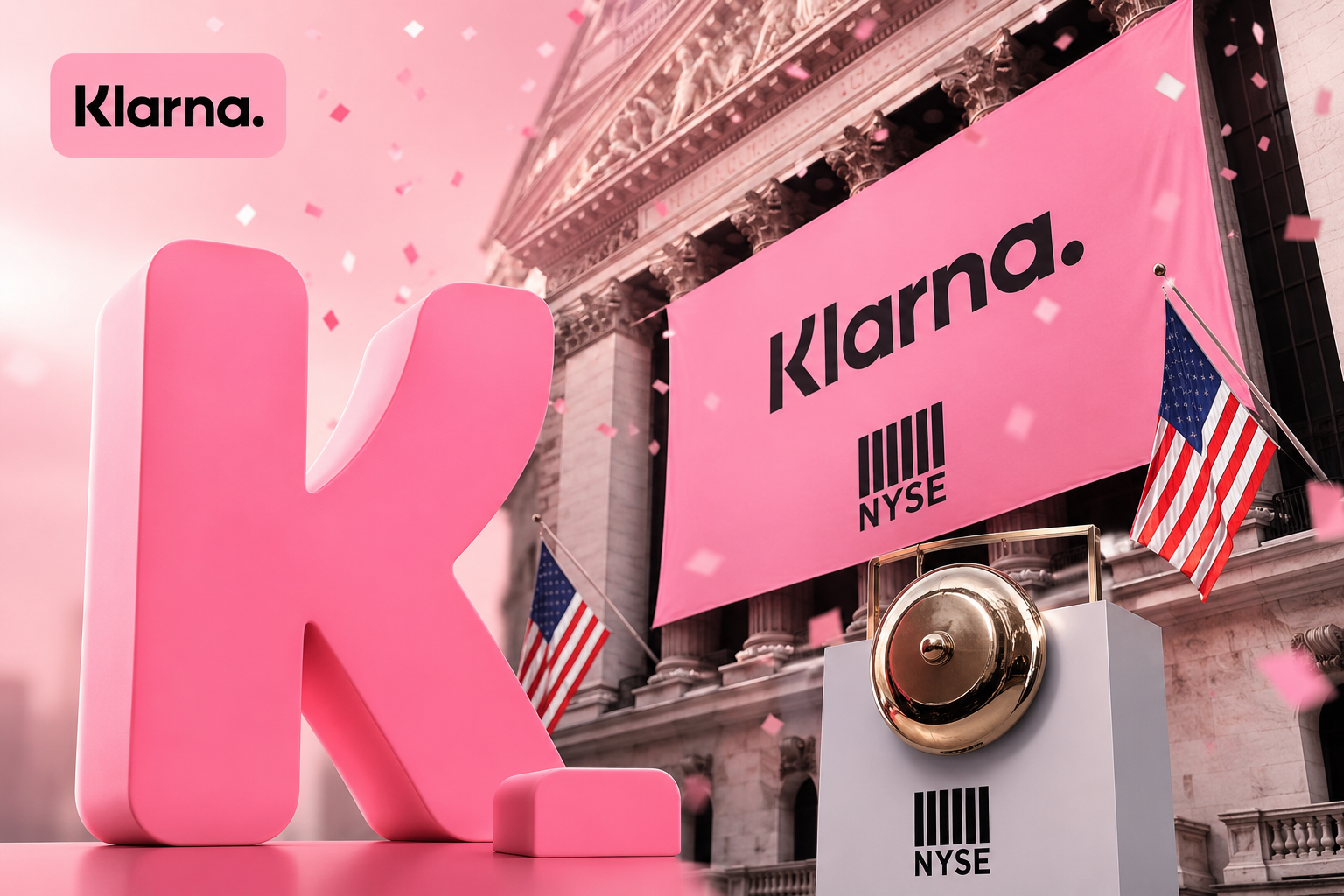
On 10 September 2025, Klarna listed on the New York Stock Exchange under the ticker KLAR, pricing its shares at $40 each — above the expected range of $35 to $37. The IPO raised approximately $1.37 billion, making it the largest IPO of 2025 at the time of listing. On opening day, shares jumped 30%, giving Klarna a market capitalisation of nearly $19.65 billion.
Notably, CEO Sebastian Siemiatkowski did not sell a single share at IPO. His stake, worth over $1 billion at the offer price, remained fully intact — a powerful signal of his conviction in what comes next.
What the Numbers Actually Say
Klarna’s financials tell a story of hard-won, accelerating discipline.
Revenue grew 104% from Q4 2022 to Q4 2025 — reaching $1.1 billion in a single quarter by the end of 2025. Over the same period, adjusted operating expenses actually fell by 8%. In other words, Klarna more than doubled its revenue while simultaneously shrinking its cost base. The total 2025 revenue reached $3.5 billion, growing 25% year-over-year.
Perhaps most tellingly, average revenue per user (ARPU) grew from $12 in 2022 to $52 in 2025 — a more than fourfold increase. That figure reveals something important: Klarna’s existing users are not just staying, they are spending significantly more through the platform every year.
Meanwhile, the merchant network surpassed 1 million partners in 2025 — up from 394,000 in 2021 — driven in large part by Klarna becoming a default integration on every major payment platform on the planet.
Why 119 Million People Choose Klarna
The investor deck reveals five reasons consumers prefer Klarna over alternatives — and they are worth understanding, because they explain why this is a sticky, habit-forming business and not just a checkout button.
Fairness tops the list. Klarna charges 0% interest on 96% of its transactions. The average Klarna balance is $124 — compared to over $6,900 for the average credit card. For consumers drowning in revolving debt, that contrast is visceral and real.
Protection comes second. Every transaction includes built-in buyer protection, effortless return management, and automatic refunds — features that legacy payment methods charge extra for, if they offer them at all.
Ubiquity is third. With over 1 million merchant partners and integrations with Apple Pay, Google Pay, Visa, and local payment networks, Klarna is genuinely available almost everywhere.
Habit is fourth — and arguably the most powerful. Klarna is relevant across every spending category, from groceries to flights to fashion. As frequency becomes loyalty, the platform becomes indispensable.
Brand rounds out the list. With ambassadors including Lady Gaga, Snoop Dogg, and A$AP Rocky, Klarna has achieved 40% brand recognition and an NPS score of 73 — compared to 44 for the broader financial industry. That gap is extraordinary for a payments company.
The Lesson Hidden in the Comeback
There is something deeply instructive about the Klarna story that goes beyond finance.
The company was not saved by a new product launch or a fortunate pivot. It was saved by clarity — by the decision to define precisely what kind of company it was (spend-centric, not lend-centric), cut everything that did not serve that definition, and rebuild with more conviction than it started with.
Ultimately, the most valuable companies are not always the ones that never fall. Sometimes, they are the ones that fall hardest, understand why, and come back with a sharper answer.
Klarna fell 85%. Then it got back up — and built something more defensible than what it had before.
Key Facts at a Glance
| Detail | Info |
|---|---|
| Founded | 2005, Stockholm, Sweden |
| Founders | Sebastian Siemiatkowski, Niklas Adalberth, Victor Jacobsson |
| IPO Date | September 10, 2025 |
| Ticker | KLAR (NYSE) |
| IPO Price | $40 per share |
| IPO Valuation | ~$15.1 billion |
| Peak Valuation | $45.6 billion (2021) |
| Low Valuation | $6.7 billion (2022) |
| Active Consumers | 119 million (↑21% YoY) |
| Merchant Partners | 1.07 million+ (↑49% YoY) |
| Annual GMV | $136 billion (↑28% YoY) |
| 2025 Revenue | $3.5 billion (↑25% YoY) |
| ARPU | $52 (up from $12 in 2022) |
| Credit Loss Rate | 0.6% of GMV |
Final Thought
SpaceX survived near-bankruptcy on the strength of a fourth rocket launch. Klarna survived an 85% valuation crash on the strength of a CEO who refused to quit and a business model that genuinely solved a real problem for real people.
In both cases, the lesson is the same: the companies that change the world are not always the ones that had it easiest. More often, they are the ones that had it hardest — understood it clearly — and kept going anyway.
At The Mind Pole, we believe resilience is not just a personal trait. Sometimes, it is a business strategy.