
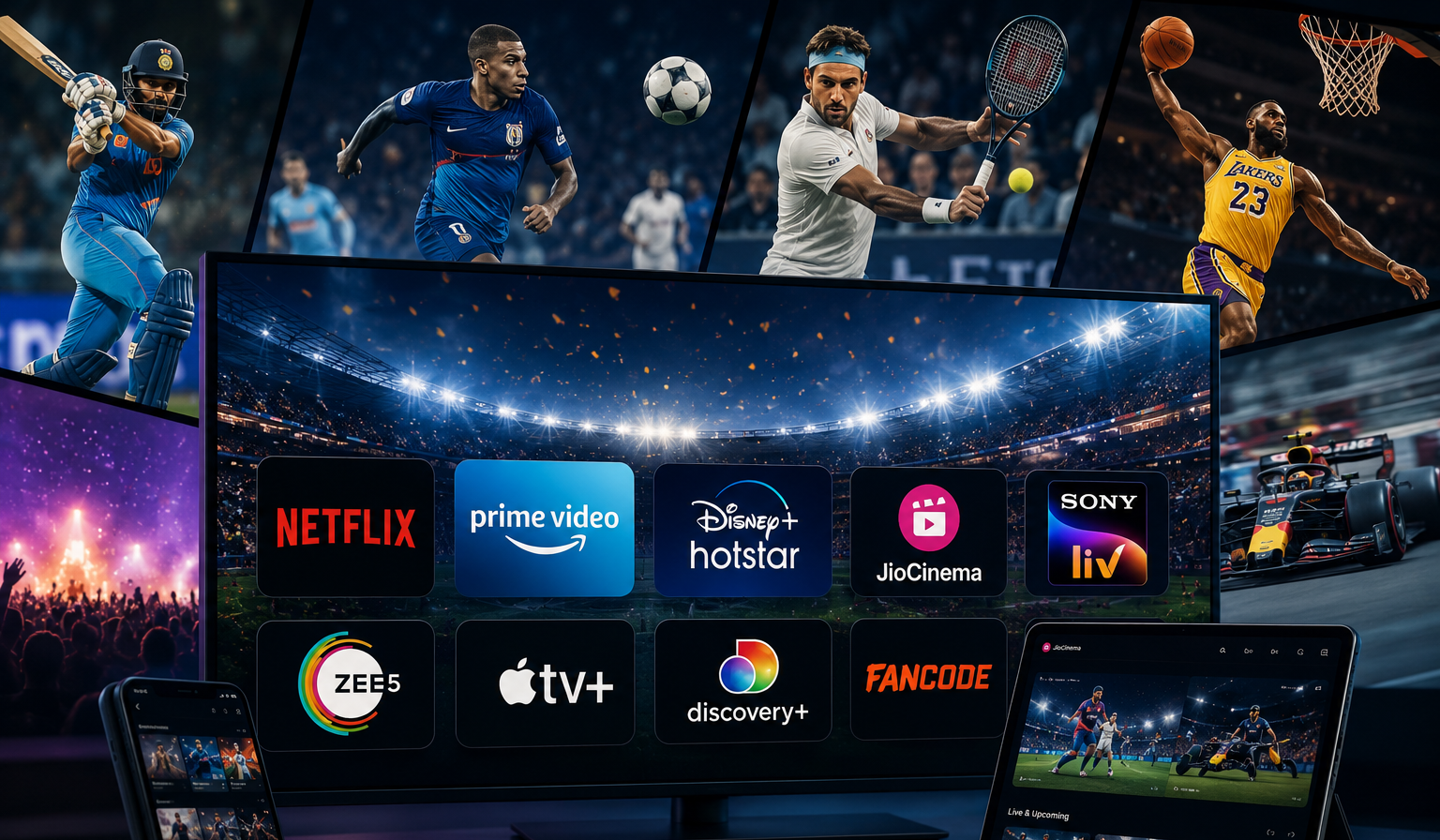
The Fan Caught in the Middle of OTT sports rights
For decades, the biggest sporting events in the world belonged to television networks. The FIFA World Cup, the Olympics, the IPL, the NBA Finals, NFL and Wimbledon — these weren’t just sporting events. They were television events. Today, that reality is changing. But most fans first notice it in a much simpler way.
Think about the last time you tried to watch a big match live.
- Maybe you opened an app you forgot you had.
- Maybe you realised your subscription had lapsed.
- Maybe you found out the game was on a completely different platform than the last one.
You spent ten minutes figuring out where to watch before you watched a single minute of actual sport. That confusion isn’t an accident. It’s the result of one of the biggest business battles happening right now the OTT sports rights— and most people have no idea it’s even going on.
Let’s Start With a Simple Question: Who Owns a Cricket Match?
When the IPL happens, you might assume the BCCI owns it, the teams play it, and anyone can broadcast it. But that’s not how it works anymore. This year as well In India, this shift was felt strongly during IPL 2026 as streaming platforms battled for broadcast dominance.
What actually happens is this: the BCCI holds an auction. Streaming platforms and TV channels come in, make bids, and whoever pays the most gets the right to show those matches to you. They then charge you a subscription, sell ads during the game, and try to make back more than they spent.
In 2022, the BCCI auctioned the IPL’s broadcast rights for the 2023–27 period. The total amount paid? Roughly ₹48,390 crore — about $6.2 billion. That works out to around ₹105 crore per match. For context, the entire 2008 inaugural IPL season was valued at around $1 billion. The same tournament, 14 years later, is worth six times more.
Why? Because platforms like JioHotstar, Amazon, Netflix and Apple have figured out that live sport is the one thing people will pay for without question — and that a cricket fan who subscribes for IPL season rarely cancels their subscription the rest of the year either.
The Merger That Changed Everything in India
Until early 2025, if you wanted to stream IPL in India you used JioCinema. If you wanted Disney content, you used Hotstar. Two separate apps, two separate subscriptions.
Then in February 2025, Reliance and Disney merged their India operations in a deal worth $8.5 billion, creating JioHotstar. One platform. One subscription. And with it — the IPL, ICC cricket, the Premier League, Wimbledon, WWE, all Disney films, Marvel, HBO shows, and Star content. All in one place.
The numbers are hard to wrap your head around: 450 million monthly active users, over 1 billion downloads on the Google Play Store alone, and more than 100 million paid subscribers — the first Indian streaming platform ever to cross that number. To put that in perspective, Netflix has around 300 million subscribers globally. JioHotstar has a third of that just in India.
This is what winning a OTT sports rights auction actually buys you — not just the matches, but the habit of an entire country.
Meanwhile, Globally: Amazon, Netflix and Apple Enter the Room
For most of its existence, Netflix said it would never do live sport. Too unpredictable, too expensive, too different from the on-demand model it was built on.
Then in 2024, it quietly paid about $150 million to stream two NFL games on Christmas Day. Just two games. $150 million. It went well. Now Netflix is deeper into live sport and there’s no going back.
Amazon has been even more aggressive. It already paid $1 billion a year to stream NFL Thursday Night Football in the US. Then in 2025 it signed an 11-year deal with the NBA worth $1.8 billion per season — covering 66 regular-season games, playoffs, and international rights across the US, Mexico, Brazil, and Europe. It also holds Champions League rights in the UK, Germany, and Italy, plus NASCAR, Wimbledon, and the WNBA.
Think about that for a second. Amazon — a company you use to order headphones and track your package — is now one of the biggest sports broadcasters on the planet.
Apple TV+ signed a five-year deal to stream Formula 1 in the US starting in 2026, paying $140 million a year — a big jump from what ESPN previously paid for the same rights.
In total, streaming platforms are expected to spend $14.2 billion on sports rights in 2026 alone. That’s more than the GDP of several small countries, spent entirely on the right to show you games.
The FIFA 2026 Story: The World’s Biggest Event, and Its Messiest Drama
The FIFA World Cup is the most-watched sporting event on the planet. Around 1.5 billion people watched the 2022 final between Argentina and France. Nowhere is this more visible than in football’s biggest event — the FIFA World Cup 2026. The 2026 tournament, hosted across the United States, Canada, and Mexico from June 11 to July 19, will be the biggest World Cup ever: 48 teams, 104 matches, and an estimated $3.92 billion in broadcast rights revenue—roughly 30% higher than the previous edition.
Major markets moved quickly. In the United States, Fox Sports and Telemundo reportedly paid around $1.25 billion for broadcast rights, while the UK continues its long-standing partnership between BBC and ITV. Across Europe, broadcasters account for roughly $850 million of FIFA’s total media-rights revenue. Rights have already been sold in more than 190 countries.
Why India Became FIFA’s Toughest Negotiation
Despite football’s global popularity, India presented a unique challenge. FIFA initially sought around $100 million for the combined 2026 and 2030 World Cup OTT sports rights package. However, broadcasters struggled to justify that valuation.
The biggest issue was timing. Since the tournament is being played in North America, many matches will be broadcast late at night or after midnight in India, reducing potential viewership and advertising revenue. Football’s popularity in India continues to grow, but it still trails cricket by a considerable margin in commercial value.
Reports indicate that JioHotstar valued the rights at roughly $20 million, while Sony Sports and Doordarshan reportedly chose not to bid at FIFA’s original asking price. As negotiations progressed, FIFA reduced its expectations from the initial $100 million to around $60 million, with further discussions continuing as market realities became clear. Eventually, Zee Entertainment emerged as the leading contender for the rights.
The episode reveals an important truth about modern sports broadcasting: while football may be global, media-rights valuations are highly local. A football-first market such as the US or UK can support billion-dollar deals, whereas emerging football markets like India still price rights according to audience habits, advertising demand, and competition from established sports like cricket.
So Why Does This Affect You?
Because every time a platform wins a rights auction, it decides your experience.
- It decides whether the match is free or behind a paywall.
- It decides the commentary language.
- It decides whether you watch in HD or not. Maybe you opened an app you forgot you had. Maybe your subscription had quietly lapsed. Maybe the game had moved to a completely different platform since last time.
- It decides the subscription price.
And since rights are sold country by country, what you get in India is completely different from what someone in London or New York gets — same match, five different platforms, five different prices.
A 2025 study found that 30% of sports fans missed a game they wanted to watch simply because they weren’t subscribed to the right platform. Not because they didn’t want to watch. Not because they couldn’t afford it. Just because the sport they love had moved somewhere they weren’t.
The Bigger Picture
Here’s the honest truth behind all of this.
Platforms aren’t spending $6 billion on the IPL because they love cricket. They’re spending it because a cricket fan who subscribes in March for the IPL is statistically likely to still be paying in December. Live sport creates habits. Habits create subscriptions. Subscriptions create revenue. It’s a business model dressed up in jersey colours.
The NBA deal tripled in value from one cycle to the next. IPL digital rights nearly doubled. FIFA’s broadcast revenue grew 30% from 2022 to 2026. Every number is going in one direction.
The match you’re watching on your phone right now? Someone paid an almost unimaginable amount of money to put it there. And they’re betting — correctly, most of the time — that you’ll keep paying to watch.
The real game isn’t on the pitch. It’s in the boardroom. And unlike the match, it never ends.
Do you think live sport should always be free to watch, or is paying for quality coverage a fair deal? Tell us below.