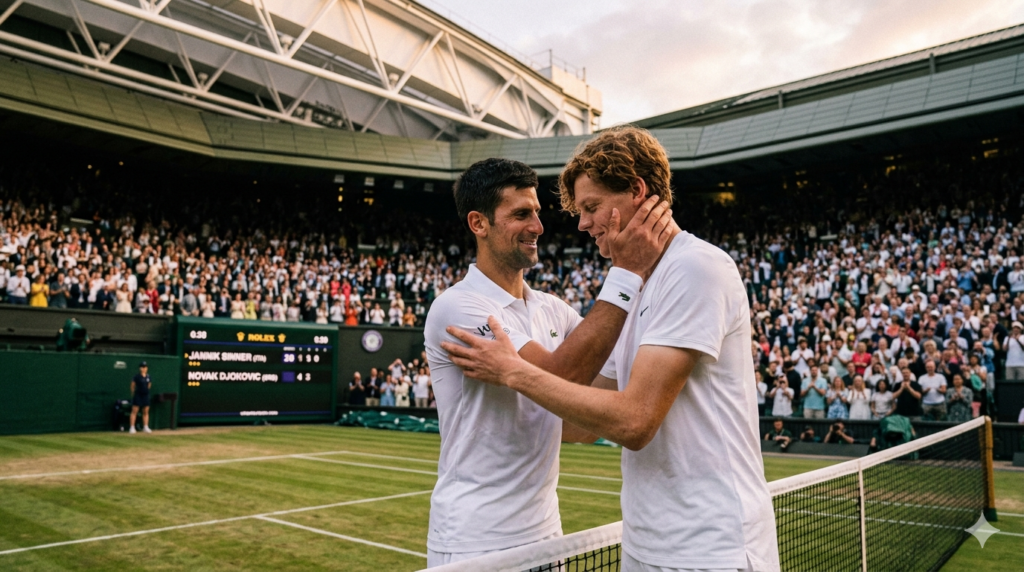
Source: Gemini AI (moment from Wimbledon Semi-final)
Djokovic losing with grace is not a phrase that appears often in discussions of the greatest tennis player in history.
His career has been defined by refusal. Refusal to lose. to accept that the moment was gone. And refusal to let a two-set deficit mean what a two-set deficit normally means. The mental fortress — built in Belgrade’s basements during NATO airstrikes, hardened across two decades of professional tennis — has been the story of his career: the man who made the impossible look like a decision.
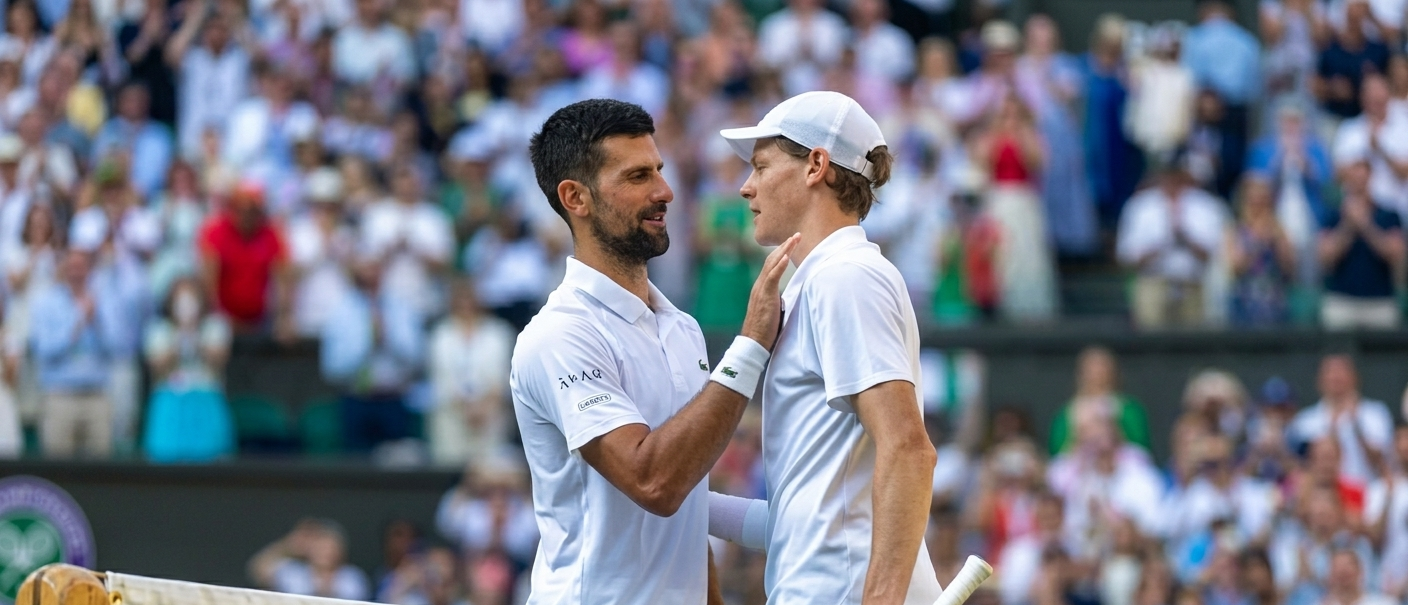
On Friday, July 11, 2026, at Wimbledon, Novak Djokovic lost to Jannik Sinner 6-4, 6-4, 6-4 in the men’s semifinal.
And what happened in the press conference afterward was, quietly, one of the most instructive mindset demonstrations in recent sporting memory.
Not because he lost with dignity — champions losing with dignity is common enough. But because of the specific things he said, and how he said them, and what those things reveal about the relationship with reality that produced 24 Grand Slam titles in the first place.
The First Thing He Said
A reporter asked Djokovic for his assessment of the match.
He did not pause. Or he did not reach for diplomatic language. He described it the way a person describes something they have looked at clearly and decided to call by its real name.
“It was a good old blowout. Nothing much I could do.”
A good old blowout.
Seven Wimbledon titles. Twenty-four Grand Slams. The most decorated men’s tennis player in the history of the sport — and he called his own defeat a blowout. Not a disappointing loss. Not a close match that went the wrong way. A blowout. Because that is what it was.
This matters more than it appears to. Most people — most athletes, most public figures, most humans in any context — apply protective language to their defeats. They speak of factors, of conditions, of what might have been different. They manage the narrative to protect the self-image from the full impact of what just happened.
Djokovic did the opposite. He named it accurately and moved on.
That is not resignation. That is a person whose self-worth is so completely decoupled from the result of a single match that calling it a blowout costs him nothing — because the blowout does not touch the thing that actually matters to him.
“Was, Was”
A reporter raised Djokovic’s legendary return of serve — historically considered the finest in the men’s game. Did it fail him today against Sinner’s unreachable delivery?
Djokovic smiled.
“Was, was,” he said. “That’s the reality.”
Two words. Past tense. A quiet, almost gentle acknowledgment that the thing he was once the best at in the world he no longer is — and a complete absence of grief about it.
Was, was.
Think about what it requires to say that. To be the person who was the best in the world at something — who built a career and a legend partly on that specific quality — and to sit in a press room in front of cameras and journalists and simply say: yes, that era has passed. That is the reality.
No performance of acceptance. No visible grief requiring management. Just the clean, undefended truth of where things stand.
This is one of the most difficult things the ego allows. The ego clings to what it was. It confuses current identity with past achievement. It resists the natural passage of capability as if acknowledging the passage means the past was somehow diminished.
Djokovic’s was, was diminished nothing. It simply told the truth about what is now. The two things — what he was, what he is — can coexist without conflict, without loss of dignity, without the identity being threatened.
“Blessed and Cursed”
When a reporter asked whether reaching the Wimbledon semifinal at 39 — competing at the highest level of professional tennis for the fifteenth time at this stage of this specific tournament — was something he could walk away proud of, Djokovic gave an answer that deserves reading slowly.
“Last year I reached four Grand Slam semifinals. This year, out of three Slams, I reached one final and one semifinal. I guess for 99 per cent of the players, that would be a very good Grand Slam result. For me, it’s good but not good enough, because I’m blessed and cursed to be used to something of a highest degree.”
Blessed and cursed.
The same standard that made him the greatest player in history is the standard that makes a Wimbledon semifinal at 39 feel insufficient. He is not performing false modesty — he genuinely holds himself to a level that most players spend entire careers trying to approach, and in holding himself to that level, even extraordinary achievements feel like something less than what was intended.
This is the double-edged nature of elite standards. The same inner voice that refuses to accept “good enough” when you are winning does not simply switch off when you are losing. It applies the same scrutiny to both. Djokovic has spent his career being harder on himself than any opponent could be — and at 39, losing in straight sets in the Wimbledon semifinals, he is still applying that standard.
Not with self-pity. Not with bitterness. With the honest, almost philosophical recognition that this is what it costs to be the kind of person who achieves what he has achieved.
“Wrong”
Here is where Djokovic losing with grace gets complicated — and more interesting.
A reporter began a question by suggesting that Djokovic seemed “more competitive this year than last year.”
Djokovic interrupted.
“Wrong.”
The reporter continued. Djokovic responded: “I just said you’re wrong. I don’t agree with your opinion. As I am always competitive. And I always give my best under the circumstances. Sometimes it looks from outside more, sometimes less. But only I know what I go through internally and what it takes to be able to still play at this level.”
This single exchange contains an important distinction that the phrase “losing with grace” can obscure if it is misread.
Losing with grace does not mean accepting every characterisation of the loss. It does not mean performing humble compliance with whatever narrative the room constructs. Djokovic’s grace in defeat is not softness — it is precision. He accepts what is true about the result: he lost, he was outplayed, it was a blowout, Sinner was better. These things are true and he says them clearly.
But he refuses to accept what is not true: the suggestion that his competitive spirit varies, that some days he brings less than his full self, that the effort level has been inconsistent. That is the reporter’s impression, not the reality — and Djokovic corrects it. Politely. Firmly. Immediately.
Grace in defeat is not passivity. It is the precise acceptance of what is real, combined with the precise rejection of what is not.
“I Just Lost to a Better Player”
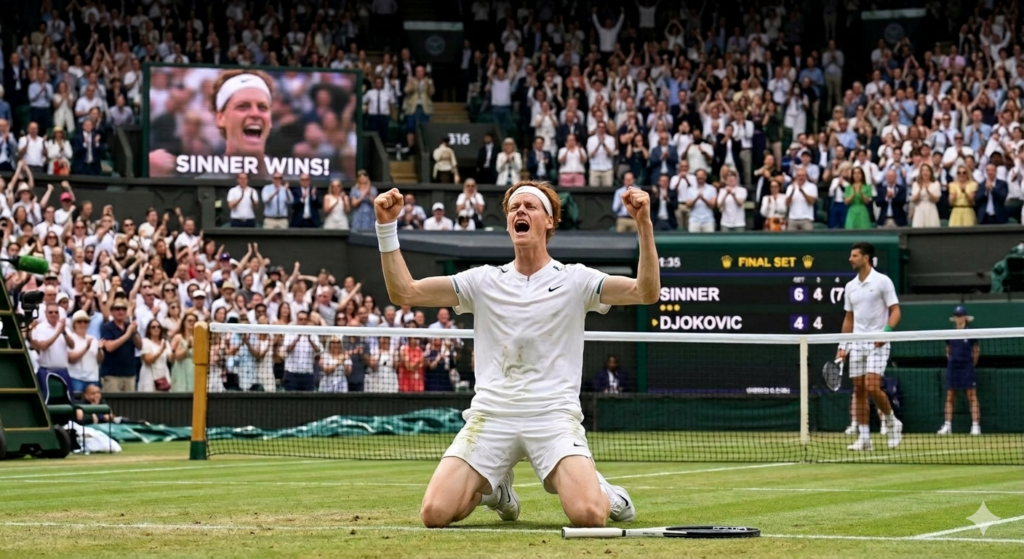
Source AI: Jannik Sinner’s win against Novak Djokovic in Wimbledon Semi-finals.
The cleanest line in the entire press conference came near the end.
“Of course I’m disappointed. Of course I wanted to win Wimbledon. That’s the reason why I’m still pushing myself so hard. I just lost to a better player. I have to accept it.”
Six sentences. No hedging, management And no narrative construction designed to protect the ego from the full weight of what happened.
Disappointment acknowledged. Desire acknowledged. The reason for continuing acknowledged. And then: I just lost to a better player.
Not a better player today. Neither a better player in these conditions. Not a better player given where I am in my career. A better player. Full stop. A clean, unqualified acknowledgment that on Friday at Wimbledon, Jannik Sinner was the superior tennis player.
The ego resists this sentence. Rather it wants qualifiers. The ego wants context, explanation, the comfort of circumstances that soften the comparison. Djokovic’s ego — forged across twenty years of being the best in the world — produces none of that.
He looks at the result, names it accurately, and moves on.
The ATP Tour’s full report of Djokovic’s post-match press conference captures the complete exchange — and what strikes any careful reader is the consistency of tone. From the first question to the last, Djokovic speaks from the same place: clear-eyed, honest, neither inflated nor deflated by what just happened.
One More Time
At the very end of the press conference, a reporter asked whether Djokovic would return to Wimbledon next year, as a 40-year-old.
“I would like to. At least one more time. Let’s see.”
At least one more time.
Not a declaration of intent. Not a performance of determination for the press room. A quiet, honest statement of what he wants — the openness of “let’s see” sitting beside it, acknowledging the uncertainty without being consumed by it.
The man who has won more Grand Slam titles than anyone in history, sitting in a press room after being beaten in straight sets, says he would like to come back. Not out of denial — he just called the match a blowout. Not out of ego — he just said someone was better than him. Out of something simpler. He still loves playing. And still wants to compete. He would like, at least one more time, to walk onto Centre Court.
That is grace. Not the absence of ambition — the presence of it, stripped of everything that is not genuine.
What Djokovic Losing With Grace Actually Teaches Us
There are five things in that press conference worth carrying away from the Wimbledon fortnight:
Name the reality accurately. “Good old blowout.” Not spin. Not protection. The actual description of what happened. Accurate naming is the beginning of genuine acceptance — and it costs nothing when the self-worth is not tied to the result.
Let the past be past. “Was, was.” The thing you were best at does not need defending once it has moved into history. It was real. It happened. The present is different. Both can be true without either cancelling the other.
Hold your standard and your acceptance simultaneously. “Good but not good enough.” The standard does not lower in defeat. The acceptance of what happened does not require abandoning the level at which you hold yourself. Both can coexist.
Reject false narratives with precision. “Wrong.” Grace is not compliance. It is accuracy. Accept what is true about the loss. Reject what is not — clearly, directly, without apology.
Want what you actually want. “At least one more time.” Not what the press room expects you to want. Not the performance of ambition or the performance of graceful retirement. What you actually want, stated simply, with the honesty of someone who has stopped performing anything.
Most people never lose at the scale Djokovic does — publicly, on the largest courts in the world, with the weight of records and history and expectation pressing on every match.
But the psychological challenge he navigates is not unique to his scale. It is universal.
The job application that did not work out. The business that did not grow the way you planned. The relationship that ended differently from how you imagined. The version of yourself you worked toward that has not yet arrived.
How you speak about those losses — to others, and more importantly to yourself — is the Djokovic question. Do you reach for protective language, for qualifiers, for circumstances that soften the reality? Or do you look at it clearly, name it accurately, take what it tells you, and continue?
Djokovic at 39 shows what the second option looks like in practice. Not as performance. Not as wisdom performed for a press room. As the natural expression of a person who has been in honest relationship with reality for so long that the relationship has become effortless.
He said he lost. And he explained why. As he wanted to come back.
Then he left the room.
Psychology Today’s research on resilience consistently identifies accurate perception of reality — not optimism, not positivity, not reframing, but honest acknowledgment of what is — as the single most reliable predictor of recovery and continued performance after setback. Djokovic’s press conference is a masterclass in exactly that quality.
Losing with grace is not about performing dignity. It is about seeing clearly — what happened, why it happened, and what remains true regardless. Djokovic at 39 saw clearly. That is the lesson.
The connection between clear perception and consistent performance