Greatest Stories Series — Vol. 07
On the night of March 24, 1999, an eleven-year-old boy was running through the streets of Belgrade.
He had fallen flat on his face on the pavement. His parents were just ahead, carrying his younger brothers. And above him, a steel-grey triangle of an F-117 bomber had appeared over the roof of his building. It dropped two laser-guided missiles directly overhead and struck a hospital a few streets away.
The whole city glowed, he would write later, like a ripe tangerine.
That night was the first of seventy-eight consecutive nights of NATO air strikes on the Serbian capital. The boy’s mother, Dijana, was knocked unconscious when the blast threw her head against a radiator. His father, Srdjan, steadied her. And Novak — the oldest child, eleven years old — went through the pitch-black apartment looking for his brothers.
He found them.
That image — a boy of eleven, in the dark, taking responsibility for his family’s safety while the windows shook and the city burned — explains more about Novak Djokovic than any match statistic ever could.
He grew up to win 24 Grand Slam titles. The most in the history of tennis. The most by any man who ever played the game.
He did not come from nowhere. He came from somewhere much harder than nowhere. And what that somewhere made of him is the most extraordinary origin story in the history of sport.
The Boy Who Declared It at Seven
Before the bombs. Before any of it.
In 1994, a seven-year-old boy appeared on Serbian television. He was small, dark-haired, serious in the way that children are sometimes serious before the world teaches them to perform otherwise. The interviewer asked him what he wanted to become.
He did not hesitate.
“My goal in tennis is to be champion.”
Not to try. Not to see how far he could go. To be champion. At seven. On national television. In a country that was already falling apart around him.
His coach, Jelena Gencic — a former Yugoslav champion who had also coached Monica Seles — had spotted something in him at four years old when he first picked up a racket. She called it, simply, genius. Moreover, she kept that assessment to herself for years. She did not want the word to distort what it was growing into.
His family ran a pizza restaurant in the mountain resort of Kopaonik. His father, Srdjan, had been a skier. Nobody in his family had played tennis before. The sport had found Djokovic, not the other way around — a racket, a television screen, a four-year-old who saw something and knew.
He trained every day. He had been training every day since he was four. By seven he was ready to tell the world.
The world would not be ready for him for another decade. He showed up anyway.
Training in the Ruins
When the bombs fell in 1999, Djokovic was twelve.
His coach Gencic kept him training through all seventy-eight nights of the campaign. She chose practice locations based on where the bombs had fallen most recently — calculating that NATO planes were unlikely to hit the same site twice. Each day they found a new court, a new wall, a new surface. Each night the city shook.
His family queued at five in the morning to buy bread. Once he stood in those lines with his grandfather as a normal childhood memory — the same way other children remember school trips or summer holidays.
He has said that even today, loud sounds fill him with fear. And he has said that the sandy, dusty, metallic smell of the air during those nights stayed with him for years. He has said that he was horrified. Helpless. That he could not understand why big countries bomb small ones. That the anger from those years fuelled him in ways he is still making sense of.
And then he has said something that deserves reading slowly.
“We decided to stop being afraid. After so much death, so much destruction, we simply stopped hiding. Once you realise you are truly powerless, a certain sense of freedom takes over.”
Powerlessness as freedom. Fear as fuel. Rubble as foundation.
That is not a quote from a self-help book. That is a twelve-year-old boy’s honest account of what it felt like when the external world removed every illusion of control — and what he found on the other side of that removal.
He found that the one thing nobody could bomb was his intention.
The Twenty-Five Percent Loan
After the NATO campaign ended, an opportunity arrived. A junior tournament in the United States. The kind of exposure that could change a career.
The Tennis Federation of Serbia could not fund the trip. His family could not fund the trip. The ticket and costs came to five thousand dollars — a sum the Djokovics simply did not have.
Srdjan Djokovic went to borrow it.
Not from a bank. Banks in late-1990s Serbia did not extend credit to families without collateral, and the Djokovics had nothing to offer. So Srdjan went to the people who lent money under those circumstances. People who did not need collateral. People who had their own methods of ensuring repayment.
The interest rate, he was told, was fifteen percent. But because you are in a rush, it is twenty-five.
Srdjan accepted the terms.
Djokovic has described what followed — car chases through Belgrade, men coming to collect the debt, his father navigating situations he kept from his son for years. Srdjan did not want Novak to carry the weight of knowing what the trip to America had actually cost.
The debt was repaid. The trip happened. The career followed.
That five-thousand-dollar loan, borrowed at twenty-five percent from people with no patience for default, funded the beginning of the greatest tennis career in history.
CNN’s 2019 profile of Djokovic captures his own words about those years: “I know what it feels like being without anything more or less, and then being on top of the world in this very global and popular sport. So this contrast gives me the right perspective in life.”
The Rivalry That Defined an Era
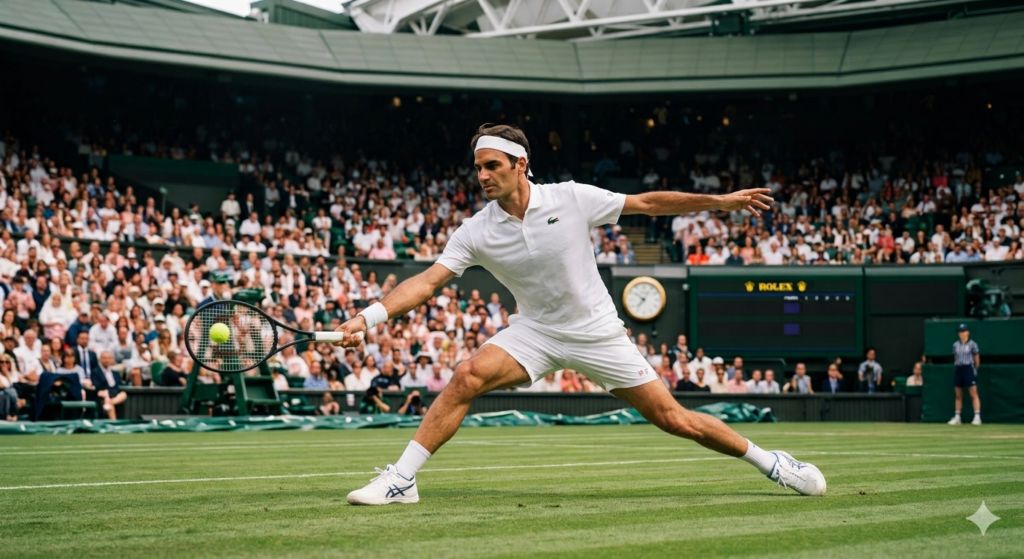
Djokovic arrived in professional tennis in the shadow of two of the greatest players who ever lived.
Roger Federer was the poet — effortless, elegant, the universal favourite. Rafael Nadal was the warrior — relentless, physical, impossible to break. Between them they had won everything. The tennis world had organised itself around the assumption that these two men would share the sport’s highest honours indefinitely.
Djokovic refused the assumption.
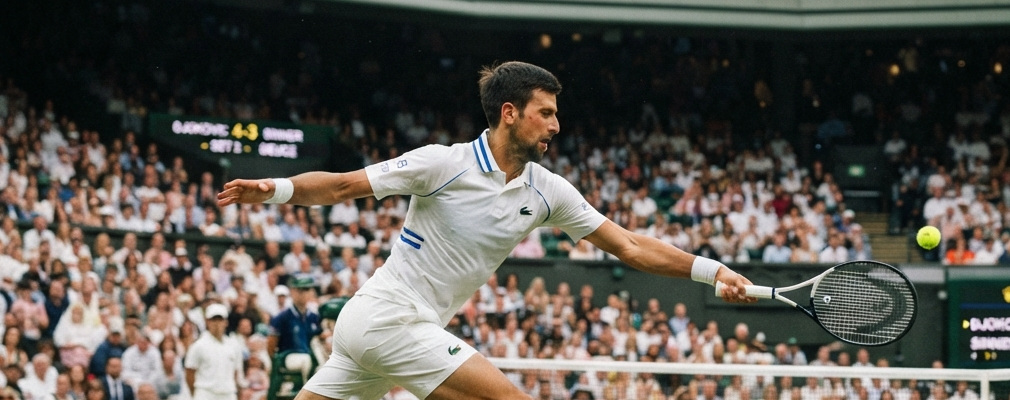
He did not win by being Federer or win by being Nadal. He won by being something neither of them were — a defensive genius with offensive power, a physical machine with a mental architecture that his opponents spent careers trying to crack and never fully did.
His body bending into positions that defied anatomy. Also, his retrieval of balls that had been written off by every watching eye. His return of serve — the most lethal in the history of the game — that turned his opponents’ greatest weapon against them.
And underneath all of it: the fortress.
The mental fortress that Djokovic constructed during those nights in Belgrade — in a cold basement while bombs fell — became the single most discussed psychological asset in the history of professional tennis. He has spoken about it in terms that strip away the sports psychology language and get to something rawer: fear, converted. Anger, channelled. The understanding, built at twelve, that the external world cannot reach the place where your intention lives.
His opponents knew the fortress was there. They could not find a way through it.
The Records Nobody Thought He Would Break
Federer had eight Wimbledon titles. The number felt permanent. Sculptural. Something that belonged to the sport’s landscape so completely that imagining it exceeded seemed almost impolite.
Djokovic tied it. Then exceeded it. Seven Wimbledons. Nine Australian Opens. Three French Opens. Three US Opens.
Twenty-four Grand Slam titles. A number nobody in the history of the sport had reached.
He broke every significant record tennis offered. And he broke most of them in the face of public sentiment that — in its most honest moments — wanted him to lose. The sport’s audience loved Federer’s elegance and Nadal’s passion. Djokovic’s excellence was harder to love because it had fewer obvious aesthetic concessions. He did not glide. Rather he ground. He did not perform beauty. While he produced results.
The results were the greatest in the history of the game.
Wimbledon 2026: “He Was a Level Above”
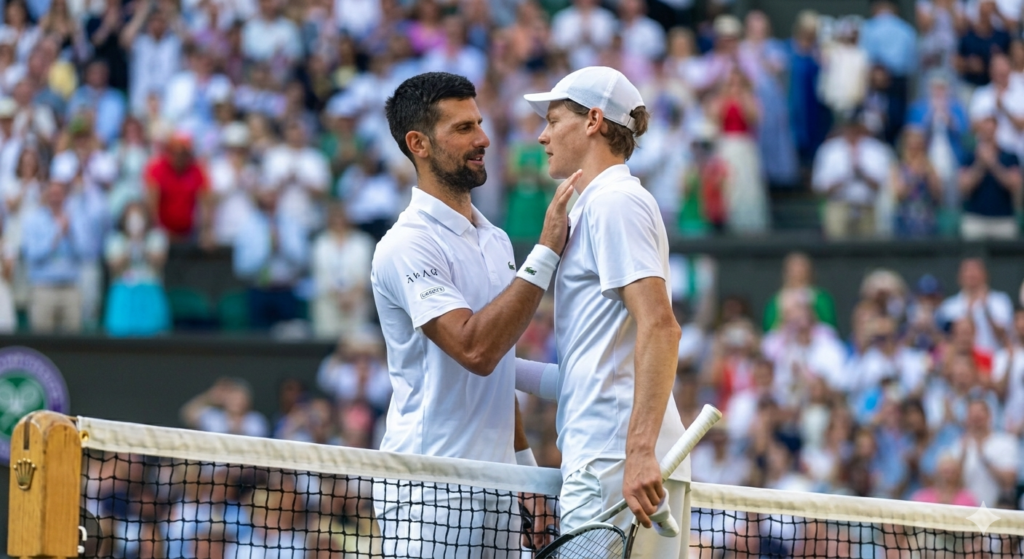
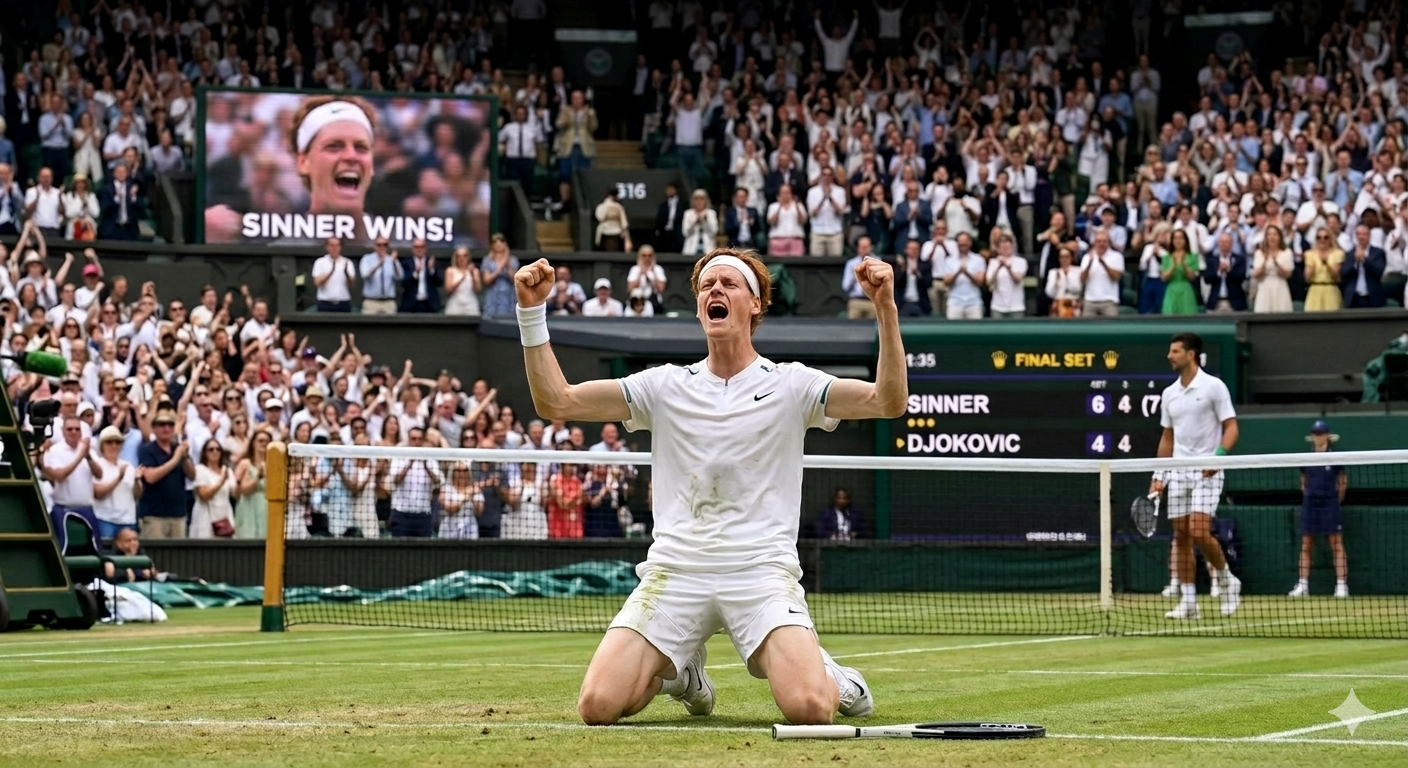
On Friday, July 11, 2026, Djokovic walked onto Centre Court at Wimbledon for the men’s semifinals. He was 39 years old. He was the seventh seed. Across the net stood Jannik Sinner — 24 years old, the world number one, defending the Wimbledon title he had won the previous year.
Sinner won 6-4, 6-4, 6-4. In two hours. Clinical, ruthless, unreachable.
At his post-match press conference, Djokovic said the thing that all the greatest champions eventually say — the thing that separates the people who were truly great from the people who were merely successful.
He said it simply, without deflection, without excuse, without the performance of graciousness that lesser competitors manage when they lose.
“He was the much better player on the court and was the dominant force. You just have to hand it to him and say: Congrats, well done. I mean, he was playing so solid from all ends. He’s as solid as anyone really from back of the court. That’s it.”
That’s it.
Two words that carry the full weight of what it means to accept the reality of a moment without distorting it to protect the ego. A 39-year-old man who has won more Grand Slam titles than anyone in history, looking at the young player who just beat him cleanly, and telling the truth about it.
That is not resignation. Not defeat of spirit. That is a man who has spent his entire life in honest relationship with reality — who learned in a Belgrade basement at twelve years old that the truth of a situation, however hard, is always more useful than a comfortable fiction.
He accepted it. And he said it clearly. He left the court.
The fortress was not broken. It bent, in this match, to someone better on this day. That is what fortresses that last are allowed to do.
The Mindset Map in His Story
1. Fear Converted Is the Most Powerful Fuel Available
Djokovic has been explicit about this. The anger and fear from Belgrade did not make him damaged. They made him hungry in a way that comfortable childhoods rarely produce. He channelled them — deliberately, consciously, over years — into the one domain where he had complete agency.
You cannot always choose your circumstances. You can choose what you do with what they produce in you.
2. Powerlessness Can Produce Freedom
The moment Djokovic’s family decided to stop hiding was not a moment of courage performing itself for an audience. It was the natural outcome of reaching the limit of what control was available. When there is nothing left to protect against, the energy previously spent on protection becomes available for something else.
This is the counterintuitive truth at the heart of his story. The bombs did not make him helpless. They taught him, at twelve, that he had been spending energy on the illusion of safety — and that the energy was better directed elsewhere.
3. The Fortress Is Built in the Difficult Seasons, Not the Good Ones
Djokovic’s mental strength — the thing his opponents spent careers trying to breach — was not built during his victories. It was built during the nights in Belgrade. During the bread queues. During the years when his family borrowed money at twenty-five percent from people who did not accept late payments.
What you build in the difficult seasons is what holds when the stakes are highest. The fortress is not the achievement. It is what made the achievement possible.
4. Accepting Reality Is a Form of Strength
The press conference after the 2026 Wimbledon semifinal is a masterclass in something that competitive culture rarely models honestly: the clean, ego-free acknowledgment that on this day, someone else was better.
Not “I had a bad day.” or “the conditions weren’t right.” Not “I wasn’t fully fit.” Sinner was better. That’s it.
The willingness to see reality clearly — without the distortions that ego introduces to protect itself — is not weakness. It is the same quality that allowed Djokovic to build an unprecedented career. The same clear-eyed relationship with truth that made him the greatest player in history makes him capable of acknowledging the moments when someone exceeds him.
Both come from the same place.
5. Age Is Not the Limitation — Unwillingness to Adapt Is
At 39, Djokovic is still competing at the highest level of the most physically demanding sport in the world. He reached the Wimbledon semifinals. He is still a threat on every surface at an age when most professional athletes have been retired for a decade.
The reason is not that he has avoided the physical realities of aging. It is that he has adapted to them with the same rigorous attention he has always brought to his game. His serve technique has changed. And his recovery protocols have evolved. His selection of tournaments has become more strategic.
He has stayed competitive not by refusing to change but by changing everything that can be changed and protecting everything that cannot.
The ATP Tour’s official Djokovic profile documents the full statistical record — 24 Grand Slam titles, 99 ATP singles titles, and 428 weeks as world number one, the most of any player in history.
A Final Thought
At seven years old, on Serbian national television, Novak Djokovic told the world he would be champion.
When twelve, bombs fell outside and he kept playing tennis.
At fourteen, his family borrowed money at twenty-five percent from people with no patience for default to fund a junior tournament in America.
Age thirty-six, he broke every record that tennis offered.
At thirty-nine, he sat in a press conference at Wimbledon and told the truth about being beaten by a better player — with the same directness and the same absence of ego that has defined every significant moment of his life.
The fortress held. It bent on Friday. It held.
That is the Djokovic story — not the trophies, not the records, not the matches that every highlight reel reduces him to. The story is the boy in the dark Belgrade apartment, in the pitch black, looking for his brothers. Finding them. And deciding, in that moment and every moment that followed, that what was inside him was not available to be destroyed by anything that came from outside.
They bombed the city. They could not bomb the intention.
He built the greatest career in tennis history from what was left.
The circumstances you were given do not determine the person you become. What you choose to do with those circumstances — in the dark, when nobody is watching, when everything around you is falling apart — that determines it. Djokovic chose. Every single day. From the ruins.
Quick Recap — Djokovic’s Five Lessons
| Lesson | What it means in practice |
|---|---|
| Fear converted is powerful fuel | The hardest experiences, channelled deliberately, produce extraordinary drive |
| Powerlessness can produce freedom | When control is impossible, the energy previously spent on it becomes available |
| Fortresses are built in difficult seasons | Mental strength is a product of hard times navigated, not avoided |
| Accepting reality is strength | Clear-eyed acknowledgment of truth — including defeat — is the same quality that produces greatness |
| Adapt everything that can be adapted | Longevity comes from rigorous evolution, not refusal to change |
Read Next in Greatest Stories Series: [Mbappé — The Boy From Bondy] · [Jude Bellingham — The Kid From Stourbridge] · [Lionel Messi]