It does not appear in the travel guides. It is not where the Eiffel Tower is, not where the museums are, not where the world pictures Paris when it closes its eyes. Bondy is a banlieue — one of the ring of working-class suburbs that surround the city, home to generations of immigrant families who came to France from Africa, from Algeria, from Cameroon, building a life at the edges of one of the world’s most celebrated cities.
Kylian Mbappé was born to that edge. His father, Wilfried, had come from Cameroon. His mother, Fayza, was of Algerian descent. They raised their son in Bondy, where his father coached the local club — AS Bondy — and where a boy with impossible speed began doing things with a football that made his coaches stare at each other quietly.
He was not supposed to go where he went.
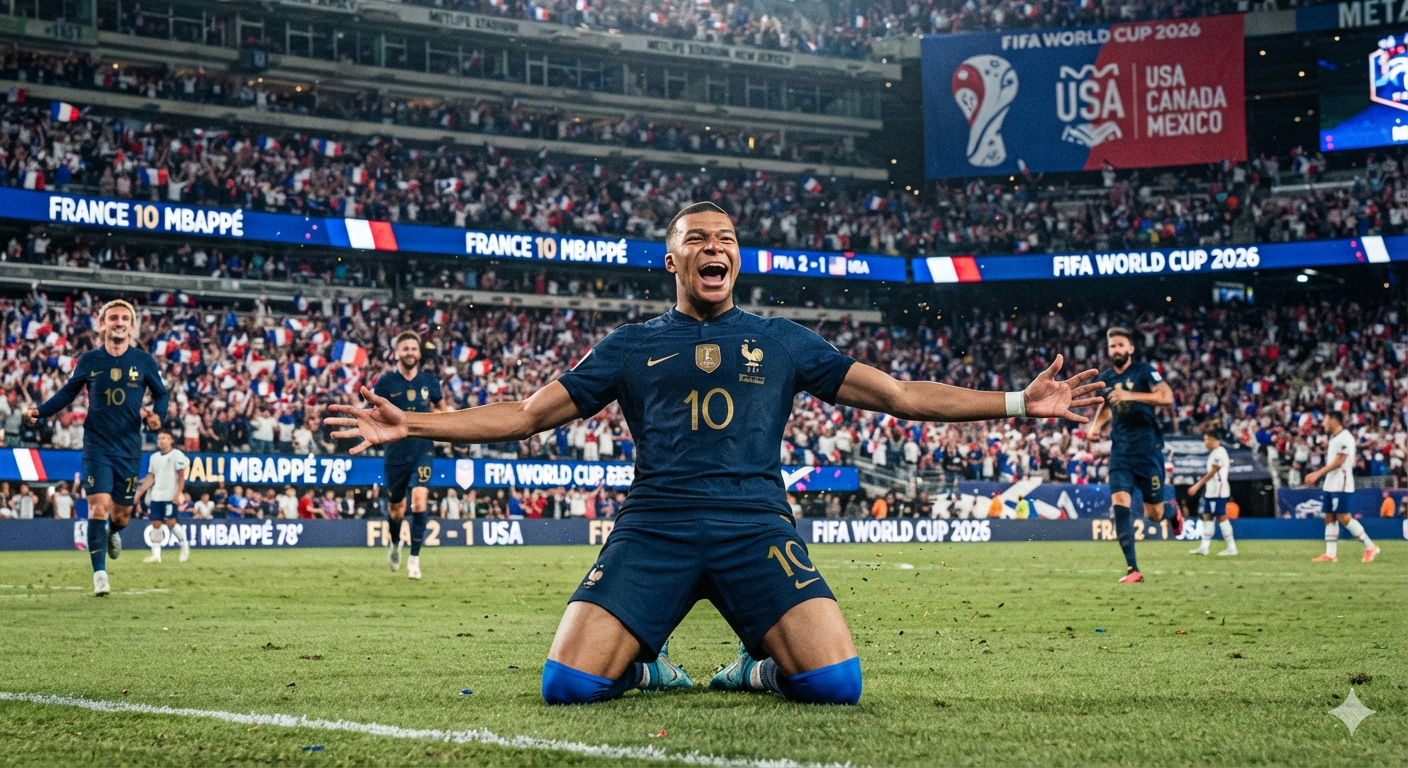
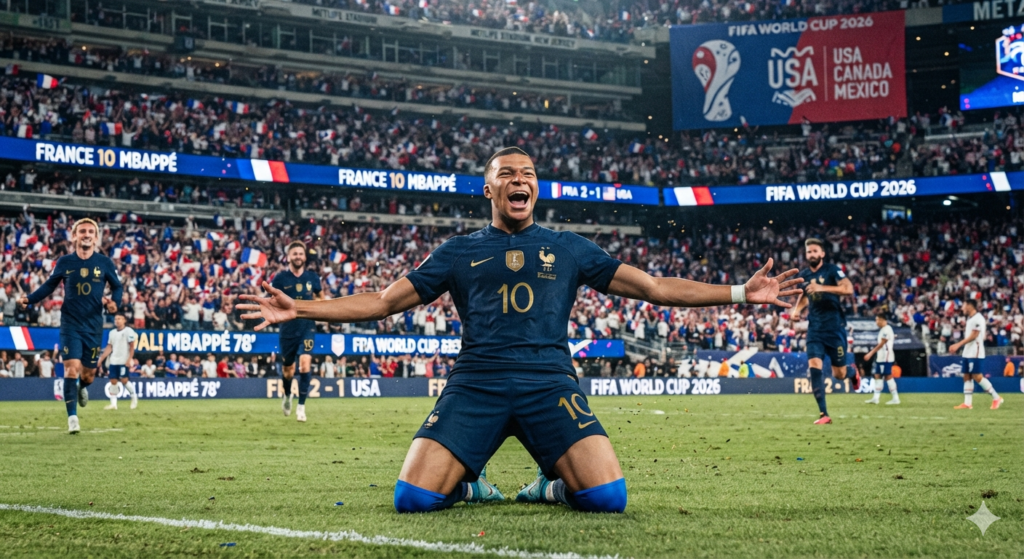
He went there anyway. And in July 2026 — at 27 years old, at his third World Cup, wearing the captain’s armband of France — he became his nation’s all-time leading goalscorer.
The boy from Bondy carried a nation. He is still carrying it.
The Speed That Changed Everything
There are players who are fast. And then there is Mbappé.
His speed is not simply a physical attribute. It is a tactical event. When Mbappé receives the ball in space, the geometry of the entire game changes — defenders calculate distances differently, full-backs stop making overlapping runs, coaches build entire game plans around the single question of what happens when he gets behind you.
He was doing this at Monaco at 17. When he broke out during the 2016-17 season, the footballing world quickly realised they were witnessing something different — he was not simply another promising winger with pace. He had a certain gravity that could alter the emotional state of defenders.
At 18 he helped Monaco reach the Champions League semifinals. At 19 he won the World Cup with France in Russia, winning the tournament’s Best Young Player award and scoring the goal that sealed the title against Croatia.
Not some day. Now. At 19.
The second-most-expensive transfer in football history followed — €180 million to Paris Saint-Germain. The boy from Bondy had a price tag larger than most countries’ football budgets.
He did not flinch.
Seven Years at PSG: Building the Foundation
At PSG, Mbappé did something that elite young talent rarely does cleanly — he grew without losing himself.
He became the club’s all-time top scorer, finishing with 256 goals. In his second season he finished as Ligue 1’s top goalscorer for the first of a record six times, and earned his first of a record five Ligue 1 Player of the Year awards. He won seven French league titles. He carried PSG to their first Champions League final. He scored more goals for more consecutive seasons than anyone in the history of French football.
And then, in 2024, he did the thing that surprised everyone.
He left for free.
Not for more money. Not for a bigger contract. For Real Madrid — the club he had dreamed of as a child in Bondy, the club that had tried to sign him when he was 14 and training at Clairefontaine. He walked away from PSG’s offer of a renewal worth hundreds of millions and joined the club that represented, for him, the purest version of what football was supposed to be.
Some decisions are financial. Some are identity.
His was identity.
Encyclopaedia Britannica’s profile of Mbappé documents his full career arc — from Bondy to the Bernabéu — and captures how consistently he has been described not just as a footballer but as a cultural figure representing modern, multicultural France.
Real Madrid: The Weight of Number 10
In his first season at Real Madrid, Mbappé scored 31 La Liga goals across 34 matches, winning both the Pichichi Trophy and the European Golden Shoe — his first in either award. He also became the second-highest Champions League scorer of all time with 50 goals in the competition.
By any measure, those are extraordinary numbers. A new club, a new league, a new language, a new city — and he finished as La Liga’s top scorer in his debut season. Real Madrid awarded him the number 10 shirt the following season, the shirt of Zidane, of Modrić — a symbolic gesture that carries weight at a club that understands symbolism.
And yet.
The questions kept coming. Real Madrid failed to win a major trophy during that span, and questions arose around Mbappé’s overall fit within the squad. His defensive contribution was compared unfavourably to former Real Madrid forwards whose relentless pressing had become part of the club’s identity.
Individual excellence. Collective questions. The loneliest kind of pressure.
“I did everything I could at Real Madrid,” he told the media during the 2026 World Cup — pointing to his last season with the club in which he was again the team’s top goalscorer, and acknowledging honestly that maximum individual output does not always produce collective results.
That honesty is the mark of someone who has stopped performing for the outside world and started speaking from the inside one.
The World Cup 2026: Still Becoming
And then the tournament started.
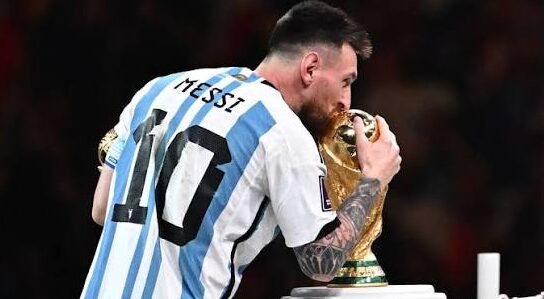
At the 2026 World Cup, Mbappé became France’s all-time top goalscorer. He scored his 19th career World Cup goal — one behind Lionel Messi — and fired France past Paraguay with a penalty to seal their place in the quarterfinals.
He is no longer the young prodigy from 2018 playing without pressure. In 2026 he arrives as the superstar expected to carry France — a different weight, carried by a different person than the teenager who lifted the trophy in Moscow.
He is 27. France expects a second World Cup. The world expects more than individual excellence. And Mbappé — the boy from Bondy who was never supposed to carry all of this — is carrying it anyway.
Not because it is easy. Because it is his.
The Mindset Map Hidden in His Story
1. Where You Start Is Not Where You’re Going
Bondy is not the Bernabéu. The distance between them is not measured in kilometres. It is measured in what you decide to do with what you have, in a place that the world is not watching, before the world knows your name.
Mbappé’s father coached a local club. His mother drove him to training. Nobody was handing him anything. The talent was real — but talent without the environment that nurtures it remains potential, not achievement.
He made the most of Bondy before he left it. That is the first lesson. You do not get to start somewhere better. You start where you are and build the next place from there.
2. Leave When It’s Time
The PSG years were historic. They were also a ceiling — one that was never fully spoken aloud but was real. The biggest trophies, the stages that define legacies, were not there.
He left. On a free transfer. Against the financial logic of every agent’s spreadsheet.
The lesson is not “always leave.” It is: know the difference between comfort that has become a ceiling and difficulty that is building a floor. Mbappé knew the difference. He chose the floor — the parallel of choosing a harder path that belongs to you
3. Individual Excellence Is Not Enough — and That’s Not a Failure
The most honest thing about Mbappé’s story in 2025 and 2026 is that his individual numbers have been elite and his team’s collective results have been questioned. He has been the most productive player on his club and his country has still demanded more.
This is a condition of carrying something bigger than yourself. The scrutiny belongs to the role, not to the performance.
The lesson: give everything you have to the collective. Know that your individual excellence is necessary but not sufficient. And keep going anyway — because the alternative is to shrink, and shrinking is the one thing a person from Bondy with something to prove was never going to do.
4. Carry the Origin, Don’t Escape It
Mbappé is one of the most celebrated athletes in France. He is also a Black man from an immigrant family in a suburb that France has historically treated as peripheral. And he has never pretended otherwise.
He has spoken about what it means to come from the banlieues. Returned to Bondy. He has carried the weight of representing something larger than football — a version of France that doesn’t always see itself in the national team’s success until someone from a place like Bondy wins the World Cup and brings it home.
His success in international play made him a star in his home country, particularly in the banlieues where he grew up. Your origin is not a liability. It is the material of your story. The more specifically you come from somewhere, the more completely you represent the people still there.
5. The Pressure Is the Point
At 19, Mbappé had already won the World Cup. Everything since has been measured against it — which means he has spent eight years performing in the shadow of his own peak moment, for a public that remembers it and a country that wants another one.
Most people would shrink from that. The sophomore pressure, the expectation hangover, the inability to be a beginner again because you already peaked publicly before you were old enough to vote.
Mbappé has not shrunk. He has leaned into it. Moreover, he enters the 2026 FIFA World Cup with something to prove — and the difference is that he is no longer the young prodigy playing without pressure. He arrives as the superstar expected to carry France.
That is not a burden. That is the destination. The person who can carry that weight — the expectation, the history, the nation — is not the same person who left Bondy at 14. He was built into that person by the pressure itself.
The pressure was the training ground. It always is.
He did not run from what was expected of him. He grew into it. That is what great stories are made of — not the absence of weight, but the decision to carry it standing up.
Somewhere in Bondy right now, there is a child kicking a football against a wall.
They do not know Mbappé grew up near them. Or they do know, and they know it differently now — not as a fairy tale, but as evidence. Evidence that the distance between this wall and the world’s biggest stages is a real distance, yes. But one that has been crossed. By someone from here. On foot.
That is what the greatest stories actually do. They don’t just entertain the people who watch from a distance. They recalibrate what is possible for the people who started in the same place.
Mbappé did not become France’s greatest goalscorer despite where he came from. He became it because of who he chose to be in the place where he started.
The banlieue was not the obstacle. It was the foundation.
Rooted in Bondy. Limitless on every pitch in the world.
Quick Recap — Mbappé’s Five Lessons
Lesson
What it means in practice
Where you start is not where you’re going
Build from what you have, not what you wish you had
Leave when it’s time
Distinguish comfort-ceiling from difficulty-floor
Individual excellence serves the collective
Give everything — knowing it’s necessary but not sufficient
Carry the origin
Specificity of background is strength, not liability
The pressure is the training ground
Great people don’t avoid weight — they grow into it
Greatest Stories Series — Vol. 08 Jannik Sinner’s greatest story does not begin on a tennis court. It begins in San Candido — a town of four thousand people in
Greatest Stories Series — Vol. 04 Before the battle begins, there is a moment. The two armies face each other across the field of Kurukshetra. Thousands of warriors on each