

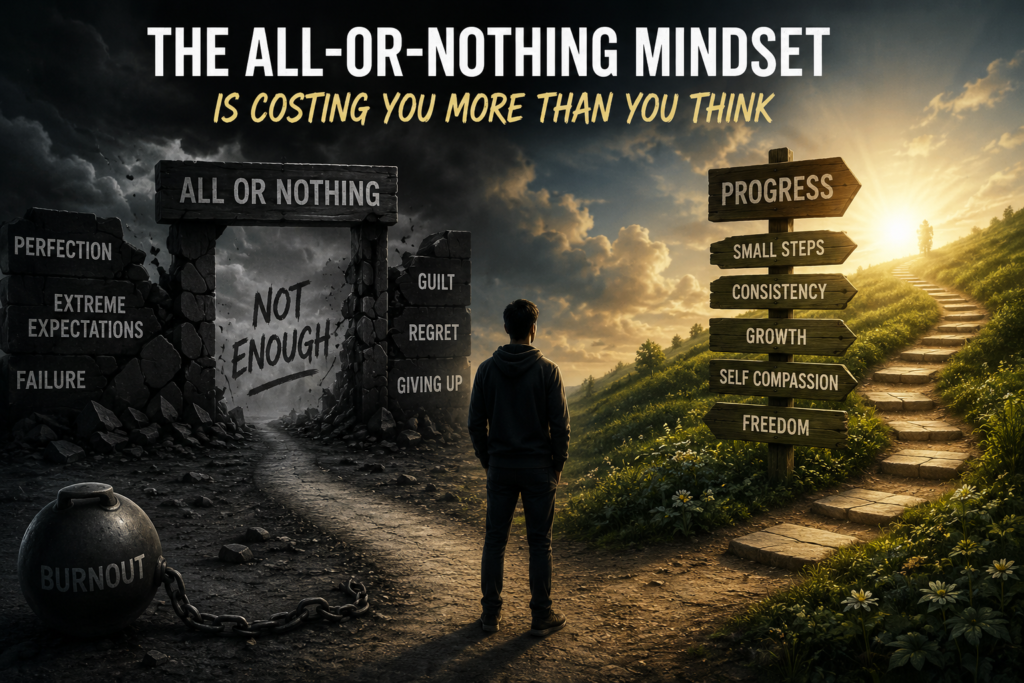
It starts with a skipped day.
The workout that didn’t happen. The meal that went off-plan. The morning routine interrupted by something outside your control. The study session that got swallowed by a bad afternoon.
One missed day. That’s all.
And then, instead of picking up where you left off the next morning, something else happens. A voice — quiet but insistent — delivers its verdict: You already broke the streak. The week is ruined. You might as well wait for Monday. Wait for next month. Wait for a clean start that actually works.
And so you wait, the clean start keeps moving forward. Also, the weeks compound into months of waiting for conditions that never quite arrive.
This is the all-or-nothing mindset. And it is one of the most expensive thinking patterns a person can carry — not because it asks too much, but because it quietly delivers nothing.
Why It Feels Like Discipline But Isn’t
The all-or-nothing mindset disguises itself as high standards. That’s what makes it so persistent and so difficult to examine honestly.
I’m not doing it halfway. Either I do it properly or I don’t do it at all.
That sounds like discipline. It has the texture of discipline. It uses the language of discipline. But it produces the exact opposite outcome — because real discipline is about sustained consistency across time, and all-or-nothing thinking is structurally incompatible with consistency.
Consistency is built through imperfect repetition. Not through perfect sprints interrupted by long abandonment. The person who exercises three times a week every week for a year, without missing more than a week at a time, will be in better shape, have a stronger habit, and carry more capacity into year two than the person who trains every day for six weeks and then stops because one interruption broke the streak.
The math is not close. Imperfect consistency wins. Every time. Over any duration worth measuring.
All-or-nothing thinking cannot produce imperfect consistency. It is psychologically incapable of it. While, it can only see the full version or the absent version. It has no category for “reduced but present” — which is exactly the category that keeps habits alive through the difficult seasons.
Where It Comes From
Understanding why all-or-nothing thinking develops makes it easier to work against it.
Perfectionism. All-or-nothing is perfectionism applied to habits. The belief that anything less than the full, ideal version isn’t worth doing is a perfectionism pattern — and perfectionism, at its root, is usually a protection mechanism. If you only do things when you can do them perfectly, you can never fully fail, because failure becomes reframed as a choice not to do the thing rather than an inability to do it well.
Black-and-white cognition. Cognitive-behavioural psychology identifies black-and-white thinking as a cognitive distortion — a pattern of interpreting experience in binary terms that strips out the nuance and middle ground where most of real life actually happens. Habits exist in that middle ground. All-or-nothing thinking cannot see it.
The fresh-start effect. Research in behavioural psychology has documented what is called the fresh-start effect: people are significantly more likely to pursue goals at the beginning of new time periods — Mondays, the first of the month, the new year, after a holiday. The flip side of this is that missing a day triggers a “the period is ruined” logic that makes the next natural fresh start feel like the only viable re-entry point. All-or-nothing thinking hijacks the fresh-start effect and turns it into an extended permission slip to stop.
Indian cultural context. There is a specific version of all-or-nothing thinking that shows up in Indian households around high-performance and achievement culture: the idea that partial effort is a character flaw. “If you’re going to do something, do it fully or not at all.” This is a well-intentioned instillation of seriousness. But when applied to habits rather than to single performances, it consistently produces the same outcome — people who can perform brilliantly in bursts and cannot sustain the ordinary consistent work that actually builds anything long-term.
What It Costs You: The Real Arithmetic
Here is the calculation all-or-nothing thinking never lets you do honestly.
Imagine two people working on a fitness habit over one year.
Person A has all-or-nothing thinking. They train perfectly for three weeks, miss two days, decide the month is ruined, restart on the 1st, train for five weeks, go on a holiday, miss a week, restart again on the next Monday, and so on. Total training sessions over the year: roughly 80.
Person B operates on “something is always better than nothing.” They train most days, miss days without treating them as failures, do shorter sessions when time is short, Also perform reduced versions when energy is low. They never have a perfect week. And they never miss two in a row. Total training sessions over the year: roughly 200.
At the end of year one, Person A has higher standards and fewer results. Person B has lower standards — by all-or-nothing logic — and significantly better outcomes.
The standard is not the output. The consistency is.
James Clear’s research on habit formation documents this consistently: it is not the intensity of the action but the frequency of the identity-confirming behaviour that determines whether a habit sticks. Missing once is an accident. Missing twice starts a new habit. The goal is never to miss twice in a row — not to never miss at all.
The “Never Miss Twice” Rule
This is the single most practical reframe available for all-or-nothing thinkers.
Replace “never break the streak” with “never miss twice in a row.”
One missed day is a human response to the complexity of life. Two missed days in a row is the beginning of a pattern that, unaddressed, becomes the default.
The rule sounds simple. It is simple. But it completely changes the psychological stakes of a single missed day. Instead of “I’ve failed the streak, everything is ruined,” the missed day becomes “I have one day to recover before this becomes a pattern.” That is an entirely manageable problem. It has a clear, one-step solution. And it keeps the identity — “I am someone who exercises / writes / meditates / studies” — alive through the interruption.
Identity is what sustains habits across time. All-or-nothing thinking attacks identity every time a day gets missed. The never-miss-twice rule protects it.
The Reduced Version Is Not a Failure
This needs to be said clearly, because the all-or-nothing mind will try to dismiss it.
A 15-minute workout is not a failed 45-minute workout. It is a 15-minute workout — categorically different from no workout at all, in terms of its physiological effect, its identity-maintenance function, and its role in keeping the neural pathway of the habit active and alive.
One page of writing is not a failed chapter. One healthy meal is not a failed diet day. Ten minutes of study is not a failed study session.
The reduced version keeps the chain unbroken. It keeps the self-image intact. And it is almost always available — even on the days when the full version is not.
The all-or-nothing mind cannot see the reduced version as success. This is not a standards problem. It is a framing problem. And framing problems are solvable.
The reframe is this: the goal of a habit is to keep the identity alive through all conditions. Any action that does that — even the smallest, most reduced version — is a full success at the actual goal, regardless of how far it falls short of the ideal version.
How to Actually Break the Pattern
Name it when it appears. The all-or-nothing thought is recognisable once you know what to look for. “The week is ruined.” “I might as well wait for Monday.” “There’s no point doing half of it.” When you catch these thoughts, name them — not as truth, but as the pattern. “That’s the all-or-nothing thought. Not the situation.”
Pre-decide the minimum version. Before the week starts, decide what the absolute minimum version of each key habit looks like. Not the ideal. The floor. Five minutes of movement. One page. One healthy meal. Whatever the floor is, pre-deciding it means that on the hard days, the decision is already made — and the floor is easy enough that there is almost no day it can’t be cleared.
Track consistency, not perfection. If you keep a habit tracker, measure the percentage of days the habit appeared in any form — not the percentage of days the ideal version happened. A tracker that shows 80% consistency across 90 days is a success. A tracker that shows 100% for 21 days and then stops is a more expensive outcome dressed up as higher standards.
Audit the cost honestly. The all-or-nothing pattern rarely gets examined because it feels principled. The exercise in this section — counting actual sessions rather than intended sessions — is worth doing with whatever habit you’re trying to build. The arithmetic is usually uncomfortable. It should be. Discomfort with the real cost is the beginning of changing it.
A Note on Standards
This post is not an argument for low standards. It is an argument for standards that are actually compatible with the human life that has to carry them.
High standards applied to the quality of the work — how well you do something when you do it — are valuable and worth maintaining. High standards applied to the consistency of the attempt — that you show up, in some form, regardless of conditions — are what build anything over time.
The confusion between these two is where all-or-nothing thinking lives. It applies the quality standard to the consistency attempt. It demands perfect execution as the price of showing up at all.
That is not a high standard. It is a closed door.
The genuinely high standard — the one that actually produces results over years — looks like this: show up every day, in whatever form the day allows, and do the best work you are capable of in that form.
Some days the form is excellent. Some days it is reduced. No day is absent.
That is the standard worth holding.
The bamboo bends in the storm and does not break. It is not less strong for bending. It is strong because it bends. Rigidity is not discipline — it is brittleness disguised as principle.
Quick Recap
- All-or-nothing thinking disguises itself as high standards — but produces the opposite of consistency, which is what habits actually require
- It emerges from perfectionism, black-and-white cognition, the fresh-start effect, and cultural narratives around complete effort
- The real cost: all-or-nothing thinkers consistently log far fewer total sessions than consistent-but-imperfect performers over any meaningful period
- The never-miss-twice rule replaces streak pressure with a one-step recovery that protects identity through interruption
- The reduced version — 15 minutes, one page, one meal — is a full success at the real goal of any habit: keeping the identity alive
- Track consistency percentage, not perfect-day percentage
Read next: [Why Discipline Feels Impossible Some Days — link here] | [Gut Health Is the New Mental Health — link here]