Category: Businesses That Are Changing the World | The Mind Pole
In September 2022, Adobe — one of the most powerful software companies in the world — announced it would pay $20 billion to acquire a thirteen-year-old startup that most people outside the design world had barely heard of.
That offer was not a favour. It was a distress signal. Adobe, the company that had defined digital design for three decades, had watched a browser-based tool built by two college dropouts quietly take over the industry — and decided it was cheaper to buy them than to beat them.
Regulators disagreed. The deal was blocked. Adobe paid Figma a $1 billion breakup fee and walked away.
What happened next is one of the most compelling business stories of 2025.
The Problem With Design Before Figma
To understand why Figma mattered, you need to understand how painful design work was before it existed.
In the early 2010s, designing a digital product — an app, a website, a software interface — meant working in desktop applications like Adobe Illustrator, Photoshop, or Sketch. These tools were powerful, but they had a fundamental flaw: they lived on one person’s computer. Sharing files meant emailing enormous attachments. Getting feedback meant printing screenshots or scheduling calls. Collaborating in real time was essentially impossible.
The result was a design process that was slow, fragmented, and deeply frustrating for everyone involved — designers, developers, product managers, and clients alike. Files had names like “final_v3_ACTUAL_FINAL.sketch”. Feedback got lost in email threads. Developers built the wrong thing because they were working from an outdated mockup.
This was the problem that Dylan Field decided to solve.
A Thiel Fellow, a College Dropout, and a Browser-Based Bet
Dylan Field was a computer science student at Brown University when he applied for — and received — a Thiel Fellowship in 2012. The fellowship, founded by PayPal co-founder Peter Thiel, pays exceptional young people $100,000 to drop out of college and pursue their ideas. It is one of Silicon Valley’s most prestigious and unconventional endorsements.
Field used the fellowship to co-found Figma with Evan Wallace. Their core insight was radical for its time: what if design software lived entirely in the browser — no downloads, no installations, no file attachments — and multiple people could work on the same design simultaneously, in real time, from anywhere in the world?
In other words, they wanted to do for design what Google Docs had done for writing.
It sounds obvious in retrospect. At the time, however, it was considered technically near-impossible. Browser technology in 2012 was not powerful enough to run the kind of complex rendering that design tools required. Moreover, the design industry was deeply attached to its existing tools. Convincing designers to trust their work to a browser felt, to many, like asking them to perform surgery on a smartphone.
Field and Wallace spent four years building the underlying technology before Figma launched publicly in 2016. The wait was worth it.
Viral by Design
Figma’s growth followed a pattern that the best software products share: it spread not through advertising but through use.
A designer at a company would start using Figma. They would share a link with a developer. The developer would open it in their browser — no login, no download required — and immediately see the design, inspect the specifications, and leave a comment. Within days, the entire product team was using Figma. Within weeks, it was the default tool.
That frictionless sharing created a viral loop that no traditional software licence model could replicate. By the time a company’s IT department noticed, Figma had already won.
Furthermore, Figma’s browser-based model proved perfectly suited to the pandemic era. When the world shifted to remote work in 2020, design teams that had relied on in-person collaboration suddenly needed exactly what Figma offered: real-time, browser-based collaboration that worked identically whether you were sitting next to your colleague or on the other side of the world.
As a result, Figma’s growth during the pandemic was extraordinary. By 2022, it had become the dominant design tool for product teams globally — with a customer list that included Netflix, Stripe, Duolingo, and nearly all Fortune 500 companies. Approximately 85% of its users were outside the United States, making it one of the most globally adopted software products of its generation.
Why Adobe Panicked — and What It Cost Them
Adobe had been watching Figma’s rise with growing alarm. Its own design tools — particularly Adobe XD, launched in 2016 specifically to compete with Figma — had failed to gain meaningful traction. Designers preferred Figma. Developers preferred Figma. Product managers preferred Figma. The collaborative, browser-based model had simply won.
In September 2022, Adobe announced it would acquire Figma for $20 billion in cash and stock — the largest acquisition in Adobe’s history, and one of the largest software acquisitions ever attempted. The price reflected not just what Figma was worth, but what it would cost Adobe to lose.
However, regulators on both sides of the Atlantic saw the deal differently. The UK’s Competition and Markets Authority, followed by the European Commission, concluded that combining Adobe’s dominant position in creative software with Figma’s growing market share would reduce competition in ways harmful to consumers and innovation. After more than a year of regulatory battles, Adobe and Figma mutually agreed to terminate the deal in January 2024.
Adobe paid Figma the agreed $1 billion termination fee. Figma, suddenly $1 billion richer and fully independent, began preparing for the next chapter.
The IPO: Independence Proven
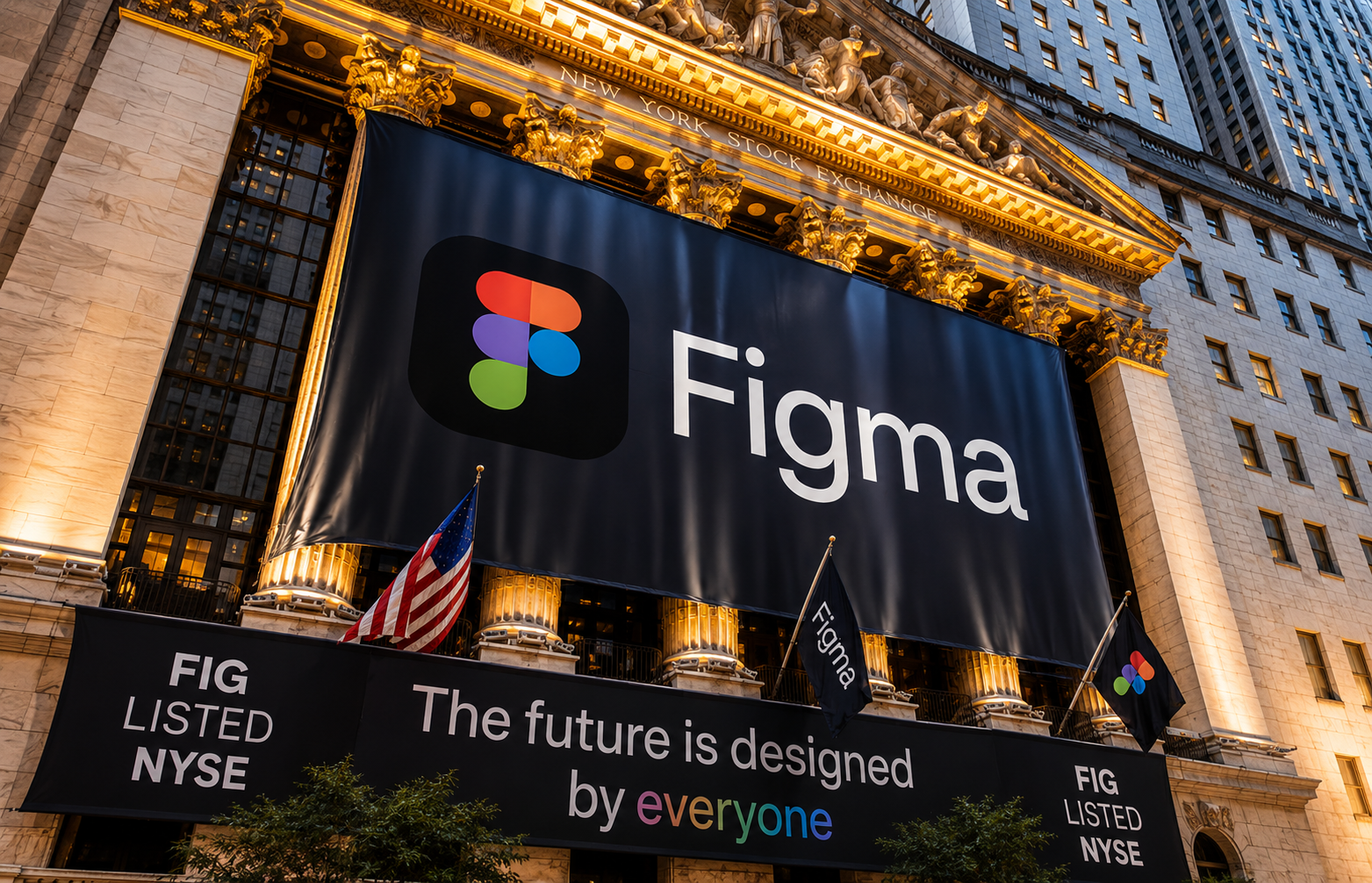
On July 31, 2025, Figma listed on the New York Stock Exchange under the ticker FIG, pricing its IPO at $33 per share. On the first day of trading, the stock opened at $85 and briefly touched $143 — a 250% surge that gave the company a valuation of nearly $68 billion at peak, far exceeding the $20 billion Adobe had offered.
The financial fundamentals justified the enthusiasm. In Q1 2025, Figma reported revenue of $228.2 million — up 46% year-on-year — and net income of $44.8 million, more than triple the same quarter a year earlier. The company had 13 million monthly active users, over 450,000 customers, and a net revenue retention rate of 132% — meaning existing customers were spending 32% more each year. Its gross margins of 91% placed it among the top 5% of software companies globally.
Notably, CEO Dylan Field retained majority control through a dual-class share structure, holding 51.1% of voting power post-IPO. Moreover, he had added Bill McDermott — CEO of ServiceNow — to Figma’s board, signalling the company’s ambitions well beyond design tools.
The Post-IPO Reality: A More Complicated Story
However, the Figma story after the IPO became more nuanced — and more honest telling requires acknowledging it.
After the initial euphoria, Figma’s stock fell sharply as lock-up periods expired and insiders began selling. By January 2026, the stock had retreated significantly from its peak. The core challenge is structural: the AI era requires massive, sustained capital investment in R&D, and Figma — with $1.6 billion in cash — faces competitors with vastly deeper pockets.
Adobe’s Firefly AI platform has already generated billions of AI-created assets. Microsoft bundles its AI-powered Designer tool into every Office 365 subscription, reaching hundreds of millions of users for free. In a world where AI can generate interface mockups from a text prompt, the question of whether Figma’s collaborative editing advantage remains decisive is genuinely open.
Figma’s own S-1 prospectus mentioned the word “AI” over 200 times and candidly warned that AI investment could be “a drag on efficiency for several years.” That is unusual self-awareness from a company going public — and it is exactly the kind of honesty that builds long-term credibility.
That said, Figma’s core business remains strong. At $1.1 billion in annual recurring revenue growing at approximately 38–40% year-on-year, it is a genuinely excellent software business. The question is not whether Figma is good. It is whether it can be great in an AI-first world — and that answer is still being written.
What Made Figma Different: Three Lessons
Looking back across Figma’s thirteen-year journey, three things stand out as genuinely instructive for anyone building a business or thinking about disruption.
First, distribution beats features. Figma’s browser-based model was not just a technical choice — it was a distribution strategy. By removing every barrier to trying the product, Figma made adoption frictionless. The best product does not always win. The most accessible product often does.
Second, the incumbent’s strength can become its weakness. Adobe’s massive installed base of desktop software users was its greatest asset — and the very thing that made it slow to respond to the browser-based threat. Figma did not try to beat Adobe on its own terms. It changed the terms entirely.
Third, regulatory intervention can create more value than it destroys. The blocked Adobe acquisition seemed, at the time, like a disaster for Figma shareholders. In the short run, it was painful. But the $1 billion termination fee strengthened the balance sheet, the forced independence sharpened the team’s focus, and the IPO ultimately gave the company a path to a valuation that exceeded what Adobe had offered — on better terms, with full independence intact.
Key Facts at a Glance
| Detail | Info |
|---|---|
| Founded | 2012, San Francisco, USA |
| Founders | Dylan Field, Evan Wallace |
| Field’s Background | Thiel Fellow, Brown University dropout |
| IPO Date | July 31, 2025 |
| Ticker | FIG (NYSE) |
| IPO Price | $33 per share |
| IPO Day Peak | $143 per share (+250%) |
| Q1 2025 Revenue | $228.2 million (↑46% YoY) |
| Annual Recurring Revenue | ~$1.1 billion |
| Monthly Active Users | 13 million |
| Customers | 450,000+ |
| Net Revenue Retention | 132% |
| Gross Margins | 91% |
| Adobe Termination Fee | $1 billion |
| Key Customers | Netflix, Stripe, Duolingo, Fortune 500 |
Final Thought
Adobe offered $20 billion to buy Figma. Regulators said no. Adobe paid $1 billion to walk away. And Figma went public at a valuation that, at its peak, was more than three times what Adobe had offered.
The lesson is not that rejecting acquisition offers is always the right move — it rarely is. The lesson is something subtler: sometimes the obstacles that seem to stand between you and your destination are actually pointing you somewhere better.
Figma was built to change how the world designs. It ended up changing how Silicon Valley thinks about independence, competition, and what it means to win.
At The Mind Pole, we believe the most interesting business stories are never just about money. They are about the decisions made under pressure — and what those decisions reveal about the people making them.