

Find your BMI, calorie target, and biological age — free
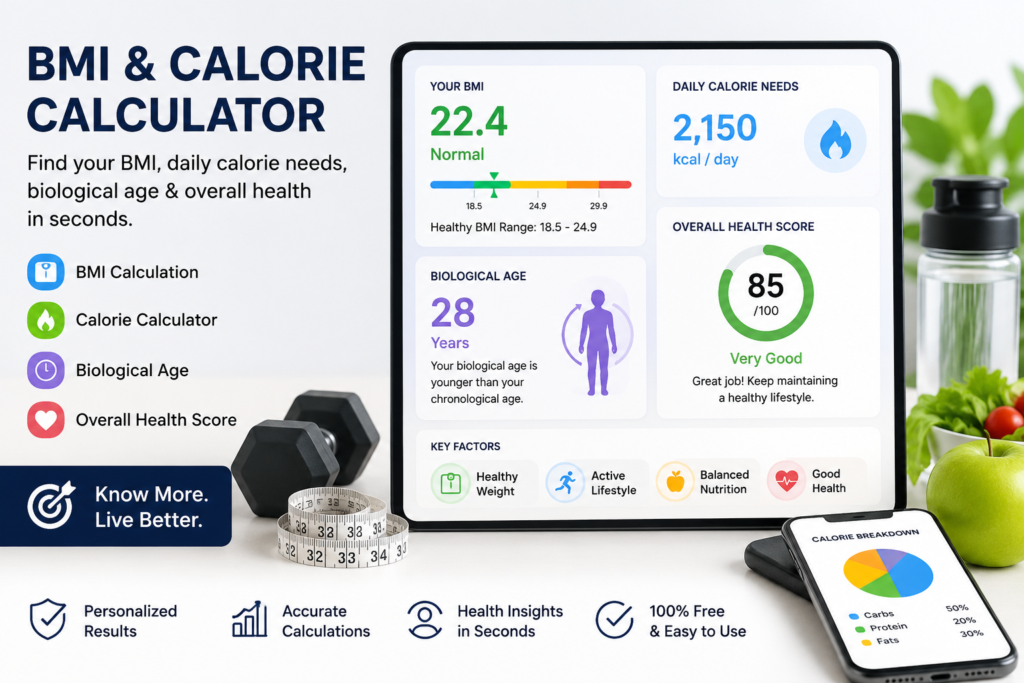
Do you know your real health numbers? Most people track their weight but miss the three numbers that actually matter — their BMI, their daily calorie burn, and their biological age. If so, this free tool calculates all three instantly. Simply enter your details, answer a few lifestyle questions, and get a complete picture of where your health stands today.
What is BMI and why does it matter?
BMI stands for Body Mass Index. In other words, it is a simple ratio of your weight to your height that tells you whether your body weight falls within a healthy range. A BMI between 18.5 and 24.9 is considered normal. However, BMI alone does not tell the full story — two people with the same BMI can have very different body compositions. Therefore, this tool pairs BMI with calorie targets and biological age to give you a more complete picture.
What is TDEE and how are calories calculated?
TDEE stands for Total Daily Energy Expenditure — the number of calories your body burns in a day, including physical activity. This tool calculates your TDEE using the Mifflin-St Jeor equation, which is currently the most accurate formula available for estimating daily calorie needs. First, it calculates your BMR (Basal Metabolic Rate) — the calories you burn at rest. Then, it multiplies that by your activity level to give your TDEE. Finally, it adjusts the target up or down based on your goal — weight loss, maintenance, or muscle gain.
What is biological age and how is it different from chronological age?
Your chronological age is simply how many years you have been alive. Your biological age, on the other hand, reflects how old your body actually is based on your lifestyle and health habits. Two people who are both 35 years old can have biological ages of 28 and 45 respectively — depending on how they eat, sleep, move, and manage stress. Consequently, biological age is a far more meaningful number for long-term health than your birth year. Research consistently shows that lifestyle factors — especially exercise, sleep, and diet — are the biggest drivers of biological ageing.
How to use this calculator
This tool has three modes. First, use the BMI tab to check your body weight category and see your healthy weight range for your height. Next, switch to the Calorie target tab to find your daily TDEE and set a calorie goal for weight loss, maintenance, or muscle gain — with a suggested macro split included. Then, try the Biological age tab — answer six quick lifestyle questions and get your estimated biological age with personalised tips for each factor. Additionally, use the Full profile tab to see all three results together in one view.
TheMindPole — Tools
BMI & Calorie Calculator
Find your BMI, daily calorie target, and estimated biological age — all in one place.
* BMI uses the standard WHO formula. Calorie targets use the Mifflin-St Jeor equation. This calculator is for educational purposes only. Consult a registered dietitian or doctor before making significant dietary changes.
Browse all tools →Calculator by TheMindPole — Mindset. Lifestyle. Growth.
How to lower your biological age — the highest-impact changes
Not all lifestyle changes are equal. Therefore, it helps to know which ones move the needle most on biological ageing. To begin with, regular exercise is the single most powerful biological age reducer — studies show that people who exercise 5 or more days a week have biological ages up to 9 years younger than sedentary individuals of the same chronological age. Furthermore, sleep quality has a compounding effect: chronic sleep deprivation of under 6 hours accelerates cellular ageing, raises cortisol, and disrupts the hormones that regulate hunger and body composition.
Diet quality is the third major lever. In particular, a diet built around whole foods — vegetables, legumes, nuts, lean protein, and complex carbohydrates — reduces chronic inflammation, which is the primary driver of accelerated biological ageing. Additionally, smoking and heavy alcohol consumption each add measurable years to biological age, and their effects are cumulative over time. On the other hand, even partial improvements — quitting smoking, reducing alcohol, or sleeping one extra hour — produce measurable biological age benefits within weeks.
What is a healthy BMI for Indian adults?
Standard WHO BMI thresholds were developed using Western population data. As a result, Indian health guidelines recommend lower thresholds for overweight and obesity risk. Specifically, a BMI above 23 is considered overweight and above 27.5 is considered obese for Asian adults — compared to the global thresholds of 25 and 30. Therefore, even if this calculator places you in the “normal” range by global standards, it is worth discussing your numbers with a doctor if you are close to the 23 threshold and have other risk factors.
What is a good calorie target for weight loss in India?
A safe and sustainable calorie deficit for weight loss is 300–500 kcal below your TDEE per day. Consequently, this produces roughly 0.3–0.5 kg of fat loss per week — slow enough to preserve muscle and not trigger metabolic adaptation. Moreover, protein intake should remain at 1.6–2g per kg of body weight even in a calorie deficit, since protein protects muscle tissue during weight loss. Additionally, your calorie needs change as you lose weight — recalculate your TDEE every 4–6 weeks and adjust accordingly.
Read our health and fitness articles to go deeper on nutrition, fitness, and evidence-based wellness strategies.