There’s a version of discipline that gets celebrated online.
4 AM wake-ups. Grinding through fatigue. “I’ll sleep when I’m dead.” Five hours is enough if your mindset is right. Sleep less, do more.
It sounds tough. It sounds committed. It’s also one of the most expensive mistakes you can make — and it’s quietly costing millions of people their focus, their decision-making, their health, and eventually, their results.
Here’s the truth the hustle culture never tells you: the most disciplined people in the world don’t sleep less. They sleep better, more consistently, and with the same intentionality they bring to their workouts and their goals.
Sleep isn’t the opposite of discipline. It is discipline — and it might be the most important one.
The Lie That Got Into Our Heads
Somewhere along the way, sleeplessness became a badge of honour.
You hear it constantly — “I only need five hours,” said as if that’s an achievement. Social media feeds full of 4 AM workout clips, dark sky mornings, and hustle metrics. The cultural message has been consistent: rest is for the weak. The successful don’t need it.
But look closer at the people making those claims and you’ll often find one of two things: they are genuinely unusual genetic outliers — the roughly 3% of the population that functions on less sleep due to a rare mutation — or they are running on a chronic sleep debt that is slowly degrading their cognitive performance in ways they cannot perceive from the inside.
The cruel irony of sleep deprivation is that it impairs your ability to notice that you’re impaired. You feel functional. You feel like you’re managing. You are not.
What Sleep Actually Does (That Nothing Else Can)
Sleep is not downtime. It is the most active recovery and rebuilding process your body and brain undergo in any 24-hour period.
During deep sleep, your brain runs a literal cleaning process — the glymphatic system flushes out metabolic waste products that accumulate during waking hours, including proteins associated with neurodegenerative disease. Your muscles rebuild. Hormones reset. Memory consolidates — converting short-term experiences into long-term learning.
None of this can be replicated by caffeine, cold showers, or willpower.
What happens when you cut sleep short:
When you sleep fewer than seven hours consistently, the effects are measurable and compounding. Decision-making degrades — your prefrontal cortex, responsible for rational thinking and impulse control, becomes less active. Emotional regulation suffers — you become more reactive, less patient, more susceptible to anxiety. Physical recovery slows — muscle repair, immune function, and hormonal balance all take hits.
Wearables like the Oura Ring and WHOOP have made this visible in a way that was never possible before. People who genuinely believed five hours was fine started seeing their recovery scores, their heart rate variability, their deep sleep percentages — and realised their body was telling a very different story from the one they’d been telling themselves.
The data doesn’t lie. And in 2026, more people are seeing their own data than ever before.
The Discipline Reframe
Here is the shift that changes everything:
Discipline is not about doing more. It is about performing better.
If you sleep five hours and spend the next day running at 60% cognitive capacity — making slower decisions, producing lower quality work, losing focus faster, reaching for short-term dopamine hits because your brain is desperately seeking stimulation — you have not been disciplined. You have been inefficient.
Seven to eight hours of quality sleep, protected like a non-negotiable, is what allows the other habits to actually work.
Your workout produces results only if your body recovers. Your focused work sessions require a brain that is actually operating at capacity. Your discipline in diet, in study, in building anything long-term — all of it runs on the engine that sleep maintains.
Cutting sleep to gain more hours is like cutting fuel to make a car go faster. It doesn’t work that way.
The person who sleeps eight hours and works six focused ones will consistently outperform the person who sleeps five and grinds for ten. Every time. Over years, the gap is not close.
What High Performers Actually Do
The narrative that successful people sleep less is simply not supported by how most high performers actually operate.
When you look at athletes, executives, and creators who sustain high output over decades — not just sprint for a year and burn out — consistent, quality sleep is almost universally present. Not as a luxury. As a system.
They protect their sleep the same way they protect their training schedule or their calendar. They have routines around it. They treat the hour before bed as preparation, not passive collapse. They wake at consistent times — not because 5 AM is magical, but because consistency in sleep timing is what keeps the circadian rhythm locked in, which is what keeps the sleep itself restorative.
The 5 AM grinders you see on social media are showing you the morning. They’re not showing you what time they went to bed — or what their performance looks like at 3 PM.
The Indian Context: Why This Matters Here Specifically
In India, sleep deprivation is normalised at a cultural level in ways that go beyond hustle culture.
Students pulling all-nighters through board exam season. Professionals treating 11 PM finish times as standard. The widespread belief that rest is earned, not scheduled — that you sleep when the work is done rather than protecting sleep so the work gets done properly.
This cultural conditioning around sleep is compounding a genuine health problem. India already carries one of the world’s highest burdens of lifestyle disease — diabetes, hypertension, cardiovascular conditions — all of which have established links to chronic sleep deprivation.
The mindset shift required isn’t just about productivity. It’s about longevity. It’s about what kind of energy you bring to the people around you, to the work that matters, to the version of your life you’re actually trying to build.
How to Actually Improve Your Sleep: The Practical Part
This isn’t about buying a wearable or following a 12-step protocol. It’s about getting the fundamentals right consistently.
1. Set a consistent wake time first. Not a consistent bedtime — a consistent wake time. Your wake time anchors your circadian rhythm. The bedtime adjusts around it naturally. Pick a wake time and hold it, including weekends.
2. Protect the 60 minutes before bed. Your brain needs a wind-down window. Bright screens, heated arguments, stimulating content, work emails — all of these elevate cortisol and delay sleep onset. The hour before bed is preparation, not leftover time.
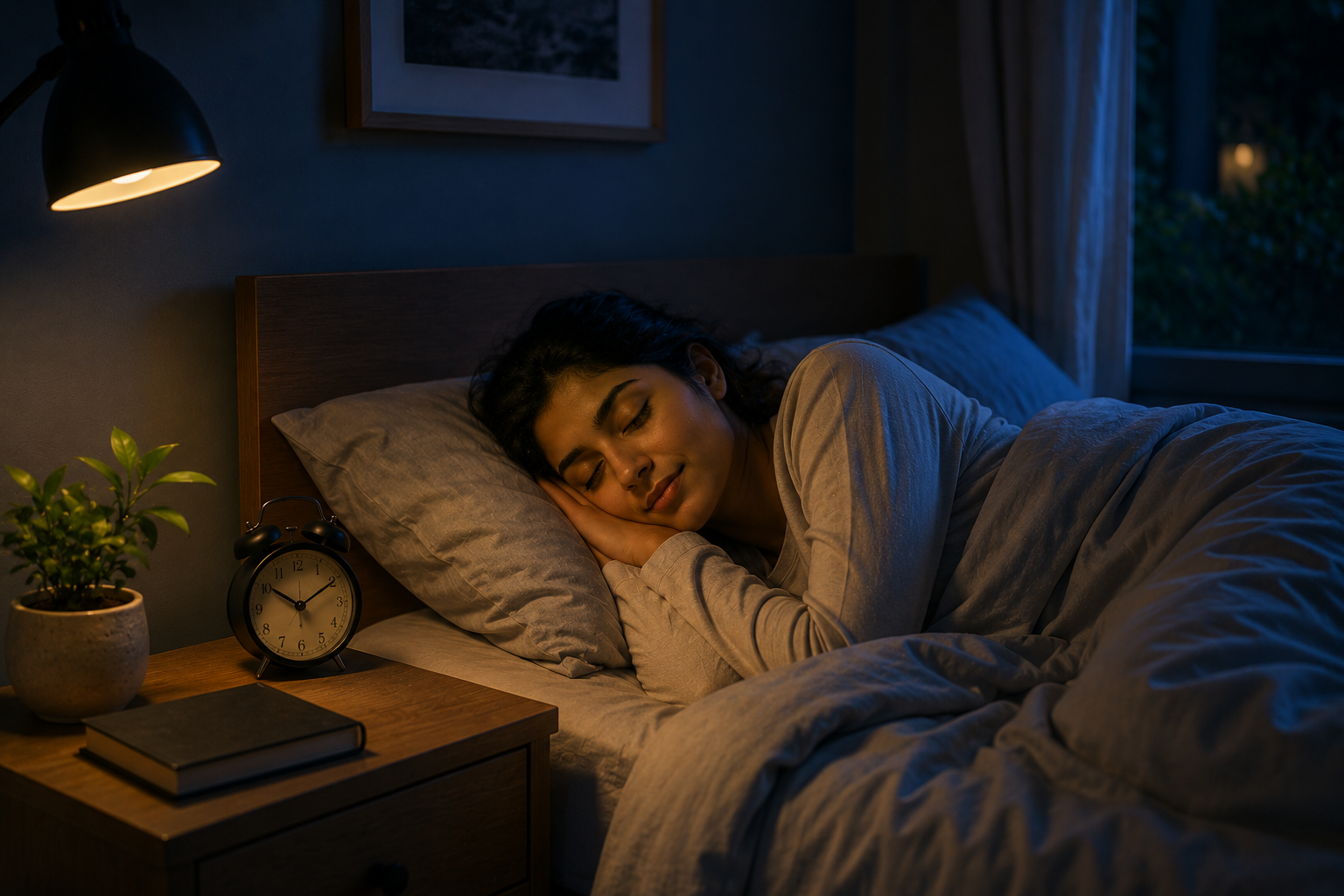
3. Keep your room cool and dark. Core body temperature needs to drop for sleep initiation. A slightly cool room (around 18–20°C) significantly improves sleep onset and deep sleep quality. Blackout curtains make a real difference — light exposure, even ambient, suppresses melatonin.
4. Stop treating caffeine as a tool for sleep deprivation. Caffeine has a half-life of approximately five to six hours. A 4 PM coffee means half of it is still active in your system at 10 PM. If you’re relying on caffeine to function, you’re borrowing wakefulness from tomorrow’s cognitive capacity.
5. Watch the alcohol. This is a major one in India where social drinking is increasingly common. Alcohol makes you fall asleep faster but fragments your sleep architecture severely — particularly REM sleep, which is critical for emotional processing and memory consolidation. You wake feeling unrested even after seven hours.
6. Make sleep identity-level. This is the mindset piece. Stop saying “I’ll try to get to bed earlier.” Start saying “I protect my sleep because it’s the foundation of everything else I do.” Identity drives behaviour far more than intention does.
The Sleep Score Shift
In Europe, sleep tracking has reached a tipping point — people are now discussing their sleep scores the way they discuss their workout metrics. What this shift reveals is important: when sleep becomes measurable and visible, it stops being something people feel they can casually deprioritise.
You don’t skip leg day when your training app shows the gap. You don’t skip recovery when your wearable shows a red score.
You don’t need an expensive device to start. Begin with the simplest metric: how do you feel 20 minutes after waking? Not immediately — that’s always groggy. But 20 minutes in, after movement and water. Clear and capable, or foggy and reluctant? That’s your daily sleep report, available every morning at no cost.
The Sleep Foundation recommends adults aim for seven to nine hours of quality sleep per night — not as a guideline but as a biological requirement for optimal cognitive and physical function.
A Different Definition of Tough
Real discipline isn’t refusing to sleep.
Real discipline is refusing to compromise the foundation that makes all your other efforts actually work.
It’s saying no to the late-night scroll. It’s setting the phone down when your brain wants the dopamine but your body needs the rest. It’s treating bedtime with the same seriousness you treat your morning alarm.
That’s harder than it sounds. Most people find it far easier to wake up early than to consistently go to bed on time. The evening is when defences drop. When discipline is most tested. When the short-term pull of one more episode, one more scroll, one more late-night conversation competes directly with the long-term investment of a full night’s sleep.
Winning that battle, night after night — that’s discipline.
A rooted mind doesn’t run on fumes. It runs on foundations.
Quick Recap
- Sleep deprivation is not a badge of discipline — it’s a performance tax paid in cognitive capacity and decision quality
- The brain’s glymphatic cleaning system, memory consolidation, and hormone reset all happen during sleep — nothing else replicates this
- Consistent wake time anchors circadian rhythm more effectively than consistent bedtime
- Caffeine half-life, alcohol’s effect on REM sleep, and screen light before bed are the three most underestimated sleep disruptors
- Identity-level commitment to sleep — not apps, not supplements — is the foundation of lasting change
Read next: [Monsoon Fitness: Why Your Body Feels Lazy in the Rain ] | [Can Skilliday’ become India’s Hottest Travel Trend]