This is not a story about football. It is a story about what you do when the thing you love the most breaks your heart.
There is a photograph that does not exist but should.
It would show a man sitting alone outside a locker room in New Jersey, still in his kit, staring at the floor. Around him, an entire stadium empties. His teammates have gone in. The fans have gone home. And he is just sitting there — not angry, not crying, just completely, utterly empty.
That man is Lionel Messi. He has just lost a Copa América final on penalties. It is the fourth final he has lost with his country in four years. And in a few minutes, he will say the words that stop the world:
“For me, the national team is over.”
He means it. And this is where the greatest comeback story in the history of sport begins — not with a dramatic vow, not with a training montage, not with a coach’s speech. It begins with a man who is simply done. A man who has given everything and received heartbreak in return. A man who, for one summer, chooses himself over the weight the world has placed on him since he was eighteen years old.
The weight no one talks about
We need to talk about that weight. Because without understanding it, the comeback does not make sense.
Imagine being anointed at eighteen. Not praised — anointed. Declared, by an entire nation of forty-five million people, to be the chosen one. The heir to a legend so large — Diego Maradona — that it has become part of national identity. Imagine carrying that every single time you pull on a shirt. Not the hope that you might win. The expectation that you must.
Messi did this for over a decade. He showed up for every qualifier, every friendly, every tournament, carrying Argentina’s decades of hurt alongside his own exceptional gifts. At club level with Barcelona, he was the best player on the planet — winning trophies, breaking records, doing things with a football that made grown men stop and question what they had just seen.
But in the blue and white shirt, the finish line kept moving. Final after final. Penalty after penalty. The 2007 Copa América. The 2010 World Cup quarter-final. The 2014 World Cup final, lost to Germany in extra time. The 2015 Copa América final. The 2016 Copa América final.
Five near-misses. Five times the world watched and quietly decided this was Messi’s flaw — that he could not do it when it mattered most. That he was great, but not that great.
He heard all of it. And in June 2016, sitting outside that locker room in New Jersey, he decided he had heard enough.
The summer of silence
What followed was seventy days of quiet.
Neither a dramatic press conference, nor an open letter. No social media campaign explaining his decision. Just a man stepping back from the thing he had given his life to and exhaling for the first time in years.
And in that silence, something unexpected happened.
He missed it. Not the expectation — that he did not miss at all. But the actual thing itself. The smell of grass before a match. The feeling of a ball struck perfectly with the inside of his left foot. The specific joy of scoring a goal that you had imagined in your head before you had ever touched the ball. He missed football. His football. Not Argentina’s burden. His joy.
So he came back. Not with a speech. Not with a promise. He simply showed up to training and got back to work. And he quietly, methodically, over the next six years, closed every single piece of unfinished business that had ever broken his heart.
The long road back
The return was not linear. There were more near-misses. More nights where it seemed like the universe had specifically decided that Messi and international glory were not meant to share the same story.
But something was different in the man who came back. He was quieter. More settled. Less concerned with the noise outside and more focused on what he could control inside. He had learned, in those seventy days of silence, that he could live without football. And knowing that — knowing you can survive without the thing you love — changes how you love it. It becomes a choice rather than an obligation. A gift rather than a burden.
He chose it. Every single day. For six more years.
The night in Qatar
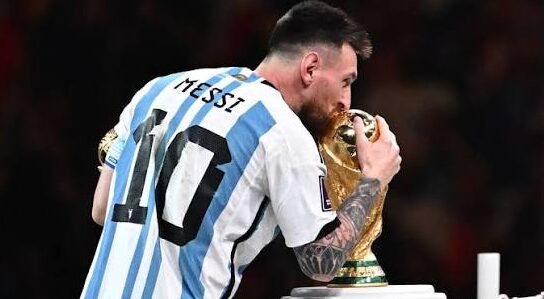
On 18 December 2022, in Lusail, Qatar, Lionel Messi lifted the World Cup.
He was thirty-five years old.
The match that preceded that moment — the final against France — was the most extraordinary football match most people alive will ever see. Argentina led. France equalised. Argentina led again. France equalised again. Penalties. Messi scored. Argentina won.
When the trophy was placed in his hands, Messi did not roar. He did not sprint across the pitch or rip off his shirt or pump his fists at the sky. He stood completely still and looked at the golden cup in his hands with an expression that was not triumph so much as recognition.
There you are, his face said. I have been looking for you for a long time.
His teammates mobbed him. The confetti fell. And somewhere in Argentina, an entire nation held each other and wept — for the trophy, yes, but also for this man, this quiet, extraordinary man who had never stopped showing up even when showing up kept ending in heartbreak.
Most people assumed that was the end of the story. The perfect final chapter. The sunset.
Messi had other ideas.
2026-One more chapter nobody saw coming
Most people assumed Qatar was the ending. The perfect final chapter. The storybook close. And honestly — who could blame them? The man had climbed the highest mountain in his sport. He had nothing left to prove, nothing left to chase, nothing left to silence. He could have walked away right there, in that golden confetti in Lusail, and every person on earth would have understood.
But here is the thing about people who are truly in love with what they do — they do not stop because they have won. They stop when the love runs out. And for Messi, the love had not run out.
So at thirty-eight years old in the 2026 FIFA World Cup, with a troublesome hamstring and a legacy already carved in stone, he showed up again. Not to prove anything. Not to chase records. Simply because when he imagined a summer without football — without the grass, without the ball, without that specific electricity of a World Cup stadium at full noise — something in him said not yet.
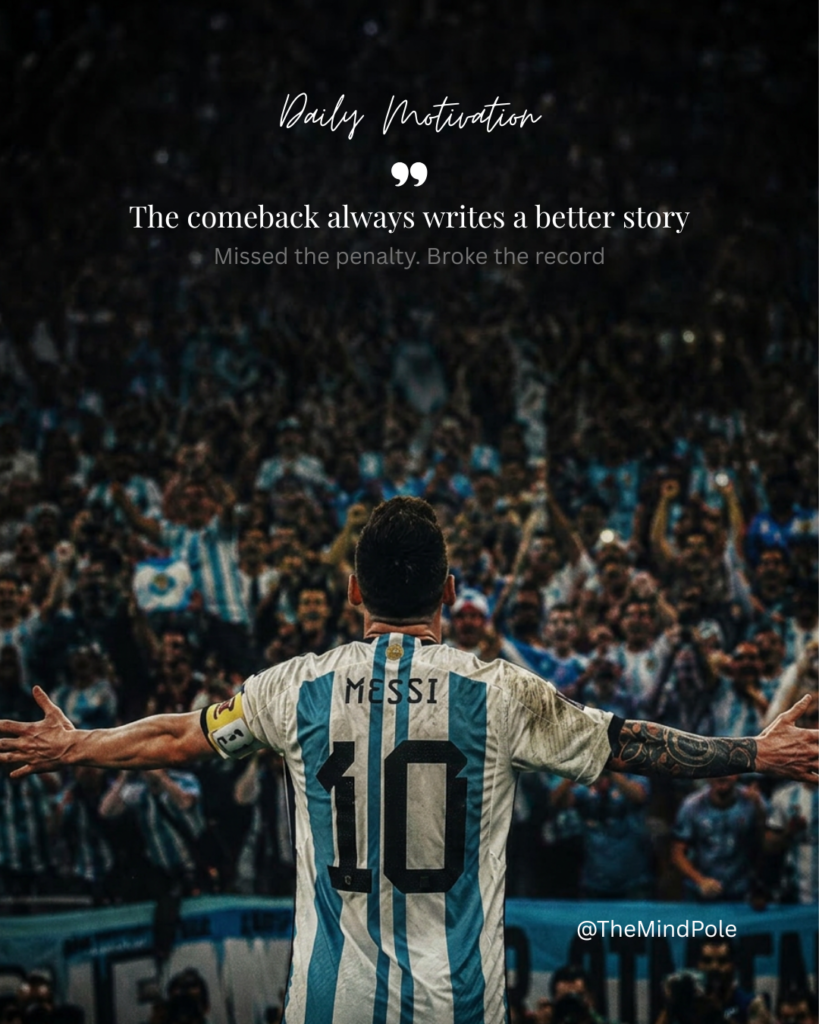
And against Algeria, in his very first touch of this new chapter, he scored. Then he scored again. Then a third. The oldest male player ever to score a hat-trick at a World Cup — doing it with the same quiet, unhurried certainty he has always carried, as if the world’s disbelief is simply not his concern.
Then came Austria. He missed a penalty early in the match. The kind of miss that would have defined a lesser man’s legacy. Instead, twenty-four minutes later, he swept home a left-foot finish that made him the greatest goalscorer in the history of the FIFA World Cup — men’s and women’s combined. Not a record he chased. A record that simply could not stay ahead of him any longer.
After the match, someone asked him to name his favourite goal. He smiled the way tired, happy people smile. “I don’t know, to be honest. I’m running low on energy. Also, finding it hard to think. I’m just going to enjoy this moment.”
No performance. No trophy-holding pose for the camera. Just a man who loves football standing in the middle of history, too grateful to be anything other than himself.
What this means beyond football
Here is the thing about Messi’s story that gets lost in the statistics and the records and the endless debates about whether he or Ronaldo is the greatest of all time.
The most remarkable part of his journey is not what he achieved. It is what he survived.
He survived being anointed at eighteen and carrying that weight for seventeen years. Faced four major final defeats and an entire planet’s worth of doubt. He survived his own decision to walk away — which is its own kind of courage, the courage to say I am not okay and I need to stop — and he came back from it not as a lesser version of himself, but as a more complete one.
The mindset lesson here is not about persistence in the way we usually talk about it. We love to celebrate the person who never gives up, who grinds through everything, who never shows weakness. But Messi’s story is more nuanced and more honest than that. He gave up. He sat on that floor in New Jersey and said he was done. And then, in the quiet that followed, he found out who he was without the noise — and chose to come back to the thing he loved, on his own terms, with nobody’s expectation but his own.
That is a different kind of strength. And it is available to all of us.
The question this story asks you
There is something in every person’s life that resembles that locker room floor in New Jersey. A dream abandoned. A project shelved. A version of yourself you stopped believing in after one too many near-misses.
The question Messi’s story asks is not did you give up? The question is what did the silence teach you?
Because sometimes the bravest thing you can do is stop. Rest. Let go of the weight. And then, when the noise dies down and you can finally hear yourself think — decide whether the fire is still there.
If it is, then you already know what to do.
You get back up. Go back to training. You do not make a speech about it. You just show up.
And maybe — not certainly, but maybe — you end up standing in a stadium with a golden trophy in your hands, too tired to even remember which goal was your favourite, just grateful beyond words that you did not let the hard years convince you that your story was finished.
Messi’s was not finished in New Jersey in 2016.
Yours is not finished either.
Read next in Greatest Stories
Just as Messi found his way back from the edge of retirement, Erling Haaland built his legacy from a farming town that most people outside Norway have never heard of. Read Haaland’s story of keeping the dream alive — and what two words before the biggest match of his life tell us about the mindset behind greatness.
Greatest Stories is a weekly series on TheMindPole — one extraordinary human story, told through the lens of mindset, resilience, and growth. Subscribe to our newsletter to get each story the moment it is published.