
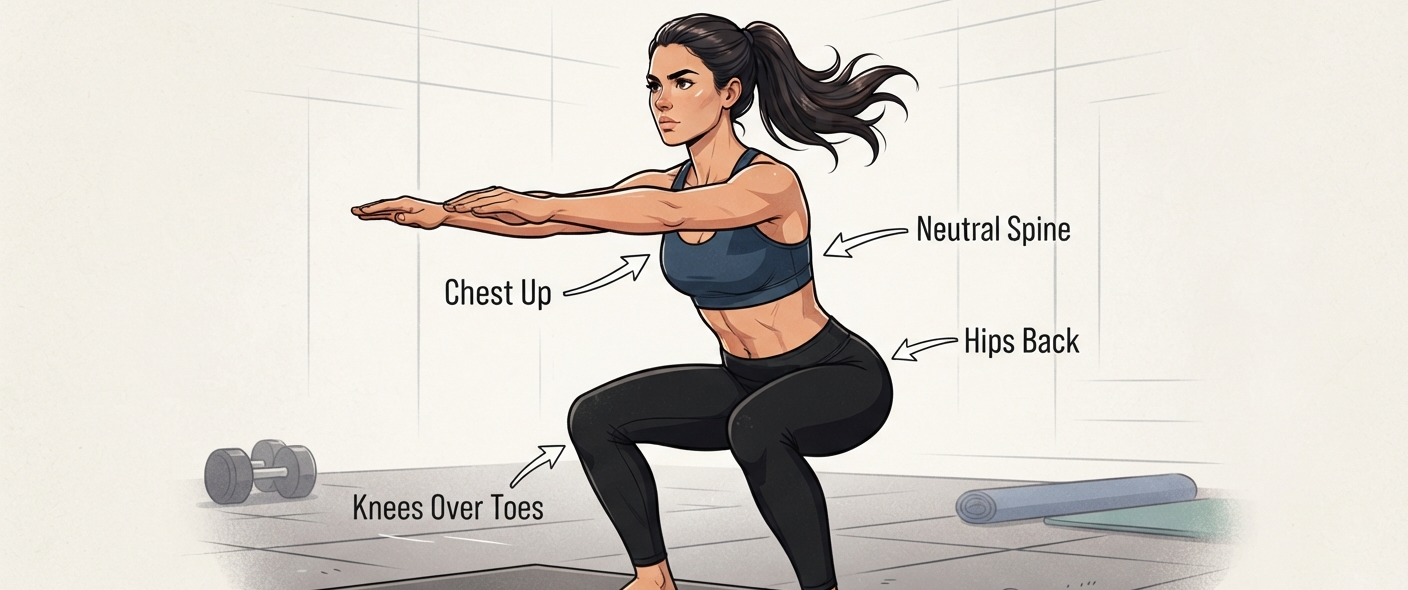
The excuse is a familiar one.
I don’t have an hour. I’ll go tomorrow when I have more time. It’s not worth doing if I can only do 15 minutes.
Most people who stop exercising don’t stop because they stop caring. They stop because the version of exercise they committed to — the 45-minute gym session, the 5K morning run, the full yoga class — stops fitting into the life they’re actually living. And when that version becomes impossible, all-or-nothing thinking takes over, and nothing happens at all.
Here is what the science now confirms clearly: that version was never the only option. And for most people, most of the time, it isn’t even the best one.
Short, consistent movement — what fitness researchers and wellness experts in 2026 are calling “snack-sized workouts” — is producing results that are genuinely challenging the assumption that exercise only counts when it exceeds a certain duration. The hour-long fitness class is not the standard. It is one option among many. And for a large number of people in a large number of life situations, the 10-minute version done consistently outperforms the 60-minute version done occasionally.
What the Research Actually Shows
For decades, the dominant message around exercise was duration-focused. Thirty minutes minimum. Preferably more. The idea that a 10-minute workout could produce meaningful physiological adaptation was treated as wishful thinking for people who weren’t serious about fitness.
That position has shifted substantially.
Research now shows that multiple shorter bouts of exercise across a day produce cardiovascular, metabolic, and muscular benefits comparable to a single longer session — provided the total volume and intensity are broadly equivalent. Three 10-minute sessions spread across a day are not a compromise version of a 30-minute session. They are a different format of the same total work — and in some measures, particularly for blood sugar regulation and cardiovascular markers, the distributed format produces equivalent or better results.
The WHO’s physical activity guidelines now explicitly acknowledge that activity can be accumulated throughout the day in bouts of any duration — removing the minimum-duration threshold that had defined the previous framing for decades.
What this means in practice: the 10 minutes is real. It counts. And if done with sufficient intensity — which is entirely achievable in 10 minutes — it produces adaptation.
Why “Snack-Sized” Works Better for Most People’s Actual Lives
The hour-long workout has a structural problem that nobody in the fitness industry talks about honestly: it requires an hour of uninterrupted time that most people — particularly those with office jobs, families, commutes, and the general complexity of adult life in India — do not reliably have.
The 10-minute workout does not have this problem.
Ten minutes exists everywhere. Before the morning shower. Between back-to-back calls. During the lunch break that doesn’t justify a gym trip but does justify a bodyweight circuit in the stairwell. After putting the kids to bed. In the gap between finishing work and starting dinner.
The capacity for 10 minutes of movement is almost universally available. The capacity for 60 continuous minutes of it is conditionally available — dependent on schedule, commute, weather, family demands, and a dozen other variables that change weekly.
Building a fitness habit around a conditionally available window means the habit will be consistently interrupted. Building it around an almost-always-available window means the habit survives the interruptions that break everyone else’s streak.
This is not about doing less. It is about building something that actually persists.
The Indian Working Professional Problem
In India specifically, there is a fitness participation pattern that repeats across cities with remarkable consistency.
January gym memberships. Enthusiastic daily attendance for three to six weeks. Gradual decline as project deadlines, family obligations, and commute fatigue compete for the same morning hour. By March, the membership is technically active and practically unused.
This is not a motivation problem. It is a format problem.
The hour-long gym session was never going to survive a Mumbai or Bangalore commute plus a full working day plus an evening family commitment. Not consistently. Moreover, not for most people. And not without something significant getting sacrificed somewhere else.
The snack-sized workout sidesteps this completely. It does not compete with the commute. Also, It does not require a separate journey to a facility. Moreover, it does not need a changing room, a locker, a protein shake, or a carefully scheduled time block.
It needs ten minutes and enough floor space to lie down.
What 10 Minutes Actually Looks Like
The key variable in a short workout is intensity. A 10-minute walk is movement and has its benefits — but a 10-minute high-intensity circuit produces a different physiological response. Both count. The point is to know what you’re doing and why.
Here are three 10-minute formats, each with a different purpose:
Format 1 — The Morning Activator (energy, not exhaustion)
This is for mornings when time is short and the goal is to wake the body up and set a physical tone for the day — not to train hard.
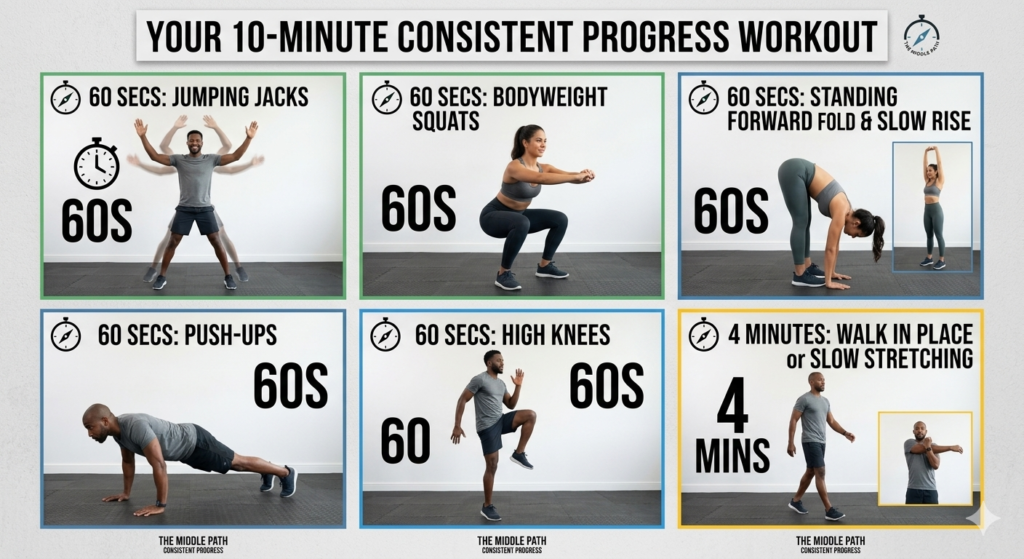
- 60 seconds: jumping jacks
- 60 seconds: bodyweight squats
- 60 seconds: push-ups
- 60 seconds: standing forward fold and slow rise
- 60 seconds: high knees
- 60 seconds: glute bridges
- 4 minutes: walk in place or slow stretching
Intensity: low to moderate. Purpose: circulation, cortisol regulation, and the identity signal that today is a movement day.
Format 2 — The Lunch Break Circuit (strength, short rest)
This is for the middle of the day — when sitting for three hours has accumulated and the afternoon needs resetting.
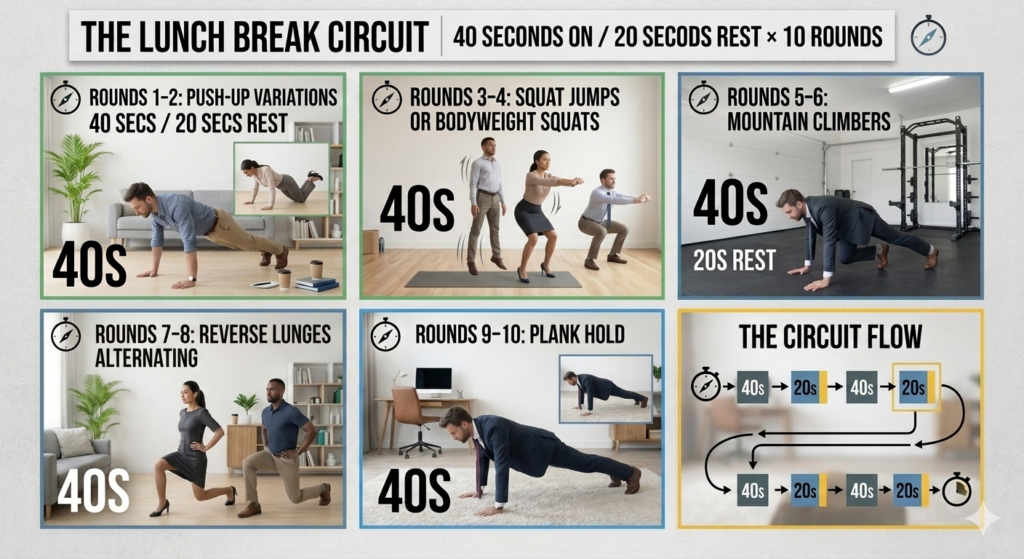
- 40 seconds on / 20 seconds rest x 10 rounds:
- Round 1–2: push-up variations
- Round 3–4: squat jumps or bodyweight squats
- Round 5–6: mountain climbers
- Round 7–8: reverse lunges alternating
- Round 9–10: plank hold
Intensity: moderate to high. Purpose: metabolic activation, strength maintenance, blood sugar regulation post-lunch.
Format 3 — The Evening Reset (stress release, flexibility)
This is for after work — when cortisol is elevated, the body is tight from sitting, and the goal is decompression rather than performance.
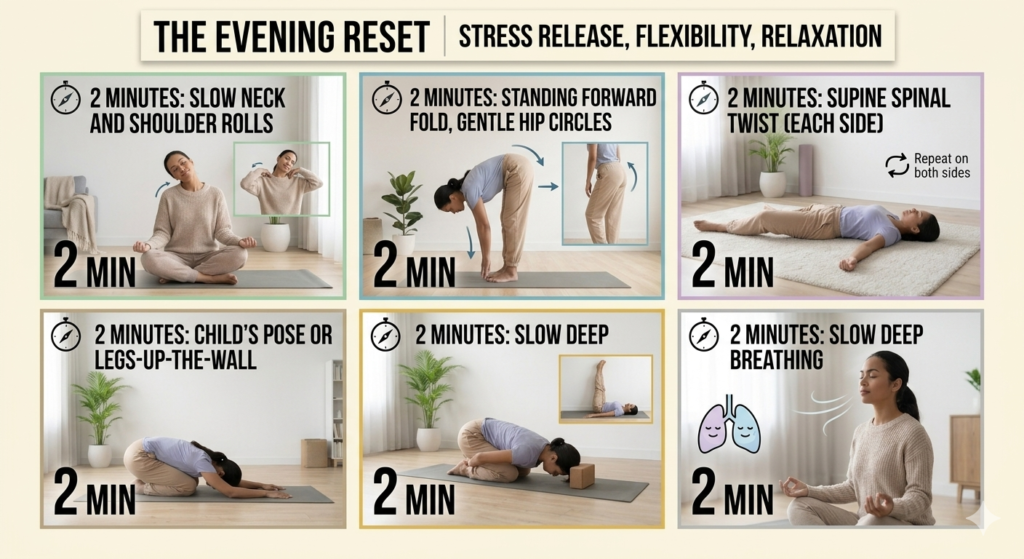
- 2 minutes: slow neck and shoulder rolls
- 2 minutes: standing forward fold, gentle hip circles
- 2 minutes: supine spinal twist (each side)
- 2 minutes: child’s pose or legs-up-the-wall
- 2 minutes: slow deep breathing
Intensity: low. Purpose: cortisol reduction, parasympathetic activation, gut-brain reset, sleep preparation.
Each of these takes 10 minutes. Each serves a distinct purpose. Done once a day — any one of them — and you have a movement habit.
The Compounding Logic of Small Consistent Movement
Here is the arithmetic that the all-or-nothing fitness mindset never runs.
Ten minutes a day, five days a week, is 50 minutes of movement per week. Over a year, that is approximately 43 hours of movement — movement that actually happened, in a body that actually improved from it.
The hour-long gym session, planned three times a week but attended with 50% consistency, is 78 hours planned and 39 hours actual — less total movement than the 10-minute-per-day habit, and with significantly more psychological disruption from the missed sessions.
The snack-sized workout does not produce a superior single session. It produces a superior year.
That is the compounding logic of small consistent actions. Not impressive in any single instance. Remarkable across time.
This is the same logic that applies to investing — small amounts, regular intervals, sustained across years — and to writing, to learning, to any domain where what matters is not the peak performance but the total accumulated volume.
How to Start This Week
The starting point for a snack-sized workout habit is deliberately small. Not because ambition is wrong — but because the goal in week one is not fitness. It is the installation of the habit.
Day 1–7: One 10-minute session per day. Any format. Any time. The only requirement is that it happens.
Week 2–3: Same. Build the time and place association — same rough time, same location if possible. The brain encodes habits through context cues as much as through intention.
Week 4 onward: Add a second daily session if life allows. Or increase the intensity of the existing one. Or try a different format. The foundation is already built. Now it can carry more weight.
Harvard Health notes that even modest, consistent movement — particularly bodyweight strength training — produces measurable improvements in posture, metabolic health, and cognitive function within weeks of starting. The adaptation threshold is lower than most people assume. The consistency threshold is the one that actually matters.
The Mindset Behind the Movement
The snack-sized workout is, at its core, a discipline reframe.
It says: the goal is not the session. The goal is the identity. The goal is becoming, over time, someone who moves every day — not someone who has excellent workouts when conditions permit and nothing when they don’t.
The 10-minute session is how you stay that person on the days when conditions don’t permit.
It is the floor. Not the ceiling. Not the aspiration. The floor — the minimum below which you do not go, because below it is absence, and absence is where habits go to die.
Hold the floor. On the good days, build above it. On the hard days, clear it and call it a win.
Both are correct. And both are progress. Both are the same person — the one who moves, in some form, every day — regardless of what the day brought.
The tree does not grow only in the rainy season. It grows slowly, in every season, because the roots never stop.
Quick Recap
- Snack-sized workouts — 10-minute movement sessions — are now validated by research as producing real cardiovascular, metabolic, and muscular benefits when performed consistently
- The WHO now acknowledges exercise accumulated in bouts of any duration — removing the minimum-time threshold
- The format problem: hour-long workouts require conditionally available time; 10-minute workouts require almost-universally available time
- Three formats: Morning Activator (energy), Lunch Circuit (strength), Evening Reset (stress relief) — each serves a specific purpose in a busy day
- The compounding logic: 10 minutes daily five days a week produces more total movement per year than three weekly hour-long sessions with 50% attendance
- The mindset: the goal is the identity, not the session — and the 10-minute session is how you protect that identity on every kind of day
Read next: [The All-or-Nothing Mindset Is Costing You — link here] | [Monsoon Fitness: Why Your Body Feels Lazy in the Rain — link here]